


Missionaries of the Poor at 45
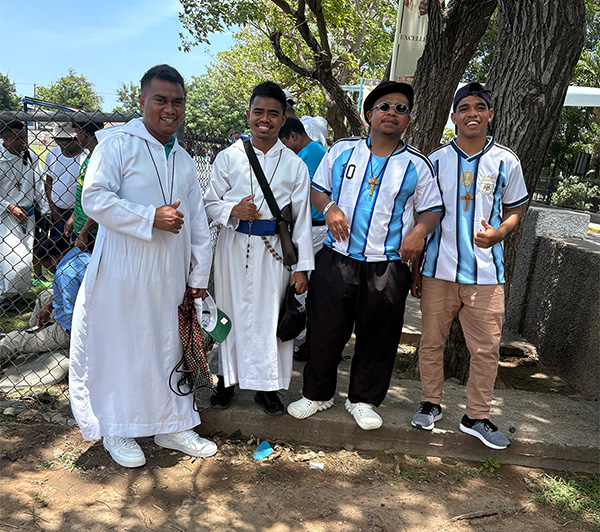 The Missionaries of the Poor brothers go out into the streets to serve the poor and sick. Their work takes them to some of most dangerous locations in the world, which their founder has said they have no intention of changing.
KINGSTON, Jamaica — Father Richard Ho Lung, 86, didn’t allow his recent brush with death to hinder Founder’s Day and the 45th anniversary celebration of the Missionaries of the Poor (MOP) order he founded in 1981.
Instead, “I still plan to … dance for you,” he joked at the July 18 celebration, even though he was barely able to walk.
He shared his love for his order, for Christ and for the poor with everyone present – including the 150 MOP brothers and 20 MOP sisters in Jamaica, dozens of residents, seven missionaries from St. Luke Church in Mint Hill and the Catholic News Herald.
“Brothers and sisters, love the Cross, love the poor, love the sick, love the dying,” he told them. The same beliefs that fueled the global mission keep many Charlotte missionaries visiting each year.
He reflected, “I thought this past week, maybe this would be it. Maybe God was saying this is the time. And I was at peace.”
He described his hospital visit the way many of his centers’ disabled residents would explain the care they receive 24 hours a day from the MOP brothers and sisters.
Home away from home
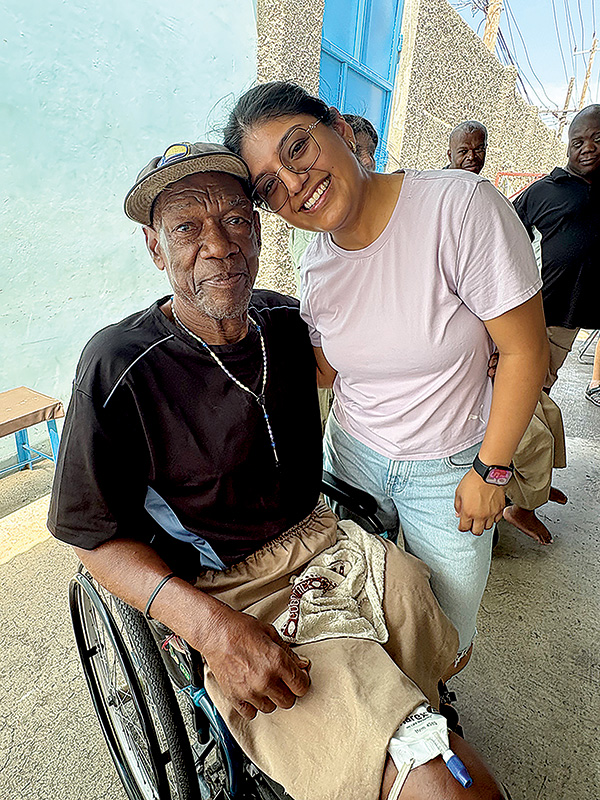 Parishioners from St. Luke Church in Mint Hill traveled to Jamaica on a mission trip to assist the Missionaries of the Poor. While there, they formed connections with medically fragile patients cared for by the MOP brothers.
With the only MOP mission in North America in Monroe, Diocese of Charlotte parishioners have gotten to know the brothers and embrace their work.
From serving locally, some take the leap to journey to Kingston, Jamaica – the homebase from which brothers and religious sisters spend their lives behind high-gated communities in prayer and service to the poor and sick.
In between Mass, Holy Hours and rosaries, they feed, bathe and care for 600 medically fragile residents housed at six centers.
This is where many visitors from Charlotte have said they enhanced their prayer lives and relationship with God.
The residents with their mangled limbs and immovable bodies, mostly nonverbal, still smile. They still blink. In their eyes the face of Jesus is revealed, many have said.
‘Pure joy’
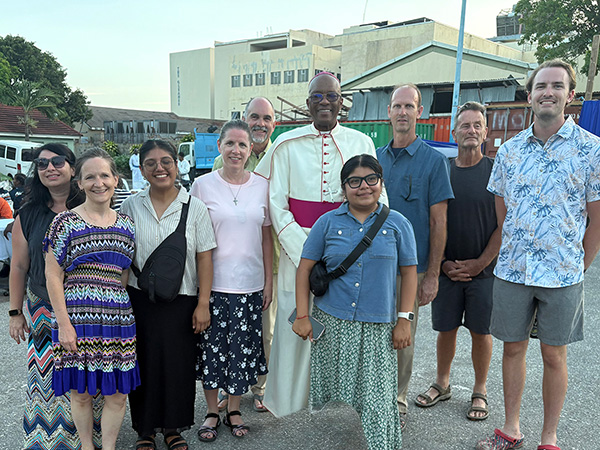
“The poor are not merely recipients of charity. They are our brothers and sisters, mirrors of God’s image,” Father Ho Lung said.
Children without legs, adults only able to crawl, and people in all types of pain can sometimes be difficult to watch. But the St. Luke parishioners choose to smile and laugh with the residents.
“Ultimately you will find unwavering expressions of pure joy,” said St. Luke parishioner Kelly Reeder, on her fifth visit with her husband, Greg, who brought their son Austin for his first trip. “It is like visiting your family that you haven’t seen in ages. You never want the time to end. Jesus is in everyone you meet.”
For other first timers, like Erika and Nancy Barranco, the trip took on a life-changing dimension.
“I went with a confused and troubled heart, carrying so many questions, and after this trip, God answered them all,” Nancy Barranco said. “God’s love comes in different forms.”
Advocacy to action
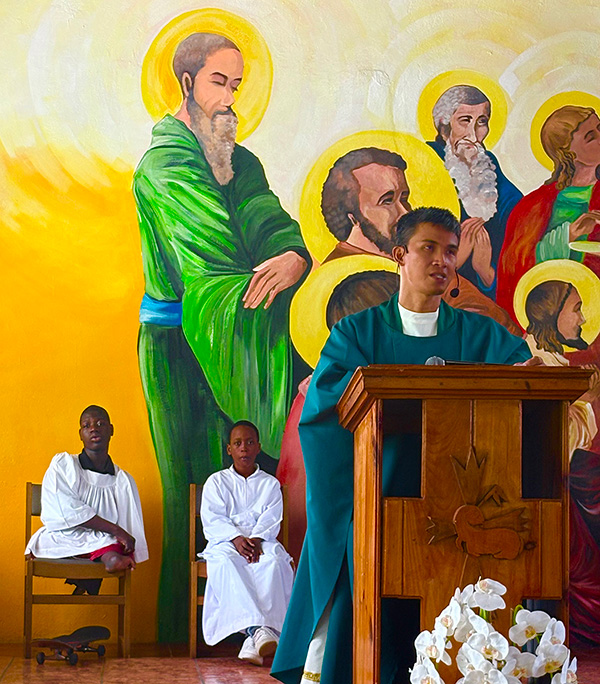 Father Ho Lung, a Chinese Jamaican who converted to Catholicism in grade school, has made an impact on Jamaica over the past 45 years.
He first shed light on the deplorable conditions of a governmental healthcare institution called Eventide, where patients were being eaten alive by rats, packed into overcrowded rooms and given improper care.
Eventide experienced the deadliest fire in Jamaica’s history, claiming 150 elderly women’s lives.
The catastrophe motivated the young priest.
Father Ho Lung left his life as a Jesuit priest and started the Missionaries of the Poor, where he would take his advocacy, transfer it through reform, and then act for the good of others.
“Christian faith cannot remain only in words, prayer or good intentions. It must deliver love and action, hands that serve, hearts that welcome, voices that contain human dignity,” Father Ho Lung said.
Growing influence
Today, the brothers serve in 12 countries, making inroads in South Vietnam, pushing deeper into Africa and gearing up to serve South Korea and China.
Many are dangerous places, but despite the deaths of two of their own –Brother Suresh and Brother Marco, who were shot in Kingston in 2005 – and the recent violence in Haiti, the brothers refuse to relocate,
Father Ho Lung told the Catholic News Herald.
“These brothers have gotten held up by gunmen, and they just keep on going,” Father Ho Lung said. “The brothers say they will never leave.”
Closer to home, Father Ho Lung cherishes his Charlotte connections.
“Our relationship with the Diocese of Charlotte is just wonderful. We look forward to seeing people come down every year,” Father Ho Lung said. “The people there know us, and the brothers, of course, are there.”
Father Ho Lung said that while providing healthcare is not the direction they are taking in the U.S., they have found a disease here that is curable … loneliness.
“I like how the brothers are going out [to make home visits]. The way they describe it, some have no visitors. They feel rejected and alone,” Father Ho Lung said. “I would love to see that continued, built up, and expanded even more. … We would love to also have the homeless and destitute there – like a night shelter.”
In the meanwhile, the fragile man who built an order from Jamaica’s scraps encouraged people in the Diocese of Charlotte to keep visiting the MOP, to bring friends and to do their part to care for the poor and the sick at home.
And, while many missionaries go to Jamaica with the intent of helping others, in the end they find something more.
As Erika Barranco said about her first-ever mission trip, “Sometimes God sends us to bless others only to realize He was also there to bless us.”
Visit missionariesofthepoor.org to learn more.
— Lisa M. Geraci
The moment my eyes adjusted
Lisa M. Geraci: A personal perspective on my mission trip to Jamaica
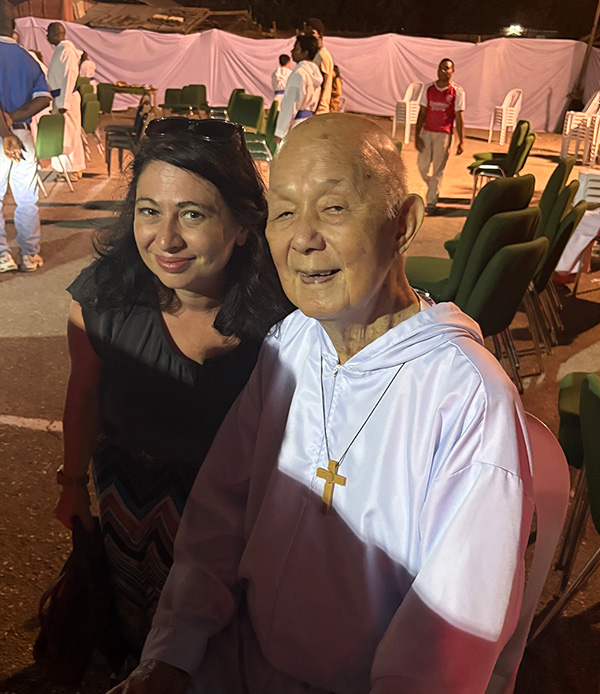 I was one of the seven St. Luke Church in Mint Hill “missionaries” who went on the Missionaries of the Poor (MOP) trip to Jamaica. I had never gone out of the country before or thought of being a missionary, but when I saw the ad in the St. Luke Church bulletin announcing one open spot, I knew it was meant for me.
I imagined I would be painting the fingernails of elderly people and blowing bubbles with disabled children – and I was, but there was much more.
My initial fears of being in gunned down in the streets or having my passport stolen subsided when we arrived in Kingston. Brother Benedict and Brother Peter greeted us at the airport with their long white cassocks held together by light blue sashes and wooden rosary beads. They hugged us like we were old friends.
My eyes met the Jamaican terrain, and it was not a slum, there were mountains surrounded by the sea.
Perhaps one of these mountains is the Mount Zion Bob Marley is always singing about, I thought.
The city streets, while colorful, were trash-ridden, and peppered with dilapidated buildings . Some people walked with music in their step while others lay on the sidewalk with desperation in their eyes.
A grey solid 18-foot-high gate with a huge lock on the side and a peep hole out front, guarded the monastery, and when Brother Benedict opened it, Kingston instantly shifted into a beautifully manicured landscape of mango trees and Marian grottos.
Though we were hungry, we would pray first, Brother Benedict said, as we followed a dozen flowing robes into the small chapel. The sticky 90-degree weather intensified as we entered the building.
The brothers kneeled barefoot in the pews, before a humble crucifix above a simple altar, joyfully singing evening prayers with a Caribbean twist as if time did not exist, and then we said the rosary.
The brothers sat among us for a dinner of rice and fish, where they laughed at our stories, genuinely interested in every word.
During night prayers, I realized I entered a land that never stops praying. I have spent more time praying in those first few hours than I had the three months prior.
Lying in my single bed, I listened to the soft reggae soundtrack of the Kingston night while drowning in sweat from the Jamaican heat. The breeze and a fan saved my life, as they had for probably hundreds of missionaries before me.
I woke up early to take a shower before morning Mass. Though it was too hot for warm water, my Americanized mentality still desired the option.
The drinking water was okay, but I really wanted a cold Diet Coke.
My clothes were already stuck to my body, and I was in desperate need of an air conditioner.
I laughed and almost cried at what a spoiled brat I am. I thought to offer my suffering up to the Lord and then felt ashamed for equating my subtle discomfort with suffering.
Mass at 6 a.m. was followed by morning prayer, and then a Holy Hour. Prayer definitely dictated the rhythm of the day instead of work. By 8 a.m. I was already tired, and we had not even eaten breakfast yet.
We spent the day at Bethlehem House, a home for children with severe physically and developmental disabilities. A boy that could have been anywhere from 12 to 18 with Down syndrome took my hand, while another child locked his arm around my shoulder, using my body as a crutch. Other residents rushed to the Reeder’s, a couple from St. Luke who visit each year. There were long hugs and residents screaming their names as if they were local celebrities.
Another teen in a wheelchair, with arms and no lower body, rolled beside us. The boys were a welcome relief, but then I walked into the other room.
Most of the children lay in cribs,with some connected to feeding tubes. Their heads were large and did not match their small, distorted bodies.
“Hypoxic-Ischemic Encephalopathy,” explained Jennifer Starnes, another St. Luke Church missionary who is a nurse, “it happens when there is not enough oxygen in the womb."
While their bodies lacked functionality, their eyes seemed to tell a different story – one of creative brains held captive within an immobile bodies.
Some looked like infants or toddlers, but their name tags listed an age at least a decade older.
Despite their condition, they were clean, fed and cared for by the brothers and the caregivers, their vital signs carefully monitored throughout the day by a nurse.
“What do I do here?” I thought.
A memory of my grandmother on her deathbed returned. At that point, there was not much left to say or do, but I cherished time with her silently praying and in soft conversation, making sure she was comfortable.
I felt that same urge to comfort each resident by lightly scratching an arm or giving a gentle hug, to sitting quietly with them for a bit.
Although other children were capable of more, I felt a deep connection with the quiet and still.
“Why did they have to suffer in this way?” I asked God, but in their eyes, I saw He was there.
“I could do this. Why am I not doing this at home?” I thought during midday prayer and another communal meal of fish.
At dinner, Brother Peter sat next to us.
“What did we think about the Center?” he asked.
Nancy Barranco, another missionary from St. Luke, explained how truly joyful the residents were, smiling and laughing through their suffering.
“In heaven, they will be whole again, and they will dance and sing with us. They will remember us,” Brother Peter said.
That was simple and comforting—not that they would remember me, or the dancing and singing, but that they would be whole. I asked myself why did I not know that already.
I slept better that night than I had in years.
The cold shower the next morning was refreshing, and the prayer could have lasted even longer.
Halfway through Mass, it was like my whole attitude shifted, a peace filled me, and I felt a void I never knew I had filled. “I need to pray like this every day,” I thought.
At 8 a.m., I was not very tired. I wanted to go to the centers.
“What a quick change of heart! What an easy adjustment”! I thought.
That morning we went to another center, this time filled with elderly women. I spoke to those who could speak. Most were medically fragile and discarded, without any family, and left on the streets to die before they came to the brothers.
Joyce, a stroke victim, was more content than ever at her new residence. After being a Protestant, she was interested in becoming Catholic. She spoke about her inevitable death, comforted by the fact the brothers would provide her with a proper burial on top of their mountain cemetery on Mt. Tabor.
The residents sang and danced to songs of praise, while I drifted to a room in the back with the still and quiet. They may have been older, but they still looked like children.
Just like the previous day, I preferred spending my hours there. The caregiver let me feed them, and afterward, one of the brothers asked me to help bathe them.
A flashback of my ex-husband bathing his elderly father, who had dementia, ran through my mind. “I can’t,” my memory told me, and I froze like a statue.
“Come on,” the brother said with a gentle smile. And I did. I started undressing strangers, drying them after their baths, redressing them, applying powder and lotion. After that initial hesitation, it was fine, maybe even pleasant. I never knew how natural something I didn't believe I was capable of doing would quickly become.
“I am not here for them”, I thought. “They are here for me. I am made for this.”
I realized I could bring them home with me, not physically, but by serving people like them at home – hospice and cancer patients, nursing home residents, the residents of Holy Angels.
During Holy Hour the next morning, I sobbed to the point of embarrassment. I tried to hide my face.
“My life before was wrong. This is right,” I thought. “This is the prayer life. This is the service I meant to do.”
When I looked up, other missionaries were whimpering, too.
The tears were telling. We had all found something in Jamaica; we found a part of ourselves.
After hearing biblical references to Mount Zion all week intermingled in the Liturgy of the Hours, I had to look it up.
I learned Mount Zion spiritually represents the dwelling place of God, divine protection, ultimate redemption, and the spiritual home of the faithful.
On the plane ride home, I sat next to a Jamaican woman from Kingston. She asked what I was doing in Kingston.
I showed her pictures, and she laughed, and in her Jamaican accent said, “You may have been somewhere, but these pictures are not from Kingston. I lived in Kingston my whole life, and this is not Kingston.”
She shook her head and smiled, “When you come back, I’ll show you the real Kingston.”
After we exchanged numbers and false promises, I knew she was right. I did not stay in Kingston that week. I stayed in a spiritual place made by God.
We, just like all previous missionaries from the diocese, discovered the real Mount Zion right there in the middle of Kingston, behind the monastery gates in the hearts of every Missionary of the Poor and every resident.
— Lisa M. Geraci