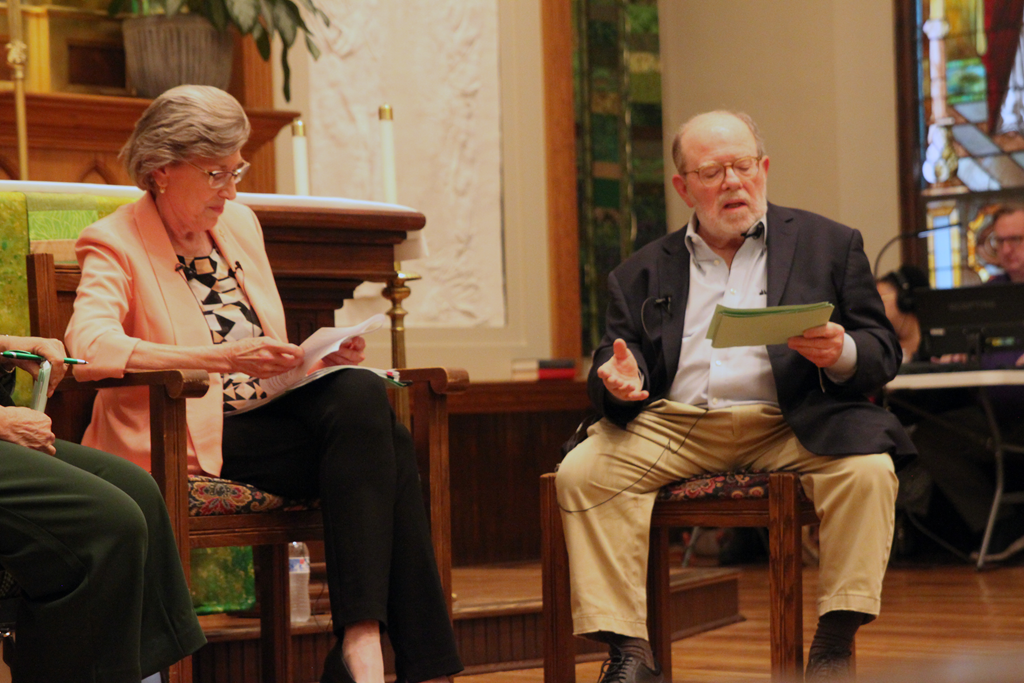
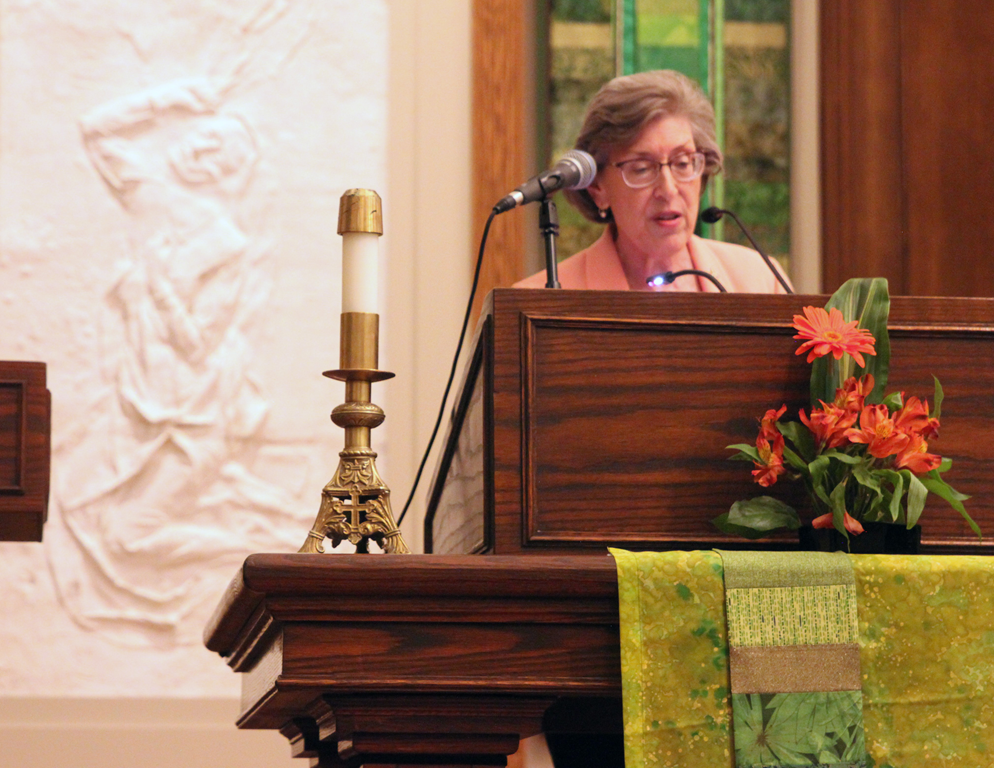
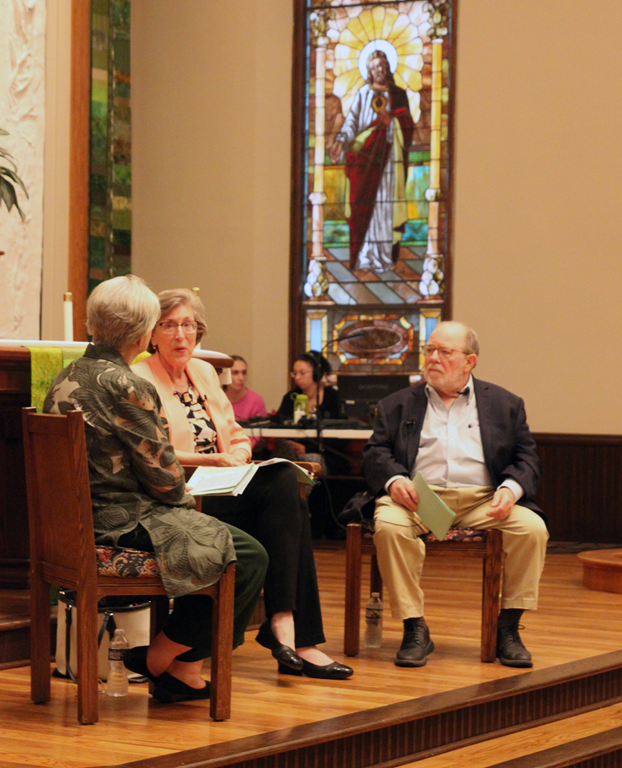
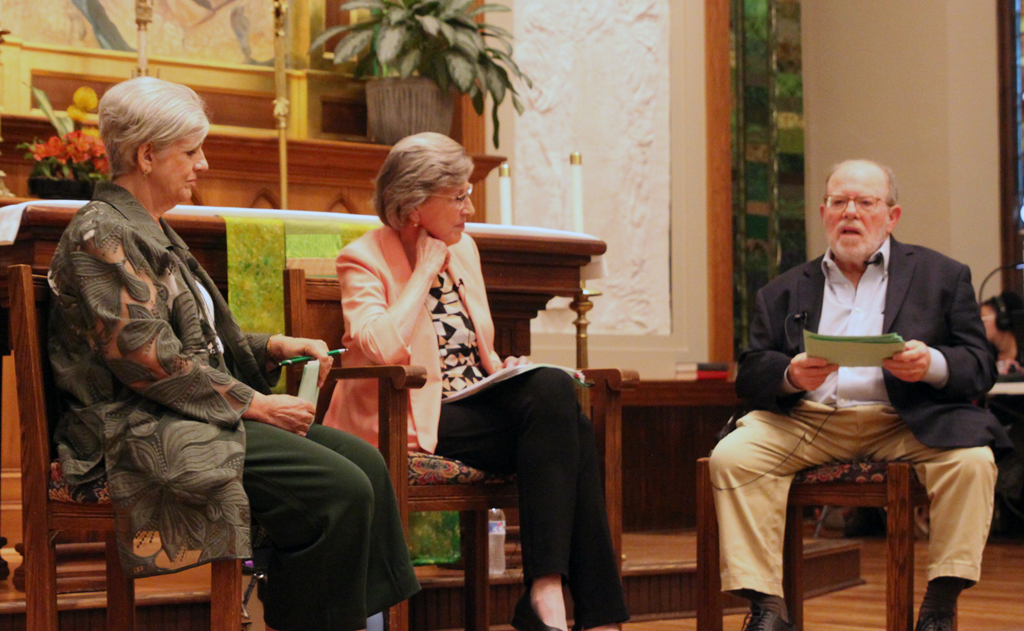
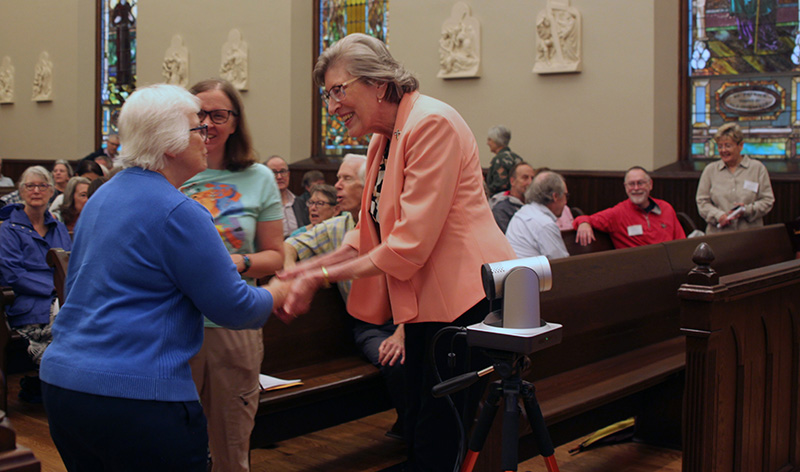
 CHARLOTTE — The 26th annual Kennedy Lecture – a longstanding series hosted by St. Peter Parish that brings nationally recognized voices in religion and ethics to Charlotte – examined the roles of women in the early Church and ongoing discussions about future leadership roles including as deacons.
The May 30 lecture, “Women Leaders in the Early Jesus Movement: Could the pivotal role women played in Jesus’ earthly ministry point the way to a greater role in the modern Church?” was originally slated for Jan. 31 but postponed because of winter storms.
This year’s Kennedy Lecturer was Dominican Sister Barbara Reid, a nationally known biblical scholar and feminist theologian. She is the first woman religious to serve as president of the Catholic Theological Union in Chicago and has written extensively on Scripture, discipleship and the role of women in the Gospel accounts.
Sister Reid, who professed her vows in 1974, described growing up seeing only men and boys having liturgical roles at Mass.
“I remember as a little girl watching male classmates serve at the altar and saying, ‘I wish I could do that,’” she recalled.
“Now, we don’t just have women altar servers, but women lectors... women serving in all different pastoral roles that didn’t exist when I was younger,” she said.
Yet a common complaint is that including women in Church leadership roles has been slow, Sister Reid said, so she looks to the example of the early Church to offer insights as today’s Church leaders explore more ways women can serve and leverage their skills to build up the Church.
“The question about women leaders is complex, but what I will offer is one important piece of the conversation, mainly the role of women leaders in the early Jesus movement,” she said.
In the early Church, she said, “The types of ministerial leadership that women exercised as disciples in the New Testament are many. They were apostles, deacons, prophets, teachers, preachers, evangelizers, heads of house churches and more.”
Sister Reid introduced attendees to prominent women who typically go unnoticed, including Junia, a prominent first-century Christian leader and missionary. In Romans 16:7 Paul commended her: “Greet Andronicus and Junia, my relatives and my fellow prisoners; they are prominent among the apostles, and they were in Christ before me.”
St. Mary Magdalene was an apostle to the apostles, according to Hippolytus of Rome. The Samaritan woman at the well in John’s Gospel later rose to the role of lead apostle and missionary after her encounter with Jesus.
Sister Reid also pointed out that the early title from which the word “deacon” evolved was given to a woman named Phoebe, as noted in Romans 16:1, where Paul wrote, “I commend to you Phoebe our sister, who is a diakonos of the Church in Cenchreae.”
While the concept of female deacons may now appear revolutionary, Sister Barabara outlined its historical roots.
Women, she said, served as “deaconesses” until the 5th or 6th centuries in the Western Church and until the 11th to 12th century in the Eastern Church. By then, the role of deacon had shifted to being a step toward priesthood, and women were instead exercising diaconal duties – teaching, providing medical care, ministering to the poor, serving parishes – through religious communities.
“Women then and now provide crucial gifts and skills that benefit the whole Church, not only other female members,” Sister Reid said. “The New Testament gives us only glimpses of leadership in the past, but it does give us a firm foundation for advancing leadership in the present and future of the Church.”
Today, she said, the issue of women deacons “has become a center of attention, and remains an open question.”
Pope Francis established two commissions to study the possibility of women becoming deacons. The most recent 2020 “Study Commission on the Female Diaconate” voted against the possibility of ordaining women deacons but supported further study and broader access to current ministries, according to a report released by Pope Leo XIV in 2025.
Sister Reid mentioned scholars such as Hofstra University scholar Dr. Phyllis Zagano, who advocates for ordaining women deacons, speculate that the issue eventually could be delegated to regional bishops’ conferences which could navigate local cultural norms and differences in gender roles.
Knowing Pope Leo from the Synod of Bishops, through consultations and from past educational endeavors, Sister Barbara said she remains optimistic he will address the topic.
“(Pope Leo) always finds ways to build bridges and is committed to synodality,” she said.
Sister Reid ended her talk with questions to help move dialogue forward. “What does the Church need today that women can participate in?” she asked. “And what obstacles can be removed to achieve full flourishing for all?”
Sister Reid also signed books, including her newest, “Wisdom’s Feast: An Invitation to Feminist Interpretation of the Scriptures,” and “At the Table of Holy Wisdom: Global Hungers and Feminist Biblical Interpretation.”
The Kennedy Lecture is sponsored by Thomas and Richard Kennedy in memory of their parents, Keith and Joan Kennedy. It was recorded and will be made available on the parish website, www.stpeterscatholic.org.
— Lisa M. Geraci