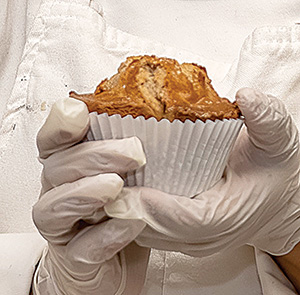
‘Muffins and sauce’
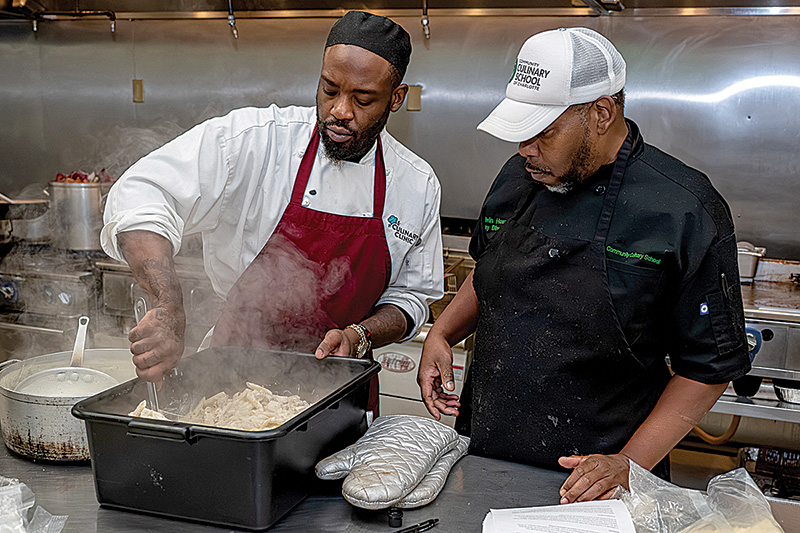 The mission of the nonprofit Community Culinary School is to give people on the margins a second chance – and to produce delicious food that graces many Charlotte tables. It often caters events for Bishop Michael Martin. (Troy C. Hull and Lisa M. Geraci | Catholic News Herald)CHARLOTTE — When Bishop Michael Martin arrived in Charlotte, one of the first orders of business was to choose a caterer to help him host small gatherings for visiting dignitaries, priests and seminarians, employees and parishioners.
His executive assistant presented him with a variety of options – from big-name local chefs to corporate caterers to mom-and-pop shops. The bishop was immediately drawn to the Community Culinary School of Charlotte, a nonprofit chef training and job placement program for people facing barriers to employment: criminal records, substance abuse issues, homelessness and poverty.
“I tried them out my first week in town and loved their food and the professionalism of their approach,” Bishop Martin said. “And you can’t argue with their mission to give people a second chance through a culinary career.”
The culinary school has now cooked for the bishop 14 times – twice just this month – serving up their specialty “airline” chicken with an appetizer of Maryland crab cakes for a dinner with incoming deacons, and four days later offering grilled lemon-butter salmon and risotto for the diocese’s record class of 10 men on the eve of their ordination to the priesthood.
“At first I was intimidated, but Bishop Martin is the most down-to-earth guy you’ll ever meet,” said Culinary Director Chef Alvin Howard, laughing. “We are both from Baltimore, and Oriole fans. At first, I tried making all these fancy dishes, but all he really wanted was some chicken and mashed potatoes.”
Giving them tools
Ron Ahlert, a fine-dining chef in Paris and New York City, joined the Community Culinary School in Charlotte more than 30 years ago because he wanted to give back by imparting his expertise to those on the margins – a familiar theme of Bishop Martin’s.
It’s a relationship that brings pride – and exposure to Catholicism – to his students, who help prepare and serve meals for the bishop. It’s more than mere coincidence, it’s God’s providence, said Ahlert, who grew up Catholic and, through this engagement, has begun to re-examine his faith and attend Mass.
During his tenure, Ahlert and his team have guided more than 1,200 chefs through the school’s tuition-free, 14-week training program, paid for through grants and donations.
To get in, there’s a “knife test,” which evaluates applicants’ acumen in the kitchen. Only about half the 50 or so applicants for each class are accepted, and from there, most everything is free, a cost of roughly $10,000 per student.
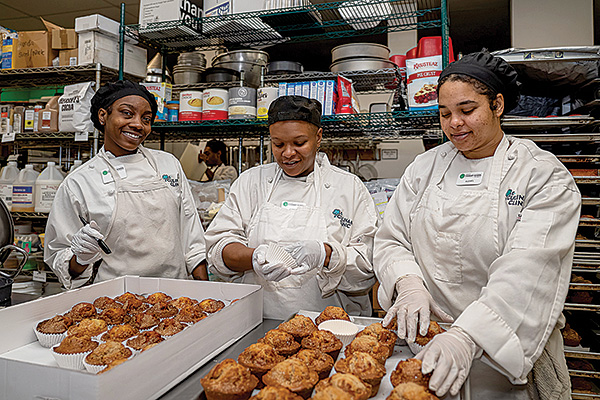
“Instead of math and English, we teach muffins and sauce …” Ahlert said. “We give them every tool to be successful – the uniforms, free meals, bus passes, wrap-around services, the whole deal. Not everybody makes it.”
“Some folks come to us assimilating after incarceration, some with recovery issues, or some stuck because minimum wage in North Carolina is $7.25,” he said. Culinary students earn twice that.
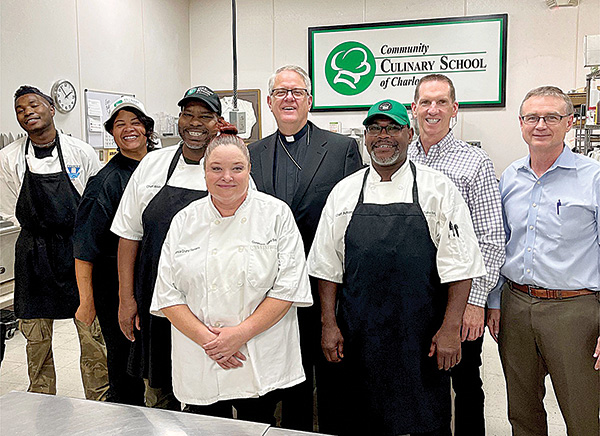
Those who do graduate generally populate local restaurants, catering companies and bakeries. Others open eateries or food trucks.
Chef Alvin manages the relationship with Bishop Martin and often brings along graduates of the program. They prep the meals at the school’s kitchen off Monroe Road and finish the dining experience in full view of the bishop and guests at his home – which one night included all the bishops of the Atlanta Province.
The bishop’s kitchen is now a familiar and comfortable space for Chef Alvin, where he chats with his new buddy and shares secret hometown recipes – such as the Smith Island cake he served at the recent deacon dinner, the official state dessert of Maryland. Smith Island is a remote fishing community in the Chesapeake Bay. The cake features eight to twelve ultra-thin layers of yellow cake stacked with rich chocolate fudge icing between layers and slathered over the outside.
Chef Kam Allen assisted Chef Alvin with the bishop’s recent dinners. A graduate of the program, she’s come a long way from difficult times, and now works for the culinary school as a pastry chef.
Allen grew up inspired to follow in her grandmother’s footsteps as a baker but says poor life choices held her back, landing her in jail more than once.
“When I first started the program, I was on the verge of being homeless,” said Allen, who is now preparing to move into her own apartment. Working with the bishop, she said, has been “very eye-opening.”
“I learned a lot. They treated me with open arms right when I walked in. It was really cool, and it seems like they liked the food because they ate pretty much everything.”
Allen’s success, like that of so many other students, is gratifying, said Ahlert: “When you see the fruit from the seeds you plant, you want to plant more.”
It’s also gratifying, he says, to see the bishop drop by the school’s dine-in café at 9315 Monroe Road for lunch, planting seeds of his own.
“A bishop walking in here – that is a big deal,” Ahlert said. “It’s funny. It’s like I’m coming full circle spiritually. That is a sign to keep going in the direction of Catholicism, where
I’ve been headed.”
— Lisa M. Geraci
Want to donate?
At www.communityculinary.org: Learn more about the program and how to help