‘You will be my deacon’
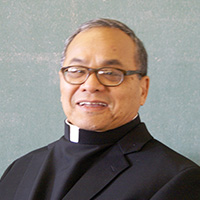 Deacon Pierre K’BriuhGREENSBORO — Deacon Pierre K’Briuh is approaching 90 and says that daily life is becoming a challenge.
“My head is a little clouded, and my body is physically deteriorating,” he says.
Yet when Deacon K’Briuh talks about his faith – and serving St. Mary’s in Greensboro for the past 25 years, his wife, eight children and 16 grandchildren – he is unable to contain his joy. “I have my own soccer team here,” he laughs. “I just pray one day God will grant me a priest out of this family. I prayed for vocations, and He answered my prayer through the diaconate, but I am still all alone.”
By “alone,” he is referring to his ministry of leading local Catholic Montagnards – immigrants from the central highlands of Vietnam – for the past two decades. North Carolina has the largest population of Montagnards outside of Vietnam. They fled persecution after the fall of Saigon and gravitated to North Carolina through their relationship with the U.S. Army Special Forces stationed at Fort Bragg.
The community of about 20,000 lives in Charlotte, Greensboro and Raleigh, and though mostly Protestant, Catholics, like Deacon K’Briuh’s family, desire to practice their faith in their native tongue and with familiar traditions.
From the Highlands to the Triad
Deacon K’Briuh grew up herding buffalo in South Vietnam. He was sent to school as a teenager, where he learned both his career and his faith.
The year was 1954. The French had relinquished control to the newly sovereign Republic of Vietnam, and he was baptized.
“I was the first in my family to ever convert to Catholicism,” he says.
He eventually got married, had children, and started working as a liaison officer between his tribe and the South Vietnamese government.
In 1975, when the North Vietnamese captured Saigon, he watched his life collapse and he was placed in a re-education camp for three years. The brutal conditions and manual labor should have left him exhausted, but he was unable to sleep amid fears for his wife and children.
Escape by boat
Released in 1978, he arrived home to find everything seized by the government and realized his family needed to escape. He did so with help from the Church.
“The priests and the nuns found a way, so I asked them if I could be included,” he recounts, and despite his lack of funds, he promised to repay them later.
He left in a small fishing boat, crowded in with 24 Catholics who had no idea how to navigate on the open water.
“We had the help of God and our prayers, and that’s all,” he says. “We were surrounded by sharks, and I didn’t know how to swim. I just knew for sure that I would be at the bottom of the ocean. But I needed to save my family by protecting my own life. If I died, what would happen to them?”
A French boat rescued them, bringing them to Singapore. Eventually, the Green Berets helped him reach North Carolina.
“When I was in the camp, I was worried about my family’s survival. When I got out, I was worried how I was going to feed them, and now that I came here, I was worried how I was going to get them here,” Deacon K’Briuh recalls.
“In my life…let’s just say, I never got too much sleep.”
The process took nine years, but he was finally able to bring his wife and children to Greensboro.
Yet he didn’t stop there. He helped resettle another 600 Montagnard refugees to North Carolina.
Payback’s a gift
The nuns who aided his escape never asked K’Briuh for payment, but the Church still settled his account.
Then-Bishop William Curlin overheard K’Briuh sharing his testimony one day at St. Mary’s in Greensboro and approached him, saying, “You will be my deacon.”
K’Briuh accepted the new task as a gift.
“Because of the good grace God has provided me, I could not refuse,” he says.
St. Mary’s Parish gave him the opportunity to attend Mass in his own dialect, with his fellow Montagnard community.
But Deacon K’Briuh serves and is inspired by all people.
“St. Mary’s attracts the poor, the rich and everybody else. We have all kinds of tribes, ourselves, the lowland Vietnamese, Africans and Latin Americans,” he reflects.
“This church, which was built for Black minorities, now has all minorities pulled together. It is a pool of love and community,” he says.
For Deacon K’Briuh, it is vital for the Church to preserve that rich diversity by including the Montagnard community.
“Right now, we don’t have any priests that speak our language,” he says, “and that is why I really want my prayer quickly answered for a Montagnard priest so they can teach our own people again.”
— Lisa M. Geraci