


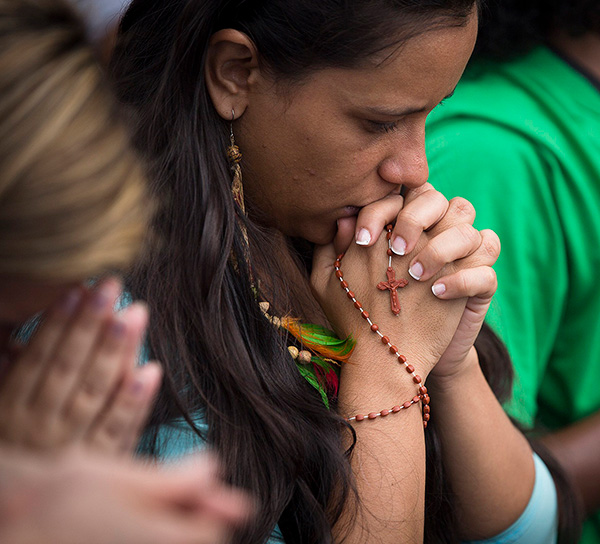
 In the wake of national tragedies, it is customary for public figures to offer their “thoughts and prayers” for those affected. Lately this phrase has been criticized by some as a pious excuse for inaction. Indeed, if “thoughts and prayers” are mere empty words, they do no good. As the epistle of James reminds us, “If a brother of sister has nothing to wear and has no food for the day, and one of you says to them, ‘Go in peace, keep warm, and eat well,’ but you do not give them the necessities of the body, what good is it?” (Jas 2:15-16).
Concrete acts of charity are important, but prayer itself is also an act of charity. Often it may be the only charity we find ourselves in a position to offer, especially if we are hindered by distance or lack of resources. No one ought to feel that their prayers are useless.
Nevertheless, even people of faith may find themselves wondering what good our prayers accomplish. God is all-good and all-knowing. That means God is fully aware of every human tragedy and is able to rectify any wrong in ways that are both merciful and just. His understanding of the needs of any situation far surpasses our own. So why do we need to bring our concerns to God? We are not telling Him anything He does not already know. Do our petitions really make a difference?
Why we pray
When grappling with these questions, it is good to remember what prayer is really for. It is not about providing information to God or trying to change God’s mind. The Catechism of the Catholic Church begins its section on prayer by rooting the concept of prayer in relationship. It opens by recalling the need for Christians to live the mystery of the faith “in a vital and personal relationship with the living and true God. This relationship,” it says, “is prayer” (CCC 2558).
Interpersonal relationships are multifaceted. Consider relationships you have with family and friends. If the only time you communicate with your loved ones is when you need something from them, no one would consider that a healthy relationship. As a father, I want my children to come to me with their needs. But I also want to hear about how their day has been. I want them to share with me their interests and aspirations. I want to know what excites them. And I also want them to listen to me. Similarly, as a husband, I want my wife to tell me her needs. But I also want to hear her words of affection. I want to know she loves me, and that is communicated not only by words but by her presence and attentiveness. The same is true of our relationship with God. If the only time we talk to God is to ask Him for something, that’s not a healthy relationship. There has to be more to it.
Prayer is a trip
In defining prayer, the Catechism begins by quoting two saints. The first is St. Therese of Lisieux, who defines prayer as “a surge of the heart … a simple look turned toward heaven … a cry of recognition and of love, embracing both trial and joy.” The second is St. John Damascene, who says, “Prayer is the raising of one’s mind and heart to God or the requesting of good things from God” (CCC 2559). Making requests of God is an aspect of prayer, but only one aspect. There are prayers of adoration, thanksgiving, repentance, intercession, as well as petition. A good way to remember these different types of prayer is with the acronym A TRIP.
When we pray, then, we take A TRIP; but to where? And to whom? The two saints quoted above provide us with the answer: to heaven and to God. The purpose of prayer is to help us get to heaven by fostering communion with God (which is what heaven is all about).
The scriptures teach that the way to abide in Christ is for us to “live just as he lived. . . this is the way we may know we are in union with Him” (1 Jn 2:6, 5). To conduct ourselves as Christ, we must learn to be like Him. This is what it means to be a disciple (a student). We must learn from the Master. If I want to learn to be a master carpenter, I have to seek out a master carpenter and say, “teach me to do what you do.” Similarly if I want to learn to play classical violin, I have to seek out a violinist and say, “teach me to do what you do.” So in the Christian life, if we want to grow in holiness we must put ourselves in the presence of Christ and say, “teach me to do what you do.” Prayer is meant to transform us.
When tragedies arise (as they will), we can often feel helpless. This is true whether the tragedy is a personal one, or something on the national or international scene. Our hearts may be filled with sorrow or moved with compassion, but we don’t know what to do. We may be prompted to anger and not know how to direct it. We may feel frustrated at our inability to “fix things.” In all of these cases, the best thing we can do is to put ourselves in the presence of our loving Father and say, “I’m scared. I’m concerned. I’m angry. I’m confused. What do you want me to do?”
Sometimes that answer may be, “There is nothing for you to do. Just trust in me.” Other times we may be inspired to a concrete action, in which case our charity will be more effective because we allowed it to be directed by the source of charity itself.
Prayer is never useless. By presenting our needs and concerns to our merciful Father, we open our hearts to being filled with His divine love. The intimacy with God born from a life of prayer is the very source of a Christian’s strength. It should never be neglected. The work of prayer inspires and infuses all our other good works with divine love.
Deacon Matthew Newsome, Catholic campus minister at Western Carolina University and regional faith formation coordinator for the Smoky Mountain Vicariate, is the author of “The Devout Life: A Modern Guide to Practical Holiness with St. Francis de Sales,” available from Sophia Institute Press.