


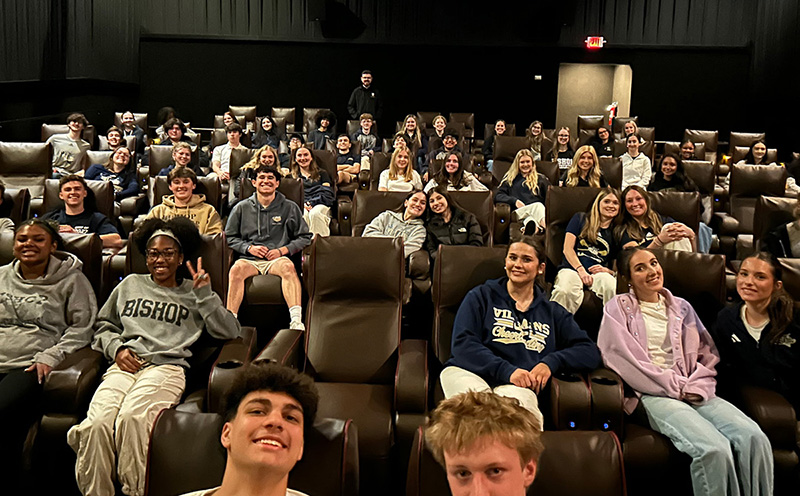
 Students from Charlotte Catholic and Bishop McGuinness high schools took a field trip to local movie theaters to learn more about the legacy of St. Frances Xavier Cabrini. The movie gave students the opportunity to reflect on the political polarization of our time and how to bring people together. CHARLOTTE — On March 12, in the non-traditional setting of a movie theater, high school students learned about St. Frances Xavier Cabrini, an Italian-American nun who fought for the dignity of Italian immigrants in New York City during the late 1880s.
Buses from Charlotte Catholic and Bishop McGuinness high schools drove through the morning dew for a special screening of “Cabrini,” an Angel Studios production, at Regal Theaters at
Piper Glen in Charlotte and AMC in High Point. Christ the King High School will view the movie in their gymnasium at a later date.
“A couple of years ago, when it first came out, some of the parishes did a screening, and that was my introduction,” said Dr. Greg Monroe, the diocesan superintendent of schools. “I was blown away by the way it showed the human element for this saint who did so much for migrants and was such a witness to the corporal works of mercy, showing us how we are supposed to work for all people.”
St. Frances Xavier Cabrini’s actions resonated with Monroe, and when folks in the Catholic Diocese of Dallas introduced him to the film’s directors with the goal of bringing the saint’s message to local students and educators, he was all in.
“They mentioned how some dioceses were taking the messages found in Mother Cabrini’s life and using them as part of their lesson plans,” Monroe said. “In schools we come from all walks of life, and we have teachers from different backgrounds. … It is a nice bridge to see what Mother Cabrini was trying to do and what we are trying to do with our students. It was so beautiful how Mother Cabrini saw the inherent dignity of every single person, no matter who they were or where they were from – she considered them a beloved child of God.”
From 1889 to 1910, more than two million Italian immigrants came to New York City in pursuit of the American dream. Instead, they found a nightmare, with many denied access to healthcare, education and housing. Racial slurs followed migrants through the city while they worked and lived in slums infested with rats.
In the Five Points area of the Lower East Side of Manhattan, where most immigrants settled, thousands of abandoned children slept under steam grates and existed in the dark cement tunnels of the city’s sewage system.
In the midst of that chaos, one nun, Frances Xavier Cabrini, overcame gender persecution and ethnic discrimination to create an orphanage and hospital for the neglected Italian immigrants.
The movie “Cabrini,” based on her life story and released in 2024, showcased her journey of resilience and persistence. During her 67 years, she established 67 hospitals and orphanages across the globe and became the first U.S. citizen to be canonized.
Though her work was largely focused on Italian immigrants in New York City, her message of human dignity remains relevant today, when migrants are still persecuted, called names and treated as second class.
The movie is trending in Catholic schools across the nation, which are incorporating its message in their curriculum to help students understand the Catholic view on human dignity associated with current events such as modern-day immigration.
Most Charlotte Catholic students said they better appreciated the works of the saint and the rawness of discrimination through the film.
“We learned a little about it in history class, but not like that graphic,” said student Brynley Wilde. “I loved the movie so much. I like how she had women power. She was very inspiring. And she took control of the men who were trying to stop her. She just kept going, even in the face of danger.”
Monroe said the movie was important on both a theological and an educational level.
“In a world that is so polarizing and fractured, where you have so much adversity, this can be a real opportunity to reflect,” Monroe said. “How can we learn from the challenges that Mother Cabrini experienced to strengthen and enhance what we are trying to do in our diocese? Especially in a diocese with so many different demographics, how can we support them and bring them together, all through the lens of our faith?”
— Lisa M. Geraci
Who was Mother Cabrini?
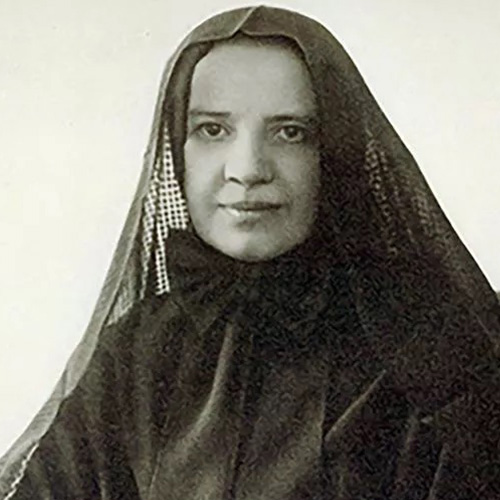 St. Frances Xavier Cabrini, the first American citizen to be a canonized, is known as the patron saint of immigrants.
Refused admission to the religious order which had educated her to be a teacher, she began charitable work at the House of Providence Orphanage in Cadogno, Italy. In September 1877, she made her vows there. When the bishop closed the orphanage in 1880, he named Frances prioress of the Missionary Sisters of the Sacred Heart. Seven young women from the orphanage joined her.
Since her childhood in Italy, she had wanted to be a missionary in China but, at the urging of Pope Leo XIII, Frances went west instead of east. She traveled with six sisters to New York City in 1889 to work with the thousands of Italian immigrants living there.
She provided the poorest of the poor Italian immigrants of New York with food, shelter, education and health services. By the 1890s, she established services in Chicago, also erecting several hospitals. She expanded those services to all immigrants across the country and around the world.
By the time of her death in 1917, at age 67, the naturalized American citizen had established 67 education, health and social service institutions throughout the world.
The route of the 2026 National Eucharistic Pilgrimage – which will come through the Diocese of Charlotte – is named after the saint.
— OSV News and Catholic News Herald