


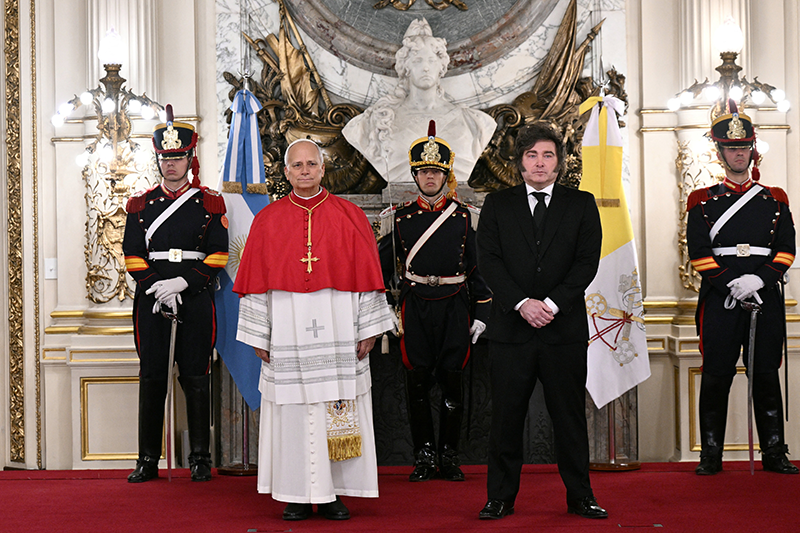
 BUENOS AIRES, Argentina — Pope Leo XIV arrived in Buenos Aires Nov. 8 urging Argentina's civil leaders to safeguard democracy, protect the unborn, and engage in respectful dialogue across political divides after meeting with President Javier Milei at the Casa Rosada presidential palace.
The papal flight from Uruguay on an Aerolineas Argentinas plane dubbed "Pontifex Maximus" touched down after 4:30 p.m. at Buenos Aires International Airport after a short 40-minute flight across the Río de la Plata. Milei, Argentina's libertarian leader since 2023, personally welcomed Pope Leo on the tarmac.
Argentina is home to more than 43 million Catholics, according to the latest Vatican statistics from 2022, which state that over 92% of the country's population is baptized Catholic. However, according to Pew Research Center, only 58% of adults self-identify as Catholic.
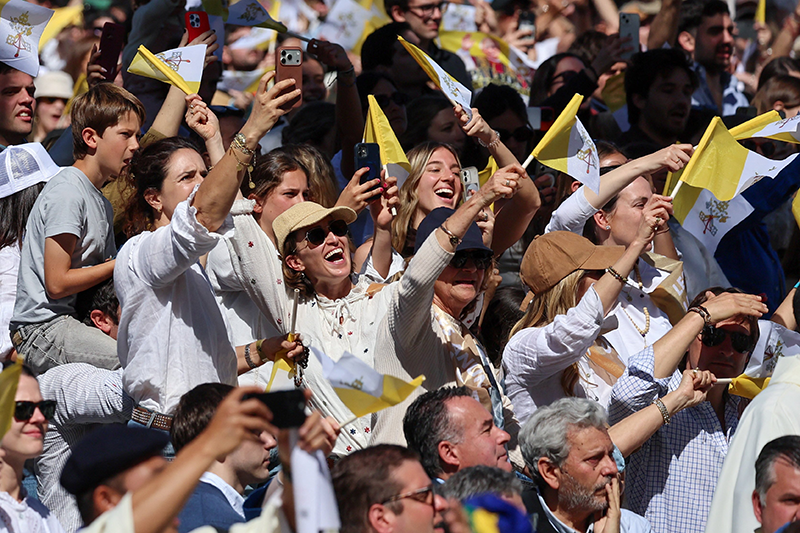
People waving Vatican flags lined the avenues of Buenos Aires, nicknamed the "Paris of South America," as the pope made his way to the Casa Rosada, where Milei resides, for a private one-on-one meeting with Argentina's self-described "anarcho-capitalist" leader who was raised Catholic, but has expressed a desire to convert to Judaism.
In the pope's first speech in Argentina in the Palacio Libertad, Pope Leo honored his predecessor Pope Francis, who was a native son of Buenos Aires, but never returned to his homeland after his election as pope in 2013.
"My arrival in this land is personally meaningful," Pope Leo said. "Today, as his successor in the Petrine ministry, I am in some sense retracing his steps in this country where the personal history of Pope Francis would later be joined to that of the entire Church."
Pope Francis, born Jorge Mario Bergoglio, led the archdiocese of Buenos Aires from 1998 until he became pope. As the bishop of Buenos Aires, he was known for riding the subway, and regularly visiting poor barrios, or neighborhoods, of the city.
Milei, who previously derided Pope Francis as a "filthy leftist," later eulogized him as "the most important Argentine in history" and shed tears while attending the late pope's funeral in 2025. He told Radio Mitre in Argentina that he had apologized to Pope Francis. "He told me, 'Don't get upset, these are youthful mistakes.'"
In the Palacio Libertad, with Pope Leo seated nearby on stage, Milei lauded Pope Francis again, saying in his opening speech that Pope Francis' death "left a huge void in our entire people, both for his faithful and for those who do not belong to the Church."
"He was an exceptional figure who, through his humanity, inspired us all, regardless of our faith," Milei said. "A person of immense generosity whom I had the honor of knowing firsthand."
Pope Leo spoke after the Argentinian president in a diplomatic and measured tone, underlining the importance of ethical technological development, respect for the environment and the dignity of every human person.
Democracy, the pope underlined, is "strengthened by the daily conduct of public life: through willingness to listen, through careful use of words, through the patient search for agreement, and through the ability to see those who think differently as fellow citizens with whom we share a common future."
"In this way, a spirit of trust is created, one that enables a society to deal with its differences without losing sight of the things that keep it united," he said.
"Those entrusted with public office are charged with a particularly demanding task. Authority is most authentic when it is exercised as service, when it looks beyond the immediate, and when it uses its power to promote the welfare of all," Pope Leo added.
In his speech, Pope Leo highlighted Argentina's unique culture from the tango, "born from the encounter of different neighborhoods, ports and backgrounds" to the sharing of a drink of mate, which "turns a moment of relaxation into an opportunity for conversation and closeness."
The pope also urged introspection on the part of Argentina's leaders, saying, "a nation must seriously ask itself where it has failed when its young people have to leave their homeland in order to make their dreams come true."
"What place do children not yet born occupy in our decision-making? Before asking ourselves what kind of world we will leave our children, we must first recognize their dignity," Pope Leo added.
"That same dignity requires that particular concern be shown for those affected by illness, dependency and disability," he said. "Here, too, we have a duty to care for others, to alleviate suffering, to accompany them, and to ensure that every person feels that his or her life always retains a value that no circumstance can diminish."
Pope Leo's speech to Argentina's political authorities marked the end of public events on his first day in Buenos Aires. After leaving the presidential palace, Pope Leo was expected to hold a private meeting with members of the Augustinian Order at the apostolic nunciature before ending his day. Pope Leo will remain in Argentina until Nov. 11.
The pope is scheduled to celebrate an outdoor Mass in the center of Buenos Aires, one of the most populous cities in Latin America, on the morning of Nov. 9 before meeting with social movements at the Catholic University of Argentina, with religious leaders at the Palacio San Martín, and with the local Catholic community at the Metropolitan Cathedral of Buenos Aires.
On Nov. 10, Pope Leo plans to fly to Córdoba, the country's second-largest city, to celebrate Mass on the grounds of the Military Aviation School and meet with Church leaders at the Cathedral of Our Lady of the Assumption. In the evening, the pope plans to preside over a youth vigil in Buenos Aires.
The pope's visit to Argentina is scheduled to culminate in a Mass at the Marian shrine of Our Lady of Lujan, Argentina's patroness and one of its leading pilgrimage sites, on the morning of Nov. 11 before he flies north to his much anticipated "homecoming" in Peru.
— OSV
Pope Leo shares advice for Catholic parents whose children left the faith at Uruguay's national shrine
-
Pope Leo shares advice for Catholic parents whose children left the faith at Uruguay's national shrine
 FLORIDA, Uruguay — Pope Leo XIV made a pilgrimage to Uruguay's national Marian shrine Nov. 8, where he shared a message of hope for mothers who feel the grief of seeing their children fall away from practicing the faith they were raised in.
"I know that many of you carry a very specific sorrow. You taught your children to pray, and today they no longer do so. You used to attend Mass together, and it has been years since they entered a church. You spoke to your grandchildren about God, and now you do not know if those words left a mark. Sometimes you wonder if you did something wrong or if it was all futile," Pope Leo said in his homily.
The pope pointed to the witness of St. Monica, who "prayed for years for a son who seemed to be drifting further and further from God, but she never stopped trusting in his grace."
"Mothers and grandmothers: never tire of passing on the faith! Preach with your lives as well as with your words. Insist on prayer, love, and hope; insist on them in season and out of season (cf. 2 Tim 4:2). Do so with patience, without harshness or discouragement. Even if your loved ones seem far from God, continue to place them before him. Do not stop blessing them, accompanying them, and simply reminding them of what they once received," Pope Leo said.
"There are doors that you cannot open, but God can," he added.
In his homily, the pontiff also offered words of encouragement to fathers and grandfathers, urging them to imitate St. Joseph.
"Dear fathers and grandfathers, young people need to see that you pray, receive the sacraments, treat your wives with respect, ask for forgiveness and live with integrity, even when doing so requires sacrifice. Children learn a great deal by seeing that their father can kneel before God without feeling that he is any less of a man for doing it," Pope Leo said, to loud applause from those gathered at Mass.
"Your children and grandchildren need to see that the faith occupies a genuine place in the lives of the men in your family," the pope added.
-- Pope Leo at the beloved Uruguayan pilgrimage site --
The pope celebrated an outdoor Mass with 50,000 people in front of the National Shrine of Our Lady of the Thirty-Three, the cathedral basilica of the Uruguayan city of Florida on the morning of Nov. 8, the date of the country's annual national pilgrimage to the Virgin Mary, which is closely tied to Uruguay's historic struggle for independence from Brazil.
At this beloved pilgrimage site, Pope Leo renewed the consecration of Uruguay to the Virgin Mary, first made by St. John Paul II in 1988, imploring God that through Our Lady's intercession "he may thwart the works of the evil one and preserve beloved Uruguay from whatever might lead it away from Christ."
The unique Marian title of Our Lady of the Thirty-Three takes its name from the image from the 33 revolutionaries whose 1825 campaign sought to free the territory then known as the Eastern Province from the Brazilian Empire.
The Assembly of Florida, which declared independence Aug. 25, 1825, met beside the town's church, and its members venerated the Marian image preserved there.
"This small image is linked to a decisive moment in Uruguay's history. In 1825, those who were fighting for the freedom of this land also turned to Mary, to place the beginning of their efforts under her protection. That gesture reminds us that the history of peoples, too, cannot be fully understood without reference to God," Pope Leo said.
"Since that time, generations have come and gone, circumstances have changed, including the relationship of many Uruguayans to the faith. Yet she has remained here."
-- Virgin of the Thirty-Three, the liberator of Uruguay --
The current cathedral basilica in Florida building was built in 1887, but the wooden image of the Virgin Mary preserved inside the national shrine traces its history back further to the late 18th century and has become closely associated with Uruguay's national story. Carved from Paraguayan cedar, it is a small representation of the Immaculate Conception believed to have originated in the nearby Jesuit missions.
"This devotion did not originate in any miraculous event or an apparition, as many Marian devotions do," Father Gabriel González Melano, a priest of the Diocese of Florida, told OSV News.
"It was the people who began to identify her with that campaign," Father González said. "From 1825 onward, they gradually began to call her the Virgin of the Thirty-Three, with many also dubbing her the liberator of Uruguay."
-- Pilgrims overjoyed to meet the pope --
Martín Lage Ponce de León, who came on pilgrimage to the shrine with his family from the capital city of Montevideo, told OSV News that Our Lady of the Thirty-Three "represents a lot for all the people in Uruguay."
"We are really excited about receiving Pope Leo," he said. "It's something that we are really grateful that he chose Uruguay to start his trip in South America. And we consider that this is because of something Uruguay really needed ... his words of mission."
Twenty-six-year-old Ximena Tejeria watched eagerly from her wheelchair as Pope Leo greeted the crowd of thousands waving Vatican flags from the popemobile. "This is my first time seeing the pope," she said of Pope Leo. "I previously met Pope Francis, and now we get to see (Pope Leo) up close, which is wonderful for all of Uruguay, too. It’s been many years since a pope visited, so this whole event is a source of joy for everyone."
Natalia Baccino, 45, from the capital city of Montevideo has made many pilgrimages to Florida's Virgin in her life, but this was the first papal Mass at the shrine.
"I woke up really early at 4:30 a.m. to arrive here because ... the routes, there were too many people coming here," Baccino told OSV News.
-- Argentina is next stop for Pope Leo after Uruguay --
The pope traveled about 60 miles by car from Montevideo to arrive at the shrine. The road included one pit stop to pray in the parish of St. Thérèse of the Child Jesus, or Santa Teresita, in Juanicó, to greet the mayor and to offer a blessing to people gathered there.
"The principal reason for Leo visiting the shrine is, of course, that the pope is coming to Uruguay, so he had to visit the country's patroness," Father González said. The convergence of her feast and the national pilgrimage, he added, makes the occasion particularly significant.
St. John XXIII authorized the image's canonical coronation in 1961 and declared Our Lady of the Thirty-Three patroness of Uruguay in 1962. In 1975, Uruguay's government designated the cathedral and the image national historic monuments, and in 1994 the cathedral became the National Shrine of Our Lady of the Thirty-Three.
At the end of Mass, Bishop Alfonso María Bauer Ormazábal of Florida told Pope Leo, "We are a country of close-knit communities, of sharing mate, and of gatherings of friends. And that country was born here, in Florida: next to the so-called 'Altar of the Motherland,' our Independence was declared, under the gaze of the Virgin of the Thirty-Three."
"Today, we face different struggles, and we ask Mary to accompany us in these as well:
the poverty of so many children and the lack of work, loneliness and a sense of meaninglessness, addictions and mental health issues, social fragmentation, and violence. With her, we wish to defend the dignity of every person, daughter and son of God," the bishop said.The Mass in Florida marked the final public event of Pope Leo's Nov. 7-8 visit to Uruguay. After Mass and lunch with local bishops, he is scheduled to fly to Buenos Aires, Argentina, where he will meet President Javier Milei in the afternoon.
Uruguay's national Marian shrine is one of three Latin American pilgrimage sites Pope Leo is visiting during his Nov. 6-17 tour of South America.
In Argentina, Pope Leo is expected to celebrate Mass at the Basilica of Our Lady of Luján, the country's national Marian shrine. In Peru, he intends to visit Zaña, where relics of St. Turibius of Mogrovejo, the missionary archbishop of Lima and patron of the Latin American episcopate, are preserved.
— Courtney Mares, OSV News
In secular Uruguay, Pope Leo urges Catholics to find strength in being few
-
In secular Uruguay, Pope Leo urges Catholics to find strength in being few
MONTEVIDEO, Uruguay — In Latin America's most secular country, Pope Leo XIV received a welcome that surprised even longtime Vatican observers: Tens of thousands of people were eager to see the pope, as tickets for a prayer vigil at the country's largest stadium were snapped up within hours of going online.
The roughly 70,000 free tickets for the Nov. 7 vigil at Montevideo's Centenary Stadium were quickly claimed in less than three hours, mirroring an unexpected display of enthusiasm in a country where only about 35% of the population identifies as Catholic and more than 50% declare having no religious affiliation at all, in a 2024 survey by Latinobarómetro.
Local media outlets reported that this demand broke records.
"I have never seen it in this country!" said Guzmán Carriquiry Lecour, a former secretary of the Pontifical Commission for Latin America and former Uruguayan ambassador to the Holy See, speaking to journalists Nov. 3, detailing that he said he had never witnessed the city's public spaces so filled with welcoming posters and demonstrations.
But the enthusiastic reception at the stadium stands in contrast to the rest of the pope's time in Uruguay, where secularism has been a defining feature of national identity for more than a century and most of Pope Leo's events were not brimming with attendees as in his recent trips to France, Spain and Africa.
Throughout his visit, Pope Leo addressed the Church's declining influence in Uruguay, urging Catholics to find strength in their status as a religious minority and demonstrate the relevance of their faith through their lives, rather than their numbers.
Uruguay's separation of church and state has roots in the late 19th century, when the government began reducing the Catholic Church's influence over public institutions. The separation was formally established in a new constitution that took effect in 1918.
The country's secular identity became so deeply embedded in public life that Christian holidays were renamed. Christmas officially became "Family Day," while Holy Week became "Tourism Week." Religious names of some towns and streets were changed, crucifixes were removed from public spaces and religious instruction was eliminated from public schools.
In more recent decades, Uruguay has also adopted legislation legalizing same-sex marriage, abortion and euthanasia, reflecting a society where Catholic moral teachings have limited influence over public policy.
For some within the Church, including Carriquiry Lecour, the country's history of secularization has included what he described as "aggressive, anti-clerical attacks."
For Manuela Rodríguez, a Catholic who came to see the pope during his visit to Casavalle, where Papal Foundation funds helped support the construction of new homes, Uruguay's secularism has gone beyond separating church and state.
"Uruguay isn't just secular, it's secularist," she said Nov. 7 to Catholic News Service. "One thing is separation between the government and the Catholic Church, which is understandable and fine. But another thing is that many times we Catholics have to hide ourselves or conceal our crosses or our beliefs because we're treated badly."
She pointed to the legalization of abortion and euthanasia, saying Catholics who publicly oppose those measures can face insults and hostility.
"We're strong because we resist attacks on Catholics, whether in our workplaces, at universities or everywhere," she said.
But Gustavo Yuane, another Catholic who came to welcome the pope at the Parish of Our Lady of Guadalupe in Casavalle, had a different perspective.
"I think it's good. It strengthens freedom and democracy in every sense. We must respect all religions," he said Nov. 7 of Uruguay's secular system.
Asked whether Yuane had ever felt persecuted or attacked for being Catholic in Uruguay, he responded: "No, not at all. Not in Uruguay."
Pope Leo addressed the relationship between religious freedom and secular government during his Nov. 6 speech to Uruguayan authorities and the diplomatic corps.
Addressing Uruguayan President Yamandú Orsi, civil authorities and the diplomatic corps Nov. 6 at Independence Square, Pope Leo acknowledged the country's secular traditions while emphasizing that religious freedom includes the right to practice faith publicly.
He said secularism has an "obligation to ensure that there is room for believers and non-believers to live together in freedom and respect."
"This neutrality does not require that the religious dimension be confined to the private sphere," the pope said.
Quoting the Second Vatican Council's teaching on freedom of conscience, the pope said religious liberty allows people of different beliefs to participate in society without compromising the independence of civil institutions.
"On the basis of this freedom, individuals and religious communities can contribute to the common good while respecting the autonomy of civil institutions," he said.
But the challenge facing Uruguay's Catholics extends beyond the separation of church and state.
During the celebration of vespers with bishops, priests, deacons and religious at Montevideo's Metropolitan Cathedral Nov. 6, Pope Leo described a country "where many of our contemporaries barely know Jesus Christ and so many young people have grown up far from the life of the Church."
He encouraged young people to consider religious vocations, noting that Uruguay's inter-diocesan seminary received no new candidates in 2024.
The decline in vocations reflects broader changes in the country's Catholic population.In 1980, the country had approximately one priest for every 4,940 residents, compared with one for every 9,700 in 2024, according to Vatican statistics.
During the same period, the number of marriages celebrated in the Church fell from 8,673 to 1,649, while First Communions declined from 15,449 in 1990 to 4,087 in 2024.Throughout his visit, Pope Leo repeatedly urged Catholics to respond to this decline not by withdrawing from society, but by living their faith in ways that encourage others to seek a relationship with God.
Celebrating Mass at París Londres Park in Paysandú Nov. 7, he called on the faithful to sow the seeds of the Gospel throughout their communities by educating children and young people in the faith, supporting the elderly and carrying out works of charity.
During a meeting with students, professors and staff at the Catholic University of Uruguay later that day, he said their mission was to "hear, see, taste, touch and smell the Good News," becoming living witnesses to Christ through their actions.
The university had previously welcomed St. John Paul II, the last pope to visit Uruguay, in 1988.
Pope Leo also emphasized that the Church's contribution to Uruguayan society extends beyond its religious institutions.
Meeting with residents of the Casavalle neighborhood in Montevideo at the Parish of Our Lady of Guadalupe, he called for greater cooperation between the Church, civil society and the government to address poverty, insecurity and inequality.
"In a country as rich in resources as this, children should never have to go to bed hungry or be denied the chance of a decent education and a dignified future because of the insecurity that reigns in the streets," he said Nov. 7.
"We must work together: the Church, civil society, and the state. We need to shake off our apathy and advocate for the common good," he said.
In Uruguay's final papal Mass Nov. 8, hundreds queued with signs, flags and cups of mate -- a hot tea made from the native yerba plant.
While speaking to CNS in the square of the Cathedral Basilica of Florida, Mariano Fontana got emotional about his faith, saying he converted after several family members passed away. Despite the country's secular nature, Fontana said some had been waiting outside for the pope since 2 a.m.
"The fact that he's here today, and that we're all experiencing this, feels like an awakening for many of us. It's something that will continue to draw us, maybe not necessarily to the Church itself, but at least toward faith and toward the Lord," he said Nov. 8. "When the moment comes, even if, perhaps, we were atheists at some point, we all eventually turn toward faith."
At a prayer vigil at Centenary Stadium Nov. 7, Pope Leo offered his clearest explanation of what it means for Catholics to live as a religious minority.
Drawing a parallel to Bethlehem, the small town where Christ was born in a manger, the pope cautioned Catholics against measuring the Church's significance by its numbers or social influence, echoing a hallmark position of Pope Benedict XVI.
"God chose Bethlehem, and that choice alone is enough to prevent us from equating smallness with insignificance," he said.
Pope Leo said that like in Bethlehem, where the inn was too full for Christ, society can sometimes see God as unnecessary.
"When we try to build a world without God, we run the risk of leaving humanity without a place as well," he said. "If we want others to find Christ, we need to know the way to Bethlehem ourselves first."
Even those who have not entered a church in years or are unsure whether they believe in God might be drawn to faith through the example of Christians, he said. To people who never would have opened a Bible on their own or set foot in a church, the pope said the faithful should live in a way that awakens the desire for God in them.
"To shed much light, we do not need to be many, but rather to reflect the Lord's light," he said.
For Yuane, the pope's visit was important. He said the visit has given the people hope, peace and has renewed their faith.
"We are small in the region, and the fact that he chose us is a privilege, something we will be grateful for all our lives," he said.
— Josephine Peterson, Catholic News Service
In 1st FIFA World Cup stadium, Pope Leo tells 70,000 Uruguayans life in Christ is the ultimate goal
-
In 1st FIFA World Cup stadium, Pope Leo tells 70,000 Uruguayans life in Christ is the ultimate goal
MONTEVIDEO, Uruguay — The stadium built for the first-ever FIFA World Cup in Uruguay was filled with cheers on Saturday night, not for a soccer match, but for Pope Leo XIV, who told the 70,000 people inside that becoming a saint is the ultimate goal.
"Be saints!" the pope told the joyful crowd in Montevideo's historic Centenary Stadium Nov. 7. "Do not settle for a merely decent life or for a habitual faith, content with doing only the essential. Do not give God only a part of yourselves -- give yourselves completely!"
In a country where soccer is sometimes treated as a religion, the pope urged people not to settle for a mediocre life, but to discover a full and free life in Jesus Christ.
"Saints are men and women who overflow with the abundance of life in Christ," he said. "They are free and authentic people whose lives make it attractive to say a resounding 'yes' to love, truth and happiness. Do not be afraid, then, to aspire to holiness. Christ did not call us to mediocrity; he called us to a new and full life like his own."
Centenary Stadium was built in 1930 to host the soccer matches for the first FIFA World Cup. The open-air stadium in Uruguay's capital city of Montevideo has been designated a world soccer monument by FIFA, the organization that organizes the World Cup.
Cardinal Daniel Fernando Sturla Berhouet, the archbishop of Montevideo, said that hosting the pope in the iconic soccer stadium is "a spectacular goal!"
"Soccer is very important in our culture; we even speak about life using the language of soccer," the cardinal said.
"We have not come merely to cheer from the stands. We don't want to just stay on the bench. Christ invites us to step onto the playing field of life -- a match played out in our neighborhoods, our families and our workplaces," he added.
The night was filled with musical performances, cheers, fireworks, and classic Spanish Catholic hymns. Many people in the stands sipped on yerba mate, a beloved drink in Uruguay, and held their cell phones in the air to illuminate the stadium.
"If the pope tries my mate, I'd be very happy," 15-year-old Eros Recalde from Montevideo told OSV News. "I think Pope Leo would like mate."
"This moment is very special because it's been a long time since a pope came here to Uruguay; the last time was in 1988, quite a long time ago. And being able to experience this with my friends, with my companions, is really nice," he added.
In his speech in the stadium, Pope Leo underlined that Jesus is truly present in the Eucharist and encouraged people to seek out Eucharistic adoration.
"That same Jesus who was born in Bethlehem, who died and rose again, lives forever and remains with us. He awaits us, truly present in the Eucharist," the pope said.
"Today, therefore, we can continue to encounter him -- so near and so humble -- in every tabernacle. Seek him there, in Eucharistic adoration. Speak to him as you would to a friend, and let him look upon you," he added.
Among those in the crowd was Ericka Cajo Cieza and her mother-in-law, Rosa Elena Castro, from Chiclayo, Peru, who now live in Uruguay. They have fond memories of attending Mass with the future Pope Leo when he was bishop of Chiclayo and were excited to be seeing him for the first time as pope.
"He is a pope who is deeply loved by everyone in Chiclayo, very humble, very loving," Cajo Cieza said.
"He is a very humble priest, very charitable in everything," she added.
For 14-year-old Illiana Alvarez, seeing Pope Leo in the soccer stadium was "a wonderful experience." She has attended soccer matches in Centenary Stadium before, but this was the first time praying with a pope in person.
Her fellow high school classmates from Colegio Pio in Montevideo all agreed Pope Leo is better than Argentina soccer legend Lionel Messi.
"The pope is the best! Messi? So-so," 13-year-old Franciso del Campo declared.
The students were among the many young people cheering loudly when Pope Leo arrived in the stadium in the popemobile.
During the prayer vigil, Pope Leo heard testimonies from young people who discovered the Catholic faith in their 20s, as well as a married couple with five children.
Twenty-two-year-old Giovanni shared why he recently made the decision to get baptized.
"In my family, no one practices the faith, except for my grandmother. I was not baptized, and I attended a secular school. I did not have a personal encounter with God until I was 20. I always felt a void that I tried to fill with fleeting things. I only heard about God through my grandmother, who prayed to the Virgin Mary for me, which sparked a desire within me that I did not understand," he said.
"In 2023, I transferred to the University of Montevideo, where, for the first time, I encountered a chapel and a priest. A friend encouraged me to speak with the chaplain, and that was when I realized that what I had always been searching for was very close: It was God," he added.
A Catholic family of seven, whose parents have been married for 30 years, huddled together on stage to share their testimony with the pope. The parents spoke about the realities of family life in the most secularized country in Latin America, describing Uruguay as a nation with "few marriages and a declining birth rate" where "ideological currents call into question the value of life, marriage and the family."
In his speech in the stadium, Pope Leo addressed Uruguay's secularization directly, saying, "When we try to build a world without God, we run the risk of leaving humanity without a place as well."
He also encouraged young people not to be afraid of the challenge of giving up "time, money, comfort and plans to serve others" and to embrace a lifelong vocation.
"Young people, dare to take the step of marrying and starting a family yourselves. Do not be afraid of 'forever,'" the pope said. "Married couples, open your home to life, even when the world tells you that a child is a burden."
"Jesus Christ is our hope. Society may find many valuable things in other institutions, but none can replace the proclamation that God's love is stronger than death, hatred, violence, war and sin. This is the joy we bring; the pope has come to remind you about this joy," he said.
Pope Leo led the stadium in praying the Our Father prayer before giving the final blessing.
Pope Leo began his first full day in Uruguay on Saturday morning with a flight from Montevideo to the city of Paysandú, a cultural and economic hub on Uruguay's border with Argentina, where he celebrated an outdoor Mass with 40,000 people. Upon his return to the Uruguayan capital in the afternoon, the pope visited a poor barrio of the city called Casavalle, where spoke with local residents, and later gave a speech at the Catholic University of Uruguay.
Before departing for Argentina on Nov. 8, Pope Leo will celebrate a morning Mass in honor of Uruguay's patroness, Our Lady of the Thirty-Three, on the date of the annual pilgrimage to the national Marian shrine. Pope Leo will visit Buenos Aires, Cordoba and Lujan, Argentina Nov. 8-11 before ending his apostolic journey in Peru Nov. 11-16.
— Courtney Mares, OSV News
Pope makes call for evangelization in secular Uruguay
-
Pope makes call for evangelization in secular Uruguay
PAYSANDÚ, Uruguay — Pope Leo XIV recalled Uruguay's first bishop who "bore faithful witness to the faith" and renewed evangelization in the South American country, where Catholics today are a minority and almost half the population professes no faith at all.
The pope, celebrating Mass in the city of Paysandú, across the Uruguay River from Argentina, urged Uruguayans to draw inspiration from the example of Blessed Jacinto Vera -- remembered as the "gaucho bishop" -- who crisscrossed the country in the late 1800s on horseback and "bore faithful witness to the faith he proclaimed through generous charity and total dedication to the apostolic mission."
"Faith," Pope Leo said, "has been part of the life of the Uruguayan people since their earliest days, and it must be passed on to future generations with creative courage." Pope Leo added, "I encourage you to carry forward the mission of evangelization with enthusiasm. Be bridges, so that many may encounter Jesus. Be a fraternal community that comes together and shares life, projects, dreams and hopes, especially with those most in need."
The Mass celebrated in Paysandú was the first in Pope Leo's 12-day apostolic visit to South America -- the longest trip of his papacy with stops in Uruguay, Argentina and Peru. It also marked his first visit to the Americas as pope and a homecoming, as he served twice as an Augustinian missionary in Peru and later became bishop of Chiclayo.
Pope Leo touched down in Montevideo, the Uruguayan capital, on Nov. 6. He was greeted by President Yamandú Orsi, who invited three former presidents to the welcoming ceremony -- a gesture of unity often missing in the messy politics of Latin America and a sign of consensus in Uruguayan society.
The pope's opening message, however, showed the challenges for Catholics in raising their voice in Uruguay's public life, where clergy say secularism is the norm and the Church hasn't exercised much influence.
"It brings us visibility, the very fact that the pope is coming here," Bishop Heriberto Bodeant of Canelones told OSV News on the eve of the papal visit. "The Church certainly has its place here, given the presence of a Catholic population, but the pope's visit helps to bring it into sharper focus."
Standing alongside Orsi, whose Broad Front party has advanced legislation on decriminalizing abortion and introducing euthanasia, Pope Leo defended life from conception to natural death in an address to the country's leaders, civil society and the diplomatic core.
"The unborn already belong to the human family and to the future of their people," he said. "Their absolute dependence on their mother does not diminish the dignity to which they are entitled or the protection they deserve."
In Paysandú, the Vatican Press Office estimated 40,000 people attended the Mass with Pope Leo in a public park -- with many traveling from neighboring Argentina and Brazil for the event.
The pope focused on evangelization, drawing on nearby landmarks, geography and customs to illustrate his message. He pointed to the nearby bridge crossing the mighty Uruguay River, saying, "This is the vocation to which we are all called: to build bridges, strengthen bonds, unite, communicate and share the joy of faith, as Blessed Jacinto Vera did, 'whether the time is favorable or unfavorable.'"
Pope Leo mentioned the local palm groves, saying, "This tree can withstand strong winds, has deep roots, rises straight toward the sky in search of light, and produces the sweet yatay fruit. This is a beautiful image of our origin and the destiny to which we are called: to take root in Christ."
He continued, "At the same time, we observe that palm trees in this region do not stand alone, but form groves; there are many of them, yet they are neither alone nor far apart. Likewise, the Church is a community of brothers and sisters that sinks its roots and draws from a common spring: the word of God, the sacraments, prayer and charitable works."
The example addressed what Uruguayan priests describe as a challenge: having Catholics participate more in parish life.
The pope offered a third item to illustrate his point, and one that sent the crowd to cheerful applause: mate, a caffeinated infusion so popular in Uruguay that many people entered Mass toting mugs with metal straws, bags of mate and thermoses of hot water.
"Mate is a sign of familiarity, friendship and encounter," Pope Leo said. "It teaches us to share and to be together, strengthening the bonds that unite us as brothers and sisters. It is a sign of welcome, integration and shared values."
"Mate has even reached Rome," Pope Leo said amid cheerful applause during homily.
"Today it is our turn to continue the legacy left to us by these sowers of the Gospel," Pope Leo said, celebrating the legacy of the "gaucho bishop" Blessed Vera. "Many men and women, like Bishop Jacinto Vera … sowed the seeds of the Gospel in the hearts of the Uruguayan people. Those seeds remain alive in the community, but it is essential to continue providing the necessary conditions for them to grow and reach their full potential."
Catholics in Uruguay comprise about 33% of the population, according to a 2024 Latinobarómetro survey, while nearly 52% of Uruguayans claimed no religious affiliation in the country of over 3.3 million people.
Catholics attending the Mass describe challenges living their faith in a country where they often "go against the current" and religion isn't spoken much -- if at all in public -- according to Bishop Bodeant.
"We are Catholic. My children go to public school, where there's nothing (religious). Afterward, they attend catechism classes at the parish," said María Elena Ramos, 44, a mother of eight children attending the Mass in Paysandú.
"It means being part of a minority. … It's a country where religion is something very intimate, very personal, not so public," she added, while expressing dismay that conservative politicians don't always defend life so vigorously. "(People) don't say, 'I'm against abortion, I'm against
euthanasia.' … It's not politically correct.""Many people say they are Catholic, but … many of them don't practice. The percentage is very low," said Salesian Father Néstor Castell.
Despite the difficulties, there was excitement among the attendees for the pope's visit.
"For me it's a blessing to receive the pope," said Pía Lombardo, who came to the Mass with an elderly friend, María Piñero, who had left Catholicism for a protestant church.
— David Agren, OSV News
Pope Leo arrives in Uruguay, saying he had 'no doubt' he would make the trip after cancer surgery
-
Pope Leo arrives in Uruguay, saying he had 'no doubt' he would make the trip after cancer surgery
MONTEVIDEO, Uruguay — Pope Leo XIV arrived in Uruguay on the afternoon of Nov. 6, telling journalists aboard his 13-hour transatlantic flight from Rome that he was "convinced that this trip had to go forward" following lung cancer surgery a little more than three weeks earlier.
"I know some people were doubtful about this trip taking place. I confess that from the first day I had no doubt and was convinced that this trip had to go forward," Pope Leo told journalists as the papal plane flew over North Africa.
"And I'm very happy to say, praise the Lord, and thanks to wonderful medical assistance, I'm here today, I think, in fairly good shape. So you're the witnesses of that."
The 71-year-old pope appeared energetic as he interacted with journalists aboard the plane at the start of his 12-day journey to Uruguay, Argentina, and Peru, scheduled for Nov. 6-17.
-- Pope Leo's advice when facing a cancer diagnosis --
Asked by OSV News during the flight what advice he would offer people facing their own cancer diagnosis, Pope Leo responded, "Not to be afraid."
"Early detection is obviously the best way to go, and so regular check-ups are a blessing. And, take care of yourselves," Pope Leo added.
A journalist from NBC News asked the pope what was his secret to making such a quick recovery. He responded, "Trust in God, good doctors, good surgeons, and overall, a healthy lifestyle."
The pope said that faith gave him the strength to face difficulties. "It is faith," he said. "And the Lord who is very generous to me."
Pope Leo also told OSV News that during the pilgrimage to the Marian shrine of Lourdes during his last international journey to France in late September, "there were no signs of any difficulties" with his health.
"I was much more concerned about the health of those there," he added, referring to the many sick and disabled pilgrims who traveled to Lourdes to pray with the pope at the Marian apparition site.
Pope Leo told The New York Times that the experience of being sick gave him "a sense of commitment of wanting to continue to be close to those who are sick." He added that he planned to speak in Uruguay about "how healthcare should be a right of all people."
The pope is making the trip just 24 days after undergoing a lobectomy surgery for a localized lung adenocarcinoma on Oct. 13. During the surgery, doctors removed the lower lobe of the pope's right lung. The pope's doctors confirmed the following week that the pope did not require further oncological treatment after surgery.
Asked by the Italian newspaper, La Repubblica, what he read while recovering during his five-day hospital stay after cancer surgery, the pope responded, "my breviary, a prayer book, and newspapers."
-- Pope Leo says he is 'proud to be an American' --
Several journalists aboard the plane asked Pope Leo about his decision to vote in the U.S. midterm elections, to which the pope replied to CNN, "I'm proud to be an American and to exercise the right" to vote. But when asked about the election results in Texas, Pope Leo replied, "No comment."
Pope Leo, who became a naturalized citizen of Peru in 2015, noted that he did not vote in the Peruvian presidential elections earlier this year because it was not possible, adding that he would have voted if he could have.
-- Pope calls Peru 'one of my many homes' --
The trip marks Pope Leo's first visit to Latin America since his election and brings him back to a region that shaped his ministry as an Augustinian missionary priest and bishop in Peru. The final and longest leg of the journey will take him to Peru, where he spent decades as a missionary priest and later led the Diocese of Chiclayo.
Reflecting on the trip ahead, Pope Leo said that he was happy to be returning to Peru, which he called "one of my many homes."
The pope did not reveal much about where he plans to travel next in 2027. Asked if he would like to travel to Santiago de Compostela for the jubilee year of the Spanish pilgrimage destination, the pope said he wanted to go, but added that wanting to go is different from being able to go.
-- Pope wants to proclaim 'the good news' in secular Uruguay --
The papal plane, a chartered ITA Airways flight, touched down in Uruguay's Montevideo-Carrasco International Airport a little before 4:20 p.m. (2:20 p.m. EST) after flying more than 6,900 miles over France, Algeria, Mauritania, Senegal, the Atlantic Ocean and Brazil.
The motto for the pope's trip to Uruguay is "I bring you good news of a great joy" (Lk 2:10), underscoring the importance of evangelization during Pope Leo's visit to the most secularized country in South America.
Christians make up 44% of the population, the lowest share in Latin America, according to the Pew Research Center. The visit will be the first papal visit to the country since St. John Paul II visited in 1988.
In his comments to journalists, Pope Leo repeatedly emphasized his desire to proclaim the Gospel during his apostolic journey.
"The primary reason for making this trip is to continue the mission of the bishop of Rome -- of the pope -- in sharing the joy of the Gospel, announcing the good news, and walking together with people, expressing that closeness which is so important for people, whether in their moments of joy or in their moments of sorrow, that they very much are looking for the message of hope in today's world," Pope Leo said.
The pope also took the opportunity to personally introduce the new prefect of the Vatican's Dicastery for Communication, Maria Montserrat Alvarado, whom he called "Montse."
"Now we have the wonderful experience, the creativity, and the life and liveliness of Montse, who will be accompanying us on this trip and helping the Vatican and myself in the very important dimension of communications, so welcome Montse," he said.
-- Three days in Uruguay before heading to Argentina --
Montevideo is Uruguay's capital, principal port and most populous city. The pope's first stop in the capital will be Independence Square for an official welcome ceremony, where he will address Uruguay's civil authorities before meeting one-on-one with President Yamandú Orsi.
The pope will next meet with the local Catholic community in Montevideo's Metropolitan Cathedral of the Immaculate Conception and Sts. Philip and James before ending a long day of travel at the country's apostolic nunciature.
On Nov. 7, the pope will fly to the city of Paysandú, a cultural and economic hub on Uruguay's border with Argentina, to celebrate Mass. Upon returning to Montevideo in the afternoon, he will visit Casavalle, a poor neighborhood of the city, where he will hear testimonies from local residents before presiding over an evening prayer vigil at the soccer stadium that hosted the first World Cup.
On his final day in Uruguay, Pope Leo will celebrate the country's patroness, Our Lady of the Thirty-Three, on the morning of Nov. 8. The date coincides with the annual pilgrimage to the national Marian shrine, which is closely tied to the country's independence movement. The pope will then fly to Argentina, where he will visit Nov. 8-11.
Asked by The Washington Post whether the Argentina leg of the trip would be about remembering Pope Francis, Pope Leo reiterated that spreading the Gospel is the main reason for the apostolic visit.
"I'm sure there will be many important connections (with the late pope), but it's not the primary business" of the trip, Pope Leo said, adding that the visit's main purpose is to proclaim the Gospel.
— Courtney Mares, OSV News
 FLORIDA, Uruguay — Pope Leo XIV made a pilgrimage to Uruguay's national Marian shrine Nov. 8, where he shared a message of hope for mothers who feel the grief of seeing their children fall away from practicing the faith they were raised in.