


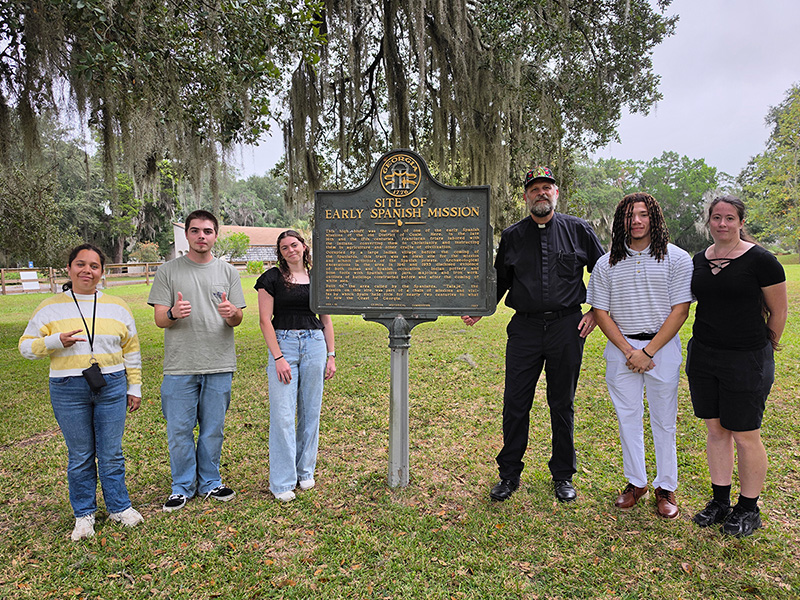
 Deacon Matthew Newsome took a group of students from Western Carolina University to the beatification Mass of the Georgia Martyrs in Savannah. The group then went to the Church of the Nativity of Our Lord in Darien, Georgia. After the beatification, they were among the first to pray at the shrine where the first of the martyrs was slain. (Photos provided)
CHARLOTTE — Halloween was a unique one for me this year: I was able to usher in the celebration of All Saints Day by participating in the Oct. 31 beatification Mass of Blessed Pedro de Corpa and companions, otherwise known as the Georgia Martyrs.
These Franciscan friars – four priests and one lay brother – came to what is now the Georgia coast in the latter part of the 16th century as part of a larger missionary effort to evangelize the native peoples of what was then called “la Florida.” This Spanish territory included Florida and parts of modern day Louisiana, Mississippi, Alabama, Georgia and the Carolinas. Though not as well-known as the later Franciscan missions in the West, the earlier eastern missions left a significant footprint on the history of religion and culture in the Southeast.
A humble backdrop
Fray Pedro and his fellow friars were part of the ministry to the Guale people who lived along what is now the Georgia coast. They suffered martyrdom after a convert to Christianity named Juanillo, a Guale chieftain, sought permission to marry a second wife. This was common practice among Guale tribal leaders, but, as Fray Pedro explained, not something permitted for Christians. Unwilling to accept this answer, Juanillo struck Blessed Pedro down, sparking a wave of violence resulting in the murders of four other friars and the imprisonment of a fifth, who later escaped to tell the tale.
Their beatification was the first in the Southeast, and only the sixth celebrated on American soil. I was pleased to mark this historic occasion with a group of college students from Western Carolina University, where I have ministered for the past 18 years.
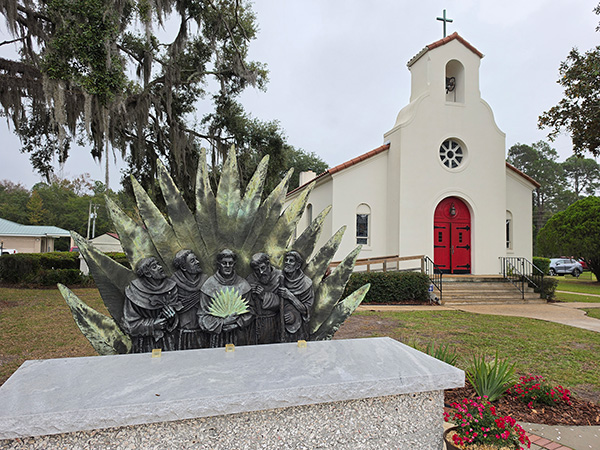
After the beatification Mass, we continued our pilgrimage to Darien, Georgia, to the Franciscan mission of Santa Domingo de Telaje, and where Fray Francisco de Veráscola was killed. There is a shrine to the Georgia Martyrs erected at the Church of the Nativity of Our Lady in Darien where we were able to pray – perhaps the first people to do so in the hours after their beatification.
Compared to other shrines I have visited, this one is humble, consisting of a statue in a garden on the church grounds. There are no traces of the original mission structure to be found. But standing there among the palmettos, live oaks and Spanish moss, I couldn’t help but feel a closeness to the missionaries and the hardships they endured for the sake of the Gospel (see 2 Timothy 1:8).
Unpacking the fruits
As is the case with every pilgrimage, the fruits of the journey don’t show themselves until after the voyage is complete. Unpacking from a pilgrimage means more than emptying your luggage.
It means reflecting on the experience in prayer and meditation.
The day of our return was All Saints Day, the gospel for which is Matthew 5:1-12, where Jesus teaches the Beatitudes. Everything Jesus says about blessedness runs counter to worldly wisdom. The world would count as blessed those who are rich, powerful and influential. Jesus says no – blessed are the poor, meek and persecuted. His description is a revelation of a truth.
The very idea of “beatitude” hit home differently for me after witnessing these five martyrs being raised to the ranks of the blessed.
I found myself wondering in what way Blessed Pedro and his companions exhibited these beatitudes. I’m sure they expressed the beatitudes in many ways in their ministry, but the one that kept coming back to me was their meekness. This may seem counterintuitive to those who extoll their bravery in defense of marriage, but meekness does not equal weakness. If their witness proves anything, it is that true meekness often requires great courage.
When Fray Pedro refused to grant permission for the Guale chieftain Juanillo to take a second wife, it was not out of a prideful refusal to give in to the convert’s request. It was a humble recognition that he had no authority to do so. Fray Pedro knew the Church’s teaching and so did Juanillo – otherwise he would not have sought the dispensation. But the friar was meek before a truth he could not change, whereas Juanillo wanted the truth to bend to his will.
To recognize there is a truth greater than ourselves, even if pretending otherwise would save our lives, is a form of meekness. Fray Pedro’s meekness made him a martyr. His persecution for Christ’s sake made him a saint.
One could say the same about all the beatitudes. It is through spiritual poverty, being peacemakers, hungering for justice, and the gentle endurance of persecution for the sake of Christ that we become blessed. This is what the martyrs see that the world does not. This is the revelation of Jesus Christ. May we all have the courage and the humility of the Georgia Martyrs. Blessed Pedro de Corpa and companions, pray for us.
Deacon Matthew Newsome is the Catholic campus minister at Western Carolina University.
Related story: 'Unconquered heralds of Christ': Georgia Martyrs killed in 1597 for defending marriage beatified in Savannah