


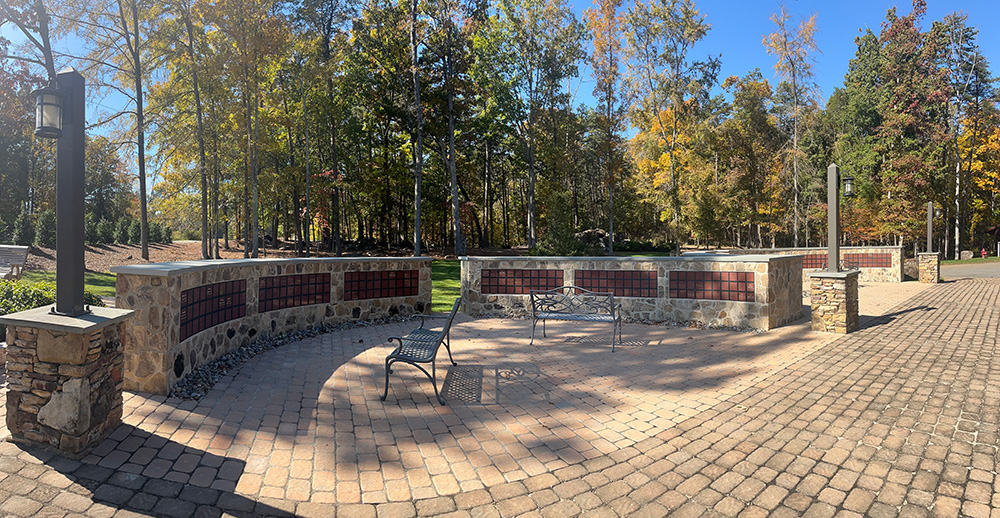
 A new columbarium was added to St. Francis Springs Prayer Center in Stoneville in 2024. (File photo)CHARLOTTE — The Diocese of Charlotte is updating policies for its cemeteries and columbaria in response to growing demand for burial space and limited land available at many parishes.
Bishop Michael Martin, OFM Conv., promulgated the new “Diocesan Norms for the Governance and Stewardship of Cemeteries and Columbaria” on March 19, the feast of St. Joseph, patron of the dying.
The norms update rules for establishing, operating and expanding parish cemeteries, columbaria, and Catholic sections in public or private cemeteries – as well as for potential future cemeteries operated by the diocese. They also set requirements for who is eligible to be interred, ensure perpetual upkeep of sites, and emphasize that burial options should remain affordable.
They replace policies first issued in 2007 and are intended to help the fast-growing diocese better meet the pastoral and practical needs of the faithful seeking Catholic burial.
Diocesan officials say demand has been increasing due to the rising population of Catholics, who want the assurance that a Catholic cemetery or columbarium will be there for them and their loved ones.
“One thing we were hearing from priests is that parishioners were increasingly asking where their loved ones could be laid to rest,” said Monsignor Patrick Winslow, the diocese’s vicar general and chancellor. “Those questions really started reaching a tipping point.”
The Church recommends burial of the body but permits cremation. As available parish land has become more limited, cremation and a reliance on civil cemeteries has increased.
MORE INTERMENT OPPORTUNITIES
Currently, three of the diocese’s 93 parishes have cemeteries and seven have cemeteries with columbaria. Another 21 parishes operate freestanding columbaria, although 10 of those are already full. Catholic burial sections are also designated in civil cemeteries in Albemarle, Charlotte, Clemmons, Cornelius, Huntersville and Matthews.
One of the new policy’s most significant changes removes the limit on the number of columbarium niches to no more than the number of burial plots at the same site.
“The previous formulas tying the number of niches to burial plots are no longer being used,” Monsignor Winslow said. “Instead, we’re allowing need, space and availability to guide the decisions.”
For parishioners and their relatives, the practical effect will likely be greater opportunities for interment options in the years ahead, Monsignor Winslow said.
The new norms reiterate Church teaching that Catholic cemeteries and columbaria are intended primarily for baptized Catholics, yet others may be eligible – including non-Catholic or non-Christian spouses, children or other relatives.
They also outline procedures for acquiring land for new cemeteries or expansions, establishing Catholic sections in civil cemeteries, and managing parish cemetery operations such as record-keeping and financial stewardship.
Parishes with cemeteries or columbaria must establish advisory boards to oversee finances and create perpetual-care endowments to ensure long-term maintenance of the property.
The norms also encourage environmental stewardship, recommending “ecologically ethical” practices such as water-saving irrigation systems. “Green” burials are permitted provided they conform to Catholic teaching.
The norms also create a framework for a possible diocesan cemetery in the future.
SACRED SPACES
Beyond administrative guidelines, the norms reflect Church teaching and emphasize the spiritual significance of Catholic burial.
“Catholic cemeteries/columbaria are extensions of the Church’s ministry – pastoral, liturgical and communal, not merely functional places of burial,” the policy states. “They are places where the faithful come to pray, to grieve, to remember, and to entrust their loved ones to God’s eternal care.”
Cemeteries should be understood as sacred spaces within the life of the Church, Monsignor Winslow said.
“We often think of sacred spaces in terms of churches and chapels,” he said, “but cemeteries are also sacred spaces – outdoor sacred spaces dedicated to the burial of the remains of the people we love and our fellow Christians.”
The norms call for cemeteries and columbaria to be located in prayerful settings and carefully maintained. Grounds, lighting, roads and sidewalks, headstones, statues, crucifixes and shrines should all reflect the dignity of the site.
Parishes are encouraged to offer liturgies and devotional events at cemeteries, such as All Souls’ Day services, to encourage prayer for the deceased.
Father Noah Carter, director of the diocese’s Office for Divine Worship and pastor of a church with both a cemetery and columbarium, was among those who provided input for the new rules.
His parish, Holy Cross in Kernersville, has a cemetery and columbarium with 300 plots and 300 niches, and has plans to expand to 600 of each.
“There’s absolutely interest,” Father Carter said. “Catholics want to be buried in Catholic places, because they know that they’re going to be assured of the prayers for the dead, they’re going to be assured that people are visiting.”
STANDARDIZED POLICY
The new policies standardize what parishes with cemeteries and columbaria were largely doing already, Monsignor Winslow and Father Carter said.
The norms were developed over several years with input from multiple diocesan offices as well as the Presbyteral Council and pastors who operate cemeteries. Diocesan leaders with expertise in Church law, finance, liturgy, real estate and legal matters contributed to the process.
To help parishes implement the new norms, the diocese has created a set of accompanying resources and templates.
“You don’t want to tell a parish, ‘You can run a cemetery now – go figure it out,’” Monsignor Winslow said. “It’s essentially a complete kit for parishes – almost a plug-and-play approach – so they don’t have to reinvent the wheel.”
— Patricia L. Guilfoyle