


If Candlemas Day be fair and bright, winter will have another flight; but if Candlemas Day be clouds and rain, winter is gone and will not come again -Old English Proverb
CHARLOTTE — Icy conditions and snow-covered roads kept Tricia Kent safely at home with her three grandchildren for the first time in 10 years during the St. Thomas-Aquinas Church Candlemas celebration.
For Kent, Groundhog Day takes a backseat to one of her favorite feast days, the Feast of the Presentation of the Lord, also known as Candlemas. Its Feb. 2 date coincides with the rodent’s weather forecast but more importantly marks the end of the 40-day Christmas-Epiphany season.
“I love going to Candlemas. I want to get one of mine blessed so I can have it around the house, but this is the first year I didn’t make it,” Kent said. Instead, she sent her husband Greg.
Kent, a St. Thomas Aquinas parishioner and candle painter, typically spends each Candlemas presenting wax votives she creates to parishioners after they are blessed.
“They descend upon them like locusts,” she joked, “but I always make sure to save some for the children, and the ones who come every year to get one.”
But this year, as Greg handed out her special creations after they were blessed by Father Joseph Yellico, she enjoyed the last day of Christmas lights while placing flowers in the manger.
“This is the last day my last Christmas tree remains lit, and also the day I decorate my manger with spring flowers,” Kent said. “Just a little foreshadowing of what is coming.”
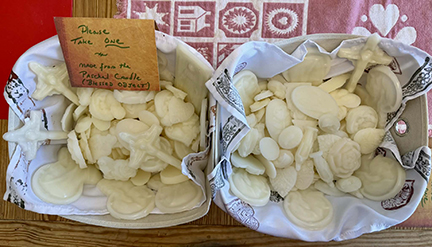
Although she wasn’t physically present at Candlemas, her devotion to the feast day was evident by the wax votives she molded weeks before. Then, she carefully melted the paschal candle and poured its wax into silicone molds to make crucifixes, Our Lady of Guadalupe icons, Our Lady of Grace images, and Jesus and Mary statues.
“People punch holes in the top and then hang them up as Christmas ornaments or hang them in the windows,” she explained.
The size of the leftover candle she has to work “depends on whether it is actually left burning during the entire octave of Easter and how many baptisms and funerals there are,” Kent said.
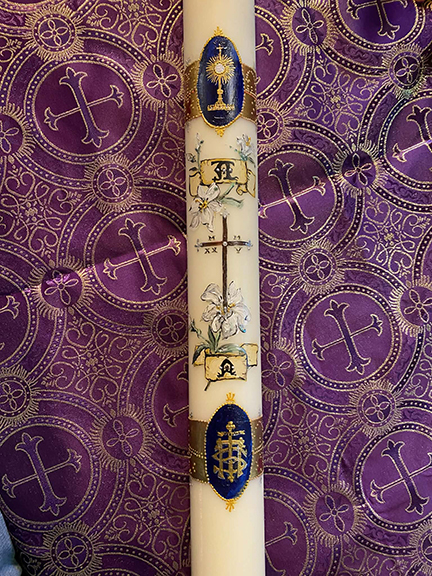 Candlemas is also the day Kent is usually given the new paschal candle to paint in preparation for Easter Vigil Mass, something she has been doing since Monsignor Patrick Winslow and Father Matthew Kauth started purchasing plain white, five-foot beeswax paschal candles.
Kent, a natural painter, asked why they bought blank candles.
After Monsignor Winslow explained how costly decorative paschal candles can be, Kent volunteered to paint and he agreed to pay for the acrylics. Kent still uses that same paint 10 years later to embellish each candle.
“It takes me a couple of weeks to paint, because I have to do it in layers,” Kent said. “This year I may put some music on it.”
Kent does the labor of love for free, but her talent is not much of a secret anymore, being commissioned around the diocese for smaller home shrine candles, baptismal candles, and wedding presents.
Kent, with her background in anthropology and archeology, finds the history of wax in the Catholic Church fascinating.
The idea of redistributing paschal candles in smaller-sized votives came to her after researching a thousand-year-old papal tradition.
Before 1964, major basilicas in Rome used to bring their candles to the Vatican, where they were made into oval wax medallions called Agnus Dei, Latin for “Lamb of God,” and consecrated by the pope.
“Traditionally, this was done every seven years,” Kent said. “The pope and the archdeacon of Rome would get together on Low Saturday or during Holy Week Wednesday and would melt down all the paschal candles from the Diocese of Rome, add chrism oil and balsam scent, and mold them into shapes, with the lamb on one side.”
The consecrated, sacramental wax pieces were used for protection against storms, fires, and floods and to ensure safety during pregnancy.
Although the tradition died almost half a century ago, individual churches with parishioners, like Kent, keep the tradition alive.
Kent also credits her Polish ancestry with her affinity for all things beeswax. In Poland, when children are baptized, they receive a very large, lifelong candle called “Gromnica.”
“They are called thunder candles because they would traditionally come out to the windowsill during thunderstorms,” Kent said.
The Polish candle is ceremoniously carried each year to Candlemas for the feast of Matka Boska Gromniczna (Mother of God of the Blessed Thunder). As legend has it, if the small candle remains lit and shielded from the winter wind and rain, the family will have no misfortune in the year ahead. Polish tradition finishes the Epiphany blessing by sealing doorways and windows with a soot cross from their blessed Candlemas candle.
The candle travels with the family for all special sacraments, including Holy Communion. According to Polish tradition, people would light it as a reminder of God's love as they asked Him for protaction during storms.
—Lisa M. Geraci