


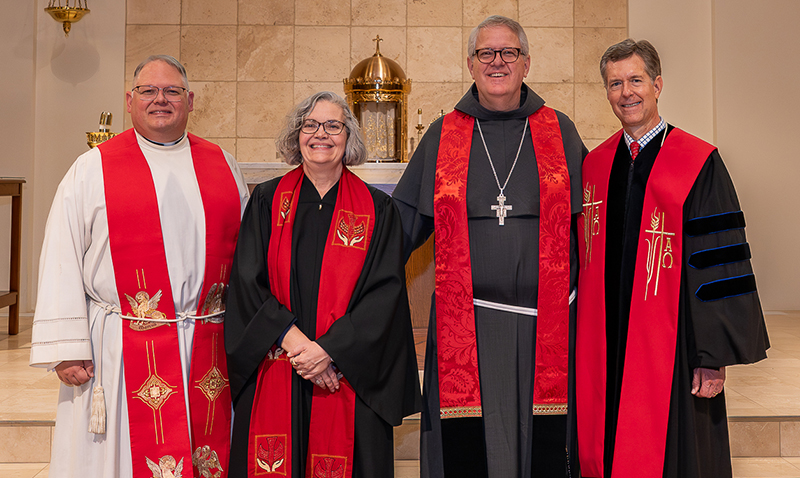
MINT HILL — “‘One body, one Spirit…one Lord, one God and Father of all,’” echoed Bishop Michael Martin at an ecumenical gathering held to observe the Week of Prayer for Christian Unity.
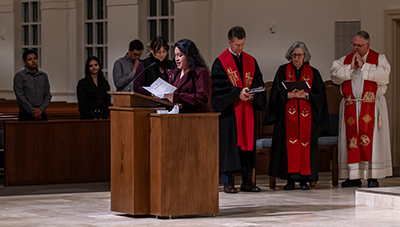
The Jan. 20 “Service of Ecumenical Friendship” at St. Luke Church featured songs, scripture and spoken word – all aimed at fostering understanding, reflecting on shared values, and building friendships.
The Week of Prayer for Christian Unity has its roots more than a century ago with Pope (now St.) Pius X. The eight-day global commemoration, always held Jan.18-25, is organized through the Vatican’s Dicastery for Promoting Christian Unity and the World Council of Churches. This year’s celebration focuses on St. Paul’s letter to the Ephesians: “There is one body and one Spirit, just as you were called to the one hope of your calling” (Eph 4:4).
The local prayer service, organized by the Diocese of Charlotte’s ecumenical officer, Father Benjamin Roberts, featured talks by Charlotte-area religious leaders on what ecumenism looks like today.
Father Roberts, the Rev. Dr. Steven Harmon, co-secretary for the Baptist-Roman Catholic Dialogue – Phase III, and the Rev. LeDayne McLeese Polaski, executive director of the Mecklenburg Metropolitan Interfaith Network (MeckMIN), reflected on three common methods of promoting conversations and connections among the Christian faiths: official ecumenism, practical ecumenism and spiritual ecumenism.
What is ecumenism?
Ecumenism is the effort to foster unity and cooperation among Christian faiths. From a Greek word meaning “the whole inhabited world,” it seeks to bridge divisions among Catholics, Protestants and Orthodox through dialogue, shared prayer and collaboration on shared goals like helping the poor.
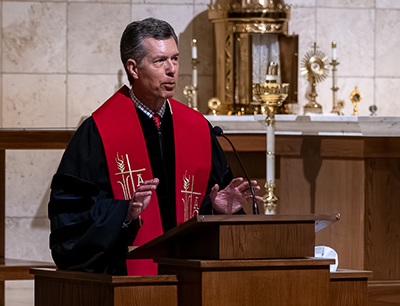 The Rev. Steven Harmon
Official ecumenism: “There is one body and one Spirit, just as you were called to one hope …” (Eph 4:4)
Official ecumenism centers on doctrinal consensus gained from over a century of faith-based dialogue. The Rev. Steven Harmon, a Baptist minister and professor of historical theology at Gardner-Webb University, explained this history, which rooted itself in 1910 through the Faith and Order Movement, later paving the way to form the World Council of Churches in 1948.
He went on to highlight the current Baptist-Catholic International Dialogue between the Vatican and the Baptist World Alliance, of which he is an active participant.
“It would be difficult to imagine a more seemingly polarized pair of ecumenical dialogue partners than Baptists and Catholics, at least according to the stereotypes,” he said.
Yet these international dialogues, which began in 1984, have yielded meaningful agreement on key Christian beliefs, Harmon said, including: “God’s saving revelation in Jesus Christ, the necessity of personal commitment to God in Christ, the ongoing work of the Holy Spirit, and the missionary imperative that emerges with God’s redemptive activity on behalf of humankind.”
A 100-page consensus report, drafted in 2023, highlights where beliefs held by the Catholic Church and the Baptist denomination converge. Though the draft is still being reviewed before official approval, it reiterates the intent of witnessing together, Harmon said.
To make a real difference, though, these reports and shared statements need to move to the grassroots level where Christians can work together and act visibly, he said.
“If our two communions can find ways forward toward visible forms of community, then there is generous space for yet other Christian communions to envision places within our Baptist-Catholic convergences," Harmon said.
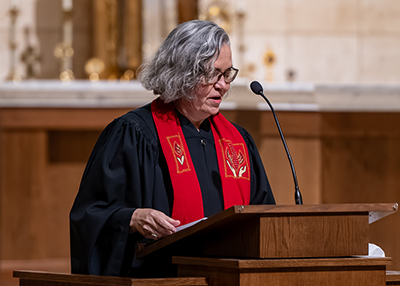 The Rev. LeDayne McLeese PolaskiPractical ecumenism: “...to equip his people for works of service, so that the body of Christ may be built up ...” (Eph 4:12)
The Rev. LeDayne McLeese Polaski, also a Baptist pastor, spoke about practical ecumenism.
What does that look like? Polaski described this scenario: “A heavy-handed government occupies the city. Armed men are everywhere, and their word is law. Paranoid officials stoke cultural resentment. They ruthlessly target anyone standing against them.”
That described the situation Jesus and His disciples faced 2,000 years ago, Polaski said. Yet despite that and knowing of His impending Passion and death, Jesus told His disciples to love one another as He loved them, she said.
“‘I have made all known to you. Therefore, I call you friends,’” Polaski paraphrased from the Last Supper discourse in the Gospel of John. Then she posed this question to attendees: “Could knowing be the key to friendship, which is the key to love?”
Through her experiences as executive director of MeckMIN, Polaski said, she has learned that knowing does make a difference.
In March 2020, when the COVID-19 pandemic hit, Polaski and her team of interreligious leaders sat through video conferencing calls, determined to help those marginalized by the crisis. They started with distributing coins for laundry machines, finding homes for the unhoused, and giving resources to people in need. Then when the pandemic ended, they kept going – expanding their efforts to address other unmet needs around Mecklenburg County and later helping victims of Tropical Storm Helene. Now, they are helping immigrants navigate the uncertainty of the current political climate.
Just like Jesus and despite denominational nuances – and called to imitate God's love through advocacy, social justice and disaster relief – they found a way to truly walk ecumenically through faith and action, Polaski said.
“It’s not magic. Just as in the day of Jesus and the disciples, betrayals, denials, arrests and even crucifixion still take place,” she said. “Still, He turns around and says, ‘I call you friends.’ In the midst of a very scary world in a very scary time, He still calls us to know and be known, to love and be loved, to lay down our lives for one another. And, in the end, what else is there to say except this: Brothers and sisters, let us be friends.”
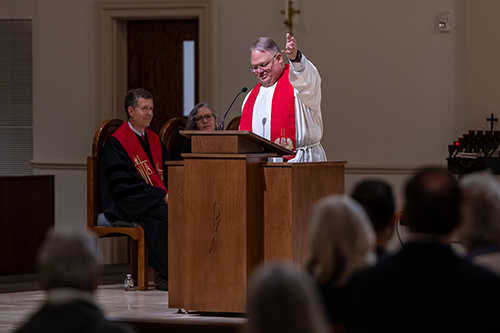 Father Benjamin RobertsSpiritual ecumenism: “Be completely humble and gentle; be patient, bearing with one another in love.” (Eph 4:2)
Father Roberts, a former Lutheran who converted to Catholicism and now serves as the diocese’s ecumenical officer, spoke about the importance of continuing faith journeys together.
Father Roberts recounted to attendees what he learned at the Summer Course in Ecumenism and Interreligious Dialogue at the Centro Pro Unione in Rome. The experience gave him a deeper understanding of spiritual ecumenism, he said.
He recalled with a smile, “Standing in St. Peter’s Square, facing that magnificent basilica, the Lutheran pastor and the Anglican bishop (fellow retreat participants) both put their hands on my shoulders, pointed to the basilica, and said, ‘Well, Benjamin, at least you all did something nice with the money.’
“Only people who have studied together, have prayed together, and have eaten together can joke about such serious matters,” he said. “It is something only friends can do.”
Fostering friendship among Christians is something the Catholic Church – and individual Catholics in the pews – are called to do, Father Roberts said.
That call was reiterated during the Second Vatican Council, in its 1964 decree “Unitatis Redintegratio” (“Restoration of Unity”), he said. In it the Church called for spiritual ecumenism – a personal commitment to unity that is lived by making an effort to live holier lives according to the Gospel, having a “change of heart,” and praying both publicly and privately.
“We should pray to the Holy Spirit for the grace to be genuinely self-denying, humble, gentle in the service of others, and have an attitude of brotherly generosity,” Father Roberts said.
Spiritual ecumenism does not require an official letter or plan to follow, he said. It is available to all, and Father Roberts suggested people start by deepening their commitment to their relationship with Jesus Christ, reading the scriptures, coming to the Lord in prayer, and joining in the worship of the Church.
“You are already participating,” he told attendees.
“Spiritual ecumenism calls us to look within to our own conversion and growth, to look around to enjoy the witness of friendship, and to look ahead to that place enjoyed by the martyrs and the holy ones where unity has already been accomplished in God’s Kingdom,” he said.
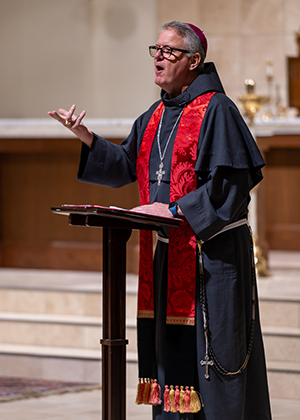 Bishop Michael Martin, OFM Conv.Call to action
Bishop Martin concluded the ecumenical service with prayer, taking the opportunity to warn people against sowing division – especially in their everyday conversations and social media activity.
“We scroll each and every day on our phones…that we think connect us to one another,” the bishop said. “Let’s not forget, it is in those spaces where it is much easier to pit us one against the other. To situate us in two camps, us and them. And it is in that framing of the world’s reality that evil triumphs and Christ – His message of true friendship – is missed.”
— Lisa M. Geraci