



Helene day by day
Helene left a path of destruction across the hemisphere. Follow the path of the storm from its origins over Honduras through Western North Carolina.
Sept. 20-22, 2024
Over Honduras and Nicaragua, a sprawling low-pressure system drenches the land before turning north. It’s slow and broad, not yet a tropical cyclone, but the National Hurricane Center expects it will be soon.
Monday, Sept. 23, 2024
The system moves into the northwest Caribbean, and a center begins to form.
Tuesday, Sept. 24, 2024
Near Cuba’s western tip, it becomes Tropical Storm Helene, with winds topping 45 mph.
Wednesday, Sept. 25, 2024
- Crossing Cozumel and Cancun, Helene enters the Gulf and strengthens into a Category 1 hurricane.
- In Asheville, heavy rain has already dropped 4 inches by midnight as a line of slow-moving showers saturates the ground.
- Based on forecasts, N.C. Gov. Roy Cooper declares a state of emergency.
Thursday, Sept. 26, 2024
- Helene rapidly intensifies over warm Gulf waters, becoming a Category 4 hurricane with 140-mph winds and making landfall near Perry, Florida, at 11:10 p.m. – the strongest strike in 125 years of recordkeeping.
- Meanwhile, a stalled stormfront dumps more rain all day in western North Carolina: 9 inches in Yancey County alone. Power fails in Chimney Rock and Lake Lure, and shelters open in Avery, Buncombe and McDowell counties. And the rains are just beginning.
Friday, Sept. 27, 2024
- Though weakened to a tropical storm, Helene speeds across Georgia toward the Carolinas. In Rome, newly ordained Bishop Michael Martin keeps up with forecasts as half his diocese lies in her path.
- Helene’s gusty winds and heavy rains uproot trees, overload saturated ground and trigger landslides. Rivers including the Watauga, Pigeon, North Toe and French Broad swell past flood stage; downstream systems like the Catawba also face severe flooding. In Asheville, the Swannanoa River surges to a record 27.33 feet within hours.
- Low-lying areas – in which so many communities sit – fill up. Fast. Riverside homes, businesses and vehicles wash completely away. Stranded residents will soon need to be pulled to safety by helicopters, boats, kayaks and canoes.
- Two St. Margaret Mary parishioners are swept away by the swollen Swannanoa but, after harrowing moments, are fortunate to survive. Gabriel Gonzales, an Asheville area parishioner also caught by the river’s current, goes missing and is later found dead.
- In Asheville, Biltmore Village floods – including a hotel complex where Catholic Charities refugees live. Catholic Charities staffer Noele Aabye narrowly escapes a tree falling on her own house before helping to rescue the refugees and relocating them to Charlotte.
- A wall of water rockets down the Broad River, overtops Lake Lure Dam and obliterates Chimney Rock. “The village? There’s just nothing left,” an emergency manager later says.
- Mudslides take out roads including stretches of I-40, severing access to much of western North Carolina and isolating victims from rescuers. Electricity, water, phone and internet are out across the region.
- Helene dumps up to 2 feet of rain and spawns six tornadoes before shifting northwest into Tennessee and Kentucky.
- Local officials describe “biblical devastation.” Calls and texts for help begin reaching diocesan leaders back east.
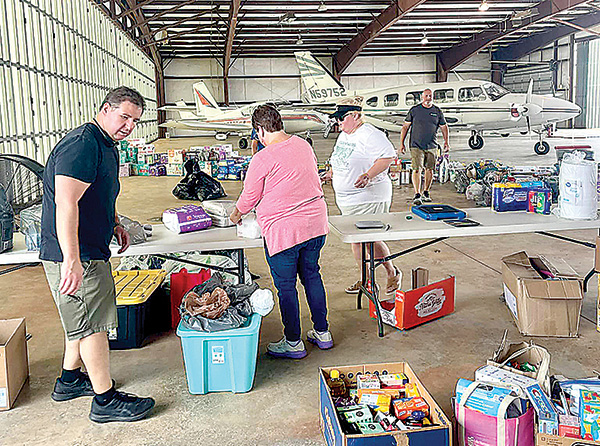 Parishioners from St. Mark Church in Huntersville drove donated supplies to the Statesville airport to be airlifted to the hardest-hit regions just hours after the storm had passed.
Saturday, Sept. 28, 2024
- Western North Carolina reels. Gov. Cooper calls it “one of the worst storms in modern history” for parts of the state: dozens of people dead and hundreds more missing, 400 roads closed or washed away, riverside business districts and neighborhoods devastated. President Joe Biden declares much of Western North Carolina a federal major disaster area, triggering FEMA help.
- Despite no electricity, Father Pat Cahill celebrates the vigil Mass by candlelight at St. Eugene in Asheville, offering prayer and solace to those able to make it in.
- Western Regional Director Jesse Boeckermann and the whole Catholic Charities team go into overdrive – including colleagues in Asheville whose own homes were severely damaged by the storm.
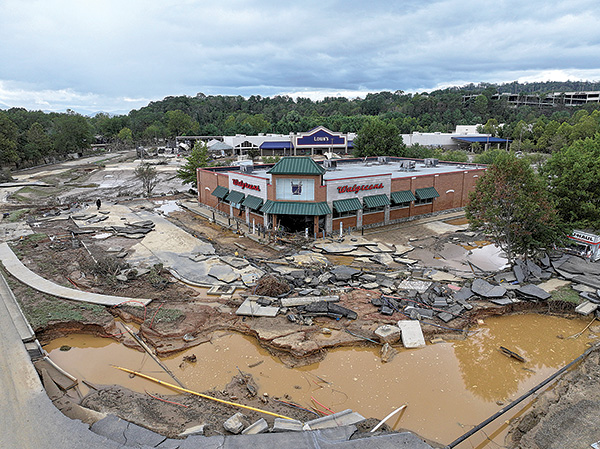 A drone view shows the scale of damage in one section of Asheville Sept. 29, 2024, after Tropical Storm Helene.
Sunday, Sept. 29, 2024
- Duke Energy outage maps report 396,000 customers in North Carolina and 508,000 in South Carolina without electricity.
- Immaculata Catholic School’s Principal Margaret Beale is finally able to call through to Dan Ward at the diocese’s Properties Office. “There is damage everywhere. Trees are down. Houses and roads are washed away. There is no power – and no water,” she tells Ward. He later recalls, “It wasn’t just what she said – it was how she said it.”
n Bishop Martin prepares to return early from Rome and, with Monsignor Patrick Winslow already leading on the ground in Charlotte, directs pastors, Catholic Charities and the faithful to “get people what they need – now.” - Over half the diocese lies within the federal disaster zone, including 20 churches directly impacted. Built on high ground, the church buildings are mostly unscathed although have no power or water. Over the coming days, many are converted into emergency aid centers.
- In Huntersville, some 400 St. Mark parishioners and others rush supplies of diapers, nonperishable goods and water to Hendersonville and Waynesville. Joining St. Mark, St. Gabriel, St. James in Concord, St. Matthew and other Charlotte-area parishes spin up additional relief efforts.
- Diocesan staff and Catholic Charities start marshaling donations of food and water at the Diocesan Pastoral Center. By Sunday afternoon, a truckload of bottled water arrives at Immaculata Catholic School, where Beale and others have set up a relief supply hub in the gym despite the school suffering storm damage of its own.
- Over the next five weeks, volunteers deliver 67 trucks carrying more than 480,000 pounds of supplies from the Diocesan Pastoral Center alone – the largest humanitarian relief effort in the diocese’s history.
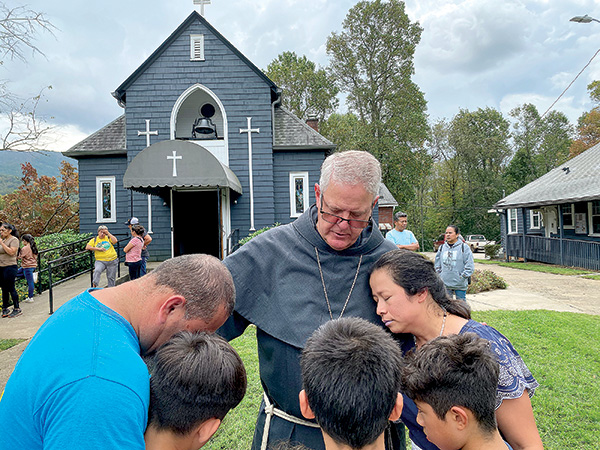 Bishop Michael Martin prays with people Oct. 4, 2024, outside St. Margaret Mary Church in Swannanoa.
Monday, Sept. 30, 2024
The diocese and Catholic Charities launch a Helene Relief Fund for online donations, eventually raising $13.3 million from more than 10,200 donors in every U.S. state as well as six other countries.
Tuesday, Oct. 1, 2024
- Buncombe County’s sheriff confirms 43 deaths in his county – the most of any community hit by Helene.
- Catholic Charities USA dispatches several tractor-trailer loads of water to Western North Carolina, sends an initial $1 million for immediate disaster relief, and begins helping Catholic Charities Diocese of Charlotte coordinate with sister agencies in Raleigh, Virginia, Louisiana and elsewhere to start scaling up for long-term aid work. CCUSA will eventually donate another $2.2 million.
Wednesday, Oct. 2, 2024
- More than 350,000 North Carolinians remain without power, as search-and-rescue efforts and supply airlifts continue. Diocesan trucks funnel supplies up to Immaculata Catholic School and other drop sites as those who can get out of the mountains fill vehicles and ATVs one at a time to carry back to their more remote or trapped neighbors.
- Starting with a delivery from the diocese, St. Margaret Mary Church begins handing out food, water, diapers and other necessities in a community relief effort that will go on for months. Similar aid hubs are busy at churches in Mars Hill, Brevard, Asheville, Waynesville, Spruce Pine and elsewhere.
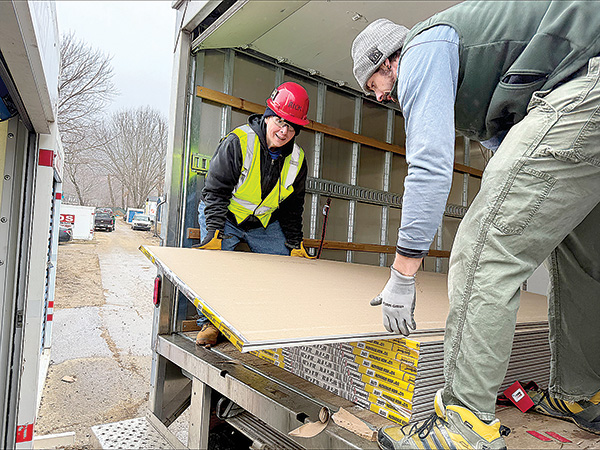 Catholic Charities formed relationships with community partners to help rebuild houses. Supply chains in many areas are still far from normal.
Friday, Oct. 4, 2024
Bishop Martin visits the aid hubs at Immaculata in Hendersonville and St. Margaret Mary in Swannanoa, delivering more supplies from Charlotte and telling people “you are not alone.”
Sunday, Oct. 6, 2024
The first weekend after the storm, churches across the diocese take up a special collection to help affected parishes and fund Catholic Charities’ initial aid efforts. Churches in the storm-hit region offer Sunday Masses as usual despite no electricity.
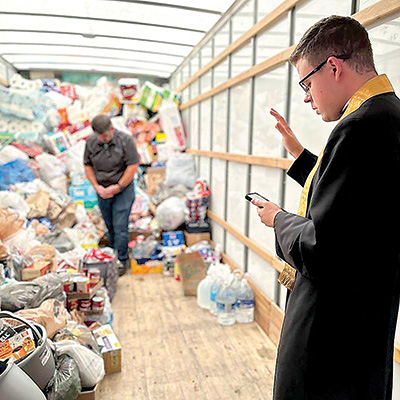 Priests blessed supplies headed toward the mountains in the early days, and continued to provide spiritual and financial support to those impacted.
Tuesday, Oct. 8, 2024
- Catholic Charities serves more than 10,000 people at its distribution sites in the first two weeks, including mobile deliveries and home check-ins. Forty-seven tons of supplies are given out and 5,000 hot meals are provided. The agency secures warehouse space through a partnership with the Knights of Columbus and continues to receive supplies for the affected areas.
- Over the coming months, Catholic Charities adds 12 disaster case workers to its existing team in Western North Carolina to survey storm damage and start organizing long-term recovery work. With 20 staff focused on Helene relief efforts, the agency connects with 400 people by Nov. 1 to start providing help.
Thursday, Oct. 10, 2024
The Sister Parish program launches, pairing 31 unimpacted parishes with 21 WNC churches in need of long-term financial and spiritual support.
Wednesday, Oct. 16, 2024
Classes resume at Immaculata Catholic School, thanks in part to clean-up help from Charlotte Catholic High School students. Students and staff from Asheville Catholic School briefly share the school with them until the city’s water system can be restored and their school building can reopen.
Saturday, Nov. 2, 2024
Instead of going on retreat, Campus Ministry students go to Asheville to help out with relief efforts.
Tuesday, Nov. 19, 2024
Bishop Martin returns to Immaculata Catholic School and the region to survey recovery efforts.
Tuesday, Dec. 31, 2024
Second collections taken up by parishes raise $466,954 for the Sister Parish program.
March 19, 2025
In total, says a National Hurricane Center report released this day, 250 people died because of Helene, counting direct and indirect deaths along her more-than-500-mile path. In North Carolina, the storm kills more than 100 people and causes damages exceeding $44 billion.
March 27, 2025
In the first six months, Catholic Charities spends $5.1 million of the Helene Relief Fund to provide direct assistance to 1,162 households and rebuild 53 homes, with another $5 million committed to rebuild more homes and handle case management and $2.2 million set aside for long-term recovery.
March 28, 2025
While clearing debris in Avery County, workers find the remains of Russell Wilber – bringing North Carolina’s death toll from Helene to 108. The Raleigh News & Observer reports five people remain missing.
March 29, 2025
Following Catholic Charities rebuilding work, Allen Campos Trailer Park in Swannanoa holds a reopening celebration as residents begin moving back into rebuilt homes.
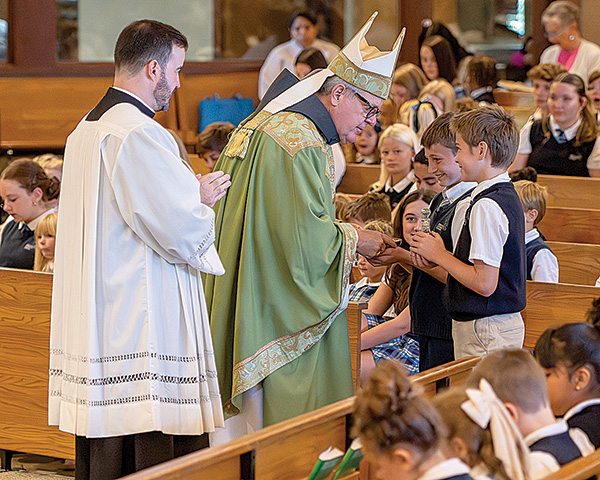 Bishop Michael Martin visited with students at Asheville Catholic School Sept. 12 to start the school year, offer Mass for the school community, and learn more about how Helene continues to impact them one year later.
Sept. 27, 2025
At the one-year mark, the long work of rebuilding lives and the region’s economy continues.
More online
One year later, Helene’s survivors still feel the pain, but walk forward in faith. Read more.
Learn how donations and prayers are helping rebuild and restore Western North Carolina.
Helene by the numbers
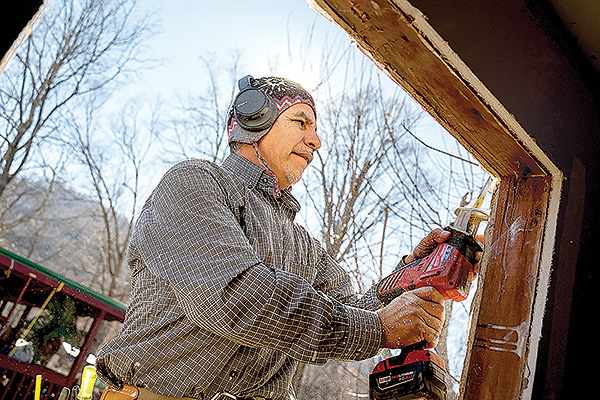
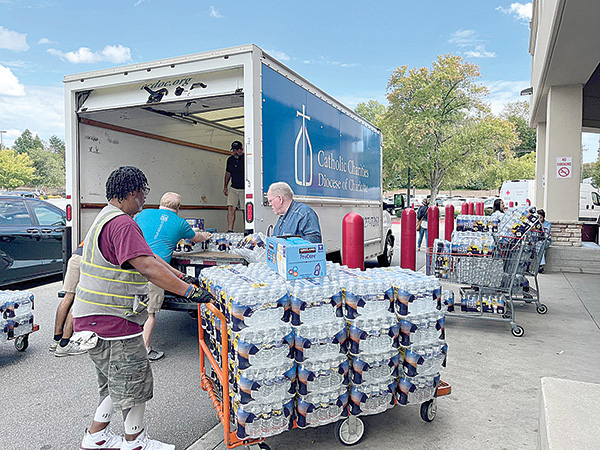 Catholic Charities Diocese of Charlotte and parishes swung into action immediately (above left) delivering water and supplies to distribution centers and then over the long term by working to rebuild homes damaged by the storm.
Helene’s impact
25 North Carolina counties declared federal disaster areas
4.1 million people in disaster zones
1 in 5 Catholics in the Diocese of Charlotte impacted
73,000 damaged homes
6,900+ roads and bridges destroyed
$44.4 billion in direct damage, billions more in economic impact
The response*
$13.3 million raised for Catholic Charities Diocese of Charlotte
10,263 gifts from 5 continents and all 50 states
$1.1 million from parish second collections in the Diocese of Charlotte
1,000+ volunteers
46 schools held emergency supply drives
1,700+ households received support, including 289 months of rent paid, 20 vehicles, 17 burials paid for
110 homes rebuilt and 35 more under contract
$10,386,781 expected to be spent by end of 2025-2026 fiscal year, with balance funding future long-term needs
$250,000 committed to the economic redevelopment of the River Arts District
*as of July 30, 2025