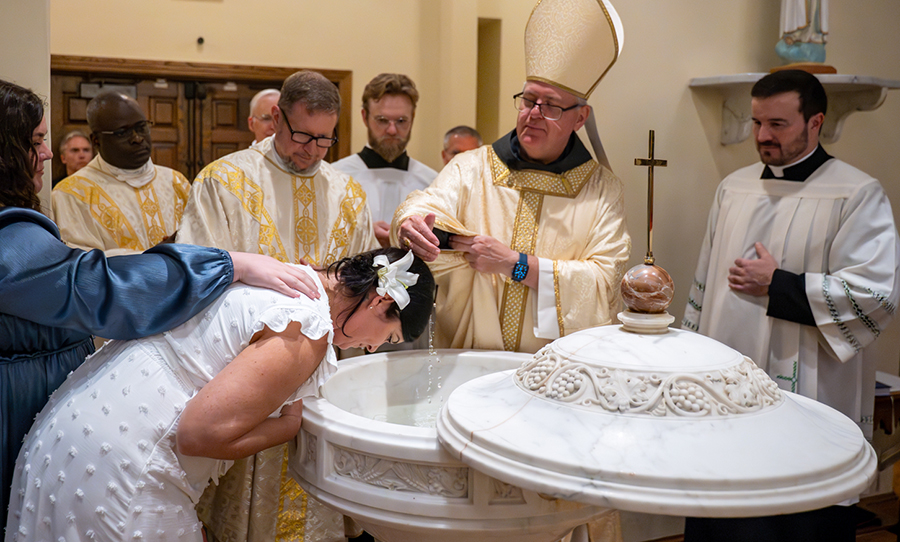
 Holy Saturday is also known as Great (or Grand) Saturday, the Angelic Night, and the Easter Vigil. It is not like Maundy Thursday, a day of joy, but one of joy and sadness intermingled; it is the close of the penitential season of Lent, and the beginning of paschal time, which is one of rejoicing. Its essential feature is the baptism of the catechumens, who have been preparing during Lent to enter the Church.
The Easter Vigil opens with the blessing of the paschal fire and the lighting of lamps and the paschal candle. St. Cyril of Jerusalem said this night was as bright as day, and Emperor Constantine in Rome added unprecedented splendor with a profusion of lamps and enormous torches, so that not only churches, but houses, streets and squares were ablaze with light symbolic of the Risen Christ.
The Holy Saturday ceremony has lost much of the significance it enjoyed in the early Christian centuries, owing to the irresistible tendency to celebrate it earlier in the evening. Originally it was held only in the late hours of Saturday and barely ending before midnight. To this day, however, the brevity of the Easter Mass preserves a memorial of the fatigue of that "watch-night" that ended the austerities of Lent.
Finally, the Vigil Mass, with its joyous "Gloria," at which the bells are again rung, the uncovering of the veiled statues and pictures, and the triumphant "Alleluias," which mark nearly every step of the liturgy, proclaim the Resurrection of Our Lord Jesus Christ.