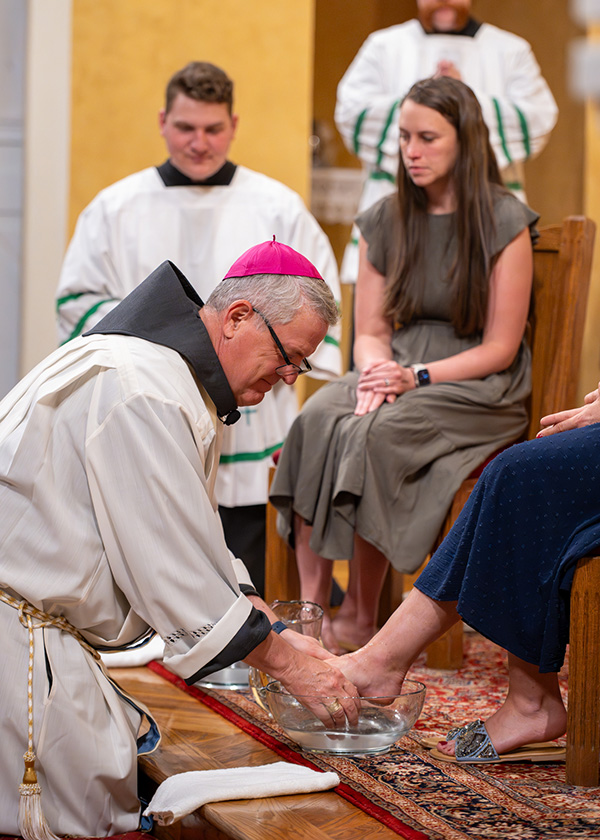
 The oldest of the Holy Week observances, this day commemorates the institution of the Eucharist. Holy Thursday consists of a succession of joyful ceremonies: reconciliation of penitents, consecration of the holy oils (the "Missa chrismalis," or "Chrism Mass"), washing of the feet ("pedilavium"), and commemoration of the Eucharist.
"Maundy" derives from "Mandatum" (the first word of the Office of the Washing of the Feet). This marks the central rite of the day.
On that day Mass and Communion typically followed the evening meal. In the early Church in Rome, everything was carried on in daylight, whereas in Africa on Holy Thursday the Eucharist was celebrated after the evening meal, in view of more exact conformity with the circumstances of the Last Supper. This early tradition survives to the present time in that the clergy do not offer Mass privately but are directed to Communicate together at the public Mass, like guests at one table.
Also on Holy Thursday the ringing of bells ceases until the Easter Vigil, the altar is stripped, and candles remain unlit – outwardly demonstrating the sense of the Church's bereavement during the time of Christ's Passion and burial. The observance of silence during these three days dates at least from the eighth century.