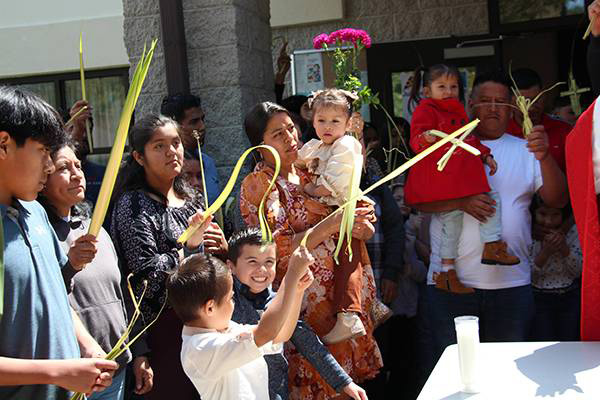
 Palm Sunday procession at Holy Angels Church in Mount Airy. (File phoot)The sixth and last Sunday of Lent and beginning of Holy Week commemorates Jesus' entry into Jerusalem. The main ceremonies are the benediction of the palms, the procession, the Mass and the singing of the Passion.
The blessing of palms and the Palm Sunday procession date back to the earliest Church in Jerusalem. Palm branches have always been symbols of joy and victory, and in Christianity, as a sign of victory over the flesh and the world according to Psalm 91:13, "Justus ut palma florebit." The blessed palms are taken home by the faithful and used as a sacramental. Blessed palms are also burned to make ashes for the next year's Ash Wednesday.
Every great feast was in some way a remembrance of the resurrection of Christ and was called "Pascha." "Pascha" really comes from a Hebrew word meaning "passage" (of the destroying angel at Passover), but the Greeks took it to be identical with "paschein" ("to suffer"). From the custom of also blessing flowers and entwining them among the palms arose the term "Dominica Florida," or "Flower Sunday." One notable bit of trivia: Related terms are "Pascha floridum," or "Pascua florida" in Spanish – and it was from this Spanish term for Palm Sunday that Florida received its name on that day in 1512.
The Gospel of the Passion is also read during the Palm Sunday Mass. As on Good Friday, and on the Tuesday and the Wednesday of Holy Week, the Passion is sung by three deacons who impersonate respectively the Evangelist ("Chronista"), Jesus, and the other speakers ("Synagoga"). This division of the Passion among three characters is very ancient, and it is even indicated by rubrical notes in early manuscripts of the Gospel.