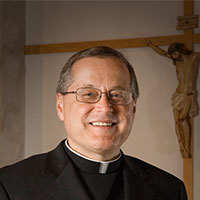
Nigerian-born Father Victor Ameh now pastors St. Joseph Parish in Bryson City and its Our Lady of Guadalupe Mission in Cherokee.Nov. 24: Father Victor Ameh begins new spiritual journey in Bryson City and CherokeeBRYSON CITY — Becoming a pastor has definitely been a learning experience for Father Victor Ameh.
Not only was the Nigerian-born priest taking on the role of pastor for the first time – he also was assigned to a parish and a region he was completely unfamiliar with.
Previously, Father Ameh worked in parishes in Nigeria and New York as both a priest and missionary. He arrived in the Diocese of Charlotte in 2024 and served as parish administrator at Our Lady of the Assumption Parish in Charlotte since February. Now, he’s left the diocese’s biggest city and settled in the North Carolina mountains, where he’ll pastor St. Joseph Parish in Bryson City and its Our Lady of Guadalupe Mission in Cherokee.
He recently reflected on his new assignment:
Father AmehCNH: What does it mean to you to become a pastor?
Father Ameh: When the letter came from the bishop that I was assigned as pastor to St. Joseph’s in Bryson City and a mission church at Cherokee, I was excited on the one hand, having been made a pastor, but on the other hand, I had no idea where Bryson City or Cherokee were – and what kind of people I was going to serve. A friend of mine, after looking it up on the internet, told me it was in the mountains. I was somewhat convinced that God has an interesting story to tell with me. Friends, I am not kidding you, it was a three-hour drive from where I was living at the time in Charlotte.
CNH: How have your earlier assignments helped you in your new role?
Father Ameh: I have worked as an associate to pastors who embody the spirit of dedication, passion for ministry and inspiration. From my years in the seminary and from the pastors I had earlier worked with, I had learned the role of a pastor is that of being all things to all people, as St. Paul rightly put it (1 Cor. 19:19-23). As administrator at Our Lady of the Assumption, many of the decisions about shepherding lay on my shoulders. Amazingly, that provided me with much opportunity for personal and professional growth.
CNH: How have your first few weeks as pastor been going?
Father Ameh: My first Sunday in church was deeply significant, as those who came to church wondered how I managed to speak good and clear English. I knew firsthand that I had inherited a very welcoming community. I received a warm welcome from the congregation, with members eager to introduce themselves, share their stories and to hear mine afterwards. Becoming part of this community and forming new relationships with the different families in the parish has been a source of inspiration, joy and support. Also, listening to the parishioners has been crucial. Understanding their needs, concerns and desires helped me build trust with the community. I intentionally used my first few weeks to learn about the church’s history, traditions and mission as a small unit within the collective body of the universal Church. Understanding the community’s needs and dynamics has been key in my ministry to them thus far.
CNH: What have you learned so far?
Father Ameh: I have learned the People of God are good everywhere and truly seek God with a sincere heart, irrespective of their race, background and social class. I have also created time within my weekly schedule for pastoral care for the sick in their homes and hospitals, providing members of my parish family with significant support in the Eucharist. I soon came to learn that ministry often requires adaptability – being prepared to adjust to plans and respond to unexpected challenges.
My role has required dedication, compassion and a commitment to serving Catholics and others within my parish geographical territory, Christians and non-Christians alike. Thanks to some of my parishioners who have been constructive in their feedback, I have been open to learning from both my successes and mistakes.
CNH: What challenges have you faced?
Father Ameh: Becoming a pastor has its own challenges. The first challenge that confronted me was trying to fit into the shoes of the previous pastor, who had worked passionately for and with the people for many years. I understand that my personality and style of shepherding may differ from his. Secondly, I am tasked with the responsibility of forming a parish council that can oversee the life and administration of the parish. Thirdly, because of our small size, the parish has no administrative personnel, so I have to be the pastor, secretary and catechist, to mention but a few roles. Nevertheless, I am optimistic that things will gradually fall in place as I look into the future with hope and with wonderful people here to give me all the helping hands I need.
CNH: Do you have a devotion to a particular saint that helps you with your ministry?
Father Ameh: I have developed a loving relationship with three saints who are very dear to my heart: Mary, Mother of God; St. Joseph; and St. John Paul II. Perhaps the reason for choosing the first two may be obvious, since both were guardians of Jesus – and my biological mother and father also go by these names. As a student under formation many years back in the seminary, I fell in love with St. John Paul II and his writings. His understanding of the priesthood and of personhood has greatly shaped who I have become today. He believed that the priesthood is a mystery, and that of service to God’s people, bringing the love and strength of Christ to them.
— Christina Lee Knauss
Bishop Michael Martin will formally install these first-time pastors during special Masses in the coming weeks. Meet the others.
HUNTERSVILLE — Seven men heard the call to bring Christ to the world and to always “err on the side of mercy” as they were ordained priests for the Diocese of Charlotte by its new bishop on Saturday, June 15.
The new priests are Father Matthew Dimock, Father Christian Goduti, Father Matthew Harrison, Father Kevin Martinez, Father José Palma Torres, Father Elliott Suttle and Father Kevin Tran.
It was one of the largest-ever classes to be ordained at one time – evidence of the diocese’s strong commitment to vocations – and it was Bishop Michael Martin’s first-ever priest ordination.
About 2,000 people – including family and friends of the new priests – turned out for the Mass, filling the pews at St. Mark Church in Huntersville and overflowing to the parish hall.
At the start of the ordination rite, the seven men stood in front of Bishop Martin and declared their willingness to be ordained and take on the duties of the priesthood.
This was followed by Bishop Martin’s stirring homily. Infused with humor, it focused on the multiple roles the seven would fill through their priesthood and how hungry the world is for their ministry.
“Your role is to take the good news to the world, not just to wait for the world to come to you,” Bishop Martin said. “We know that the heart of the good news is the message of Jesus Christ…and how that gets understood becomes dependent on the seven of you, how your voice will be a prophetic one in a world of many, many voices. You have to be men who go out into the world and show that there is a greater good that can only be found in Christ.”
The bishop said some of their most important moments as priests will come in their service to people in crisis.
“To be a priest is to be the means by which the world receives the saving grace of our Lord…and we know that for so many people that grace is so beautifully made real in difficult moments,” he said. “You will anoint people who are afraid, people who are dying, people who are at a crossroads in their lives. You will be that grace bearer to our world that is afraid.”
He described the special role the new priests will perform as confessors for the faithful.
“One of the most powerful ways you bring sacramental grace is by being the forgiving ears of Jesus, the forgiving spirit of Jesus,” he said. “You will hear sins…and you will offer grace that all of us know is unique to our Church – because the world hasn’t figured out that only when we bow down before our God and profess our weakness that we’re ever able to become strong.
“When in doubt, err on the side of mercy, because that is the message Jesus came to bring – the mercy of the Father.”
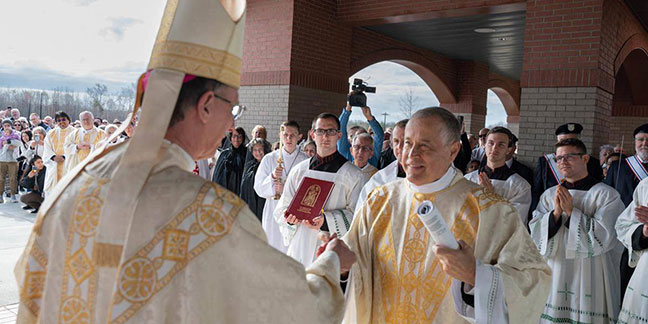
After the homily, the men lay prostrate during the Litany of Supplication. The bishop then laid his hands on their heads and prayed over them. Dozens of priests who attended the ceremony followed and laid hands on them as a symbol of priestly unity.
The seven were then vested with their stole and chasuble by priests who had played meaningful roles in their lives. They were anointed with sacred chrism and received bread and wine as a sign of their ability to offer Holy Mass. They then received the fraternal kiss of peace from Bishop Martin and the other priests in attendance.
At the end of the Mass, Bishop Martin took time to offer tribute to the families who had come out to witness their loved ones become priests.
“The gift of life you’ve given them is also a powerful gift to the Church,” he said. “You made Jesus the center of your lives and doing that bears fruit in lots of great marriages, lots of beautiful single lives, and lots of wonderful priests and people in religious life.”
Family members and friends stood together after the ceremony to reflect on the milestone they had just witnessed.
Father Goduti’s grandparents Fred and Barbara Goduti traveled from Naples, Fla., for the ordination.
“This is evidence of God’s glory,” Fred Goduti said. “We’re so in awe at what Christian has sacrificed for himself and for others to get to this point. What a gift this is! I pray that he’ll always remain a faithful, caring priest who will get us all to heaven.”
Father Kevin Tran’s mother Theresa Tran said, “I’m so honored and happy that God has called him to be a priest – I’m very blessed and our family is blessed.”
Michele Dotson of Mint Hill taught Father Tran English when he was a student at Independence High School. She never imagined that one day she would see him be ordained a priest, but the calling suits him, she said.
“I don’t think most teachers believe they will ever see a student become a priest, but this wasn’t out of character for the student I remember,” she said. “He’s going to be a great priest because he’s a good solid human being – he listens and he’s kind.”
At the end of the ordination Mass on Saturday, Bishop Martin announced where each new priest has been assigned as parochial vicars:
Their assignments are effective July 9.
— Christina Lee Knauss. Photos by Troy Hull and Patricia Guilfoyle
Following their ordination, the new priests offered first Masses at their home parishes on Sunday, June 16.
Matthew Dimock Jr.: at St. Thomas Aquinas Church in Charlotte. Homilist: Father Matthew Kauth, rector of St. Joseph College Seminary.
Matthew Harrison II: at Sacred Heart Church in Salisbury. Homilist: Father Darren Balkey, parochial vicar at St. Matthew Church.
Christian Goduti: at St. Mark Church in Huntersville. Homilist: Father Timothy Reid, pastor of St. Ann Church.
Kevin Martinez: at Our Lady of Grace Church in Greensboro. Homilist: Father Peter Rusciolelli, parochial vicar at St. Leo the Great.
José Palma Torres: at St. Ann Church in Charlotte. Homilist: Father Chinonso Nnebe-Agumadu, parochial vicar at St. Mark Church.
Elliott Suttle: at St. Mary Help of Christians Church in Shelby. Homilist: Father Peter Shaw, pastor of St. Joseph Church in Bryson City.
Kevin Tran: at St. John Neumann Church. Homilist: Father Dominic Tran (his uncle), who is the provincial superior of the eastern province of the Salesians of Don Bosco.
During the June 15 Mass, the newly ordained priests removed their deacon’s stoles and were presented with the symbols of their new office in the Church: a priestly stole and chasuble (vestment). This moment is known as the “investiture.” The priests were assisted by other priests they have personally chosen to vest them. Here, each of the new priests shares who they have chosen and why:
Matthew Dimock Jr.: Father Patrick Winslow: “He's been a mentor for me. I knew him when I was in high school at St. Thomas Aquinas, and he was my pastor at the time and after all these years, he's a good friend now, too.”
Christian Goduti: Father John Putnam: “He came to St. Mark Parish while I was a freshman in high school. He’s very much like a father to me.”
Matthew Harrison II: Father Aaron Huber: “He’s a fellow alpha class student from St. Joseph College Seminary, and we’re really close.”
Kevin Martinez: Father Casey Coleman: “I was assigned to him for a summer when he was pastor in Sylva. I got to really know him as the good man that he is, and he's taught me a lot about priesthood, about human nature. I think he's a fantastic role model.”
José Palma Torres: Father Phillip Kollithanath: “I chose him because he's my parish priest. In the very beginning, when I came to him and told him that I thought the Lord wanted me to be a priest, he very clearly told me I should enter diocesan formation.”
Elliott Suttle: Father Cory Catron: “Before my second year of theology, I was assigned to him for my summer assignment. We had a great time and developed a great friendship.”
Kevin Tran: Father Alfonso Gamez. “I’ve known Father Gamez since I was in high school. While he was in college at UNC-Charlotte, Father Gamez helped out with the youth ministry at my home parish, St. John Neumann. I've been kind of following his path, unknowingly. He was president of College Campus Ministry at UNC-Charlotte. And then eventually I became president of campus ministry. I went to the Pontifical College Josephinum with him.”
Home parish: St. Thomas Aquinas Church, Charlotte
Birthplace: Little Rock, Arkansas
Raised in: Indian Trail
Age: 26
College: St. Joseph College Seminary
Favorite music: (Aside from anything sung in Church) “I listen to a lot of indie rock right now. I also listen to a lot of bluegrass, some country music. I grew up listening to a lot of country music, but I've sort of moved more toward the indie rock side of things.”
CNH: What has been your biggest challenge or struggle in living the faith?
Dimock: “The noisiness of the world is difficult to escape. My generation is often accused of having a short attention span, and those critics are correct! It’s a true reorientation to escape that noisiness, and cling to Christ Jesus in the silence of His Eucharistic Presence every day.”
CNH: How can priests today foster greater unity in the Church?
Dimock: “I hope that as a minister of the Word and preacher of the Gospel, I can take those truths that I have learned in seminary and give them to the People of God in a manner that they can comprehend. And that giving on of the Tradition, spoken of by St. Paul in 1 Corinthians 11:23, should be our model, and always accompanied by prayer.”
CNH: After you get ordained, what is the first thing you’re looking forward to doing?
Dimock: “I look forward to going on a multi-day hike without having to find Mass. After I get ordained, Mass goes along with me. I love hiking Grandfather Mountain in Linville and I’ve found some really beautiful hikes out in Brevard and up in Highlands and Sapphire.”
Home parish: St. Mark Church, Huntersville
Birthplace: Charlotte
Raised in: Huntersville
Age: 25
College: St. Joseph College Seminary
Fun facts: Loves to cook, landscape and listen to audio books. Has listened to audio versions of the Bible. “The person who’s playing Jesus’ voice can throw it off, though. Not that you would have known what Jesus’ voice sounds like, but if it’s not necessarily the best voice for Him, it’s hard to just sit there. Maybe it’s better to just read the Gospels.”
CNH: What does faith mean to you personally?
Goduti: “Faith, believing in Jesus and His saving work, is necessary for our salvation. Faith is the gifted virtue by which we hold fast to Jesus Christ and all He has revealed. Personally, I am ever grateful to God for the gift of faith, and I ask the Blessed Mother for her intercession so that I may grow in this faith every day.”
CNH: What do you love most about the Catholic faith?
Goduti: “The Catholic faith has handed on through Scripture and tradition the treasured truth of the Eucharist. Our Lord Himself is present to us. It also hands on the beauty of the priesthood and the sacraments, of which the priest is a minister. I am ever grateful for the deposit of truth present in the Catholic Church."
CNH: After you get ordained, what is the first thing you’re looking forward to doing?
Goduti: “I know that after my first Mass and then the reception at the parish, we're going to have a family dinner, and I'm looking forward to that. I'm also making a pilgrimage to Fatima with my parents.”
Home parish: Sacred Heart Church, Salisbury
Birthplace: Richmond, Virginia
Raised in: North Carolina
Age: 26
College: St. Joseph College Seminary
Fun fact: Plays at least six instruments: guitar, mandolin, cello, piano, bagpipes and banjo, many self-taught. Family dinners often end with bluegrass jam sessions late into the night.
CNH: How did your family play a role in your discernment to the priesthood?
Harrison: “I am blessed to have an amazing family, and my process of discernment has heavily relied on their constant support, prayers and advice. My parents always encouraged me to serve at Mass growing up, always nurtured my desires and interest in the faith, and served as excellent models of the Christian life with their firm and constant love and joy."
CNH: What do you love most about the Catholic faith?
Harrison: “I love the communal nature of the sacraments. Coming together for Mass and singing to God, but then spending time afterward either with coffee and donuts or just chatting outside, is such an amazing privilege to be a part of. Our faith is built around the Body of Christ, and being a small part of that body is both fun and edifying.”
CNH: What do you see as the biggest challenge for the Church and the Diocese of Charlotte?
Harrison: “It seems to me the biggest challenge for the Church is the constant pursuit of Christ and holiness in a world that directly opposes that pursuit. Knowing what the Truth is, is one thing, but knowing who the Truth is, is much more important. It is crucial that we know Christ personally, and the best way this can happen is through silent prayer with Him.”
Home parish: St. Joseph Church, Asheboro
Birthplace: Asheboro
Raised in: Franklinville
Age: 26
College: St. Joseph College Seminary
Favorite food: Mom’s tacos, but loves everything mom makes.
CNH: Tell us about your family, where you grew up and how your family practiced the Catholic faith.
Martinez: “I am a first-generation American. My parents are from the same hometown in Mexico – specifically, El Rosario, Nayarit, Mexico. I was born in Asheboro but was raised on a farm in Franklinville. Until I entered seminary, I lived on the farm my whole life.
From very early on, my parents taught me the importance of the Catholic faith. Other things could be joked about, but Holy Mother Church was not to be joked about. The gravity and passion for the Church is something that was taught in my family. Although I didn’t always apply these properly throughout my earlier stages in life, my parents never failed me in teaching me what the Church taught.”
CNH: What do you love most about the Catholic faith?
Martinez: “I love the way we worship in the Catholic Church. It is Theocentric (God-centered). In other denominations, folks sit around and listen to a preacher deliver a sermon for an extended time.
In the Catholic Church, the efficaciousness of the worship is not dependent upon how well the priest delivers his homily. Our worship is centered around the Eucharist, the source and summit of our faith. The Mass is centered around the representation of Christ’s sacrifice for us. The Mass is the perfect act of worship, which is rendered to God the Father by Jesus Christ in the Holy Spirit. It is the unbloody sacrifice of Calvary, which takes place on the altar. This is what I love about the Catholic faith.”
CNH: How can priests today help foster greater unity in the Church?
Martinez: “By helping refocus people to realize what truly matters – furthering the kingdom of God upon Earth. During our earthly pilgrimage, we aim to know, love and serve God in this life and be with Him in the next. It is also our duty as baptized sons and daughters of the Father to bring as many souls as we can to God.”
Home parish: St. Joseph Church, Asheboro
Birthplace: Veracruz, Mexico
Raised in: Randleman
Age: 30
College: St. Joseph College Seminary
Fun fact: Loves sports, dreamed of becoming a professional soccer player.
CNH: How did you live your faith in your young adult years, prior to discerning the seminary?
Palma Torres: “When I began taking my faith seriously, I started to pray by setting time in the mornings to read scripture. I had a job that was near my home parish, so I would often step into the church and pray before the tabernacle. Sometimes, I would stay there for up to an hour and sometimes it was just for a few minutes, but this practice was crucial in my discernment.”
CNH: What is one thing people would be surprised to know about you?
Palma Torres: “I have been blessed to learn different languages, so I can speak English, Spanish and Latin. I have also studied a little bit of Greek and some French."
CNH: What do you love most about the Catholic faith?
Palma Torres: “I love that the Catholic faith brings fulfillment to the ends for which man was created. In the faith, one worships God through the liturgy, which involves body and soul. One is able to know who God is through prayer, and one is also able to study theology and know about God. Faith and reason come together in a beautiful way so that everyone is able to know and love God.”
Home parish: St. Mary Help of Christians, Shelby
Birthplace: Lumberton
Raised in: Cherryville and Shelby
Age: 50
College: University of Alabama
Fun fact: Father Suttle collects hobbies: beer-making; car racing (watching and driving) ; hockey; fencing; hiking; backpacking; camping; archery; skateboarding; reading; writing short stories; board games.
CNH: What does faith mean to you personally?
Suttle: “I had to drive an hour each way to Mass every weekend when I lived in Japan. Even finding a parish in the first place was difficult because most don’t have websites. I also had to teach myself how to go to confession in Japanese due to the lack of English-speaking priests.”
CNH: How can priests today foster greater unity in the Church?
Suttle: “We need to demonstrate that the faith is bigger than any one of us. We all gravitate toward a spirituality or facet of the faith that speaks most to us. Just because my spirituality isn’t the same as yours doesn’t make us enemies, but rather just people who have different ways of relating to the same faith. Think of it this way: Franciscans, Dominicans and Benedictines all have very different ways of living out the Catholic faith. That doesn’t make one right and the others wrong. It just shows the breadth of the Catholic faith. That isn’t to say that anything you do is fine, however. You still have to ‘color within the lines,’ as it were. Having said all this, I will attempt to show people that, so long as you believe what the Church teaches to be true, we’re all working toward the same goal. We just go about it in different ways.”
Home parish: St. John Neumann, Charlotte
Birthplace and raised in: Charlotte
Age: 28
College:University of North Carolina, Charlotte
Favorite instrument: The trumpet. “I grew up playing the trumpet, and it’s the most quoted instrument in the Bible."
CNH: What do you see as the biggest challenge for the Church and for the Diocese of Charlotte?
Tran: “Thanks be to God that we in Charlotte have the problem of needing to expand and build. As immigrants continue to move to Charlotte, particularly Catholics from the northern states and Latin America, we should not assume they will be bringing a Catholic culture with them. Rather, the challenge in front of us will be the same as it has always been: evangelizing and re-evangelizing not just in deed but in word also.”
CNH: What do you love most about the Catholic faith?
Tran: “I love all the tangible signs we have of Christ’s promise that He would be with us to the end of the age, from the Paschal candle to the priesthood, to the Church herself and ultimately to the Blessed Sacrament itself.”