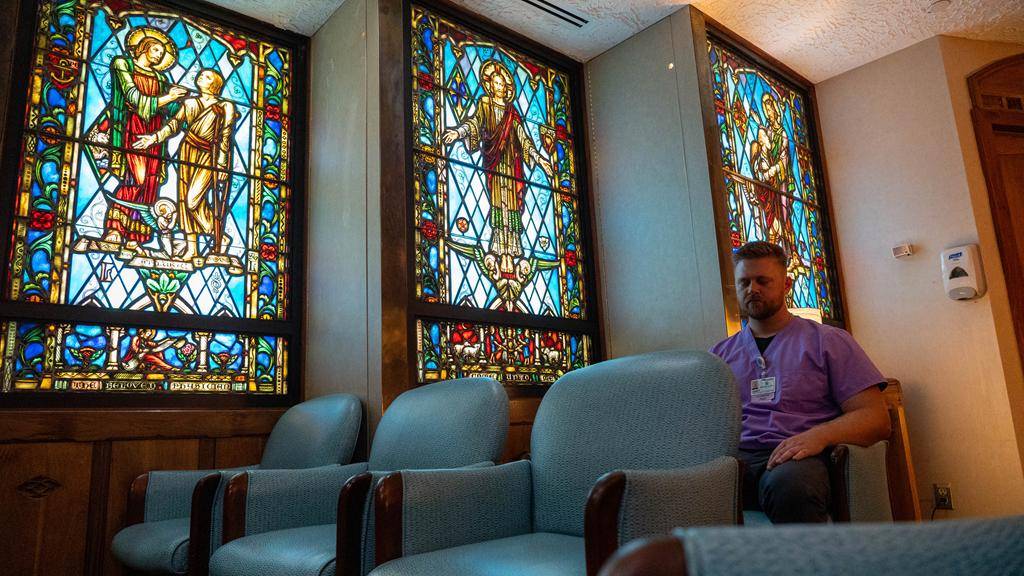
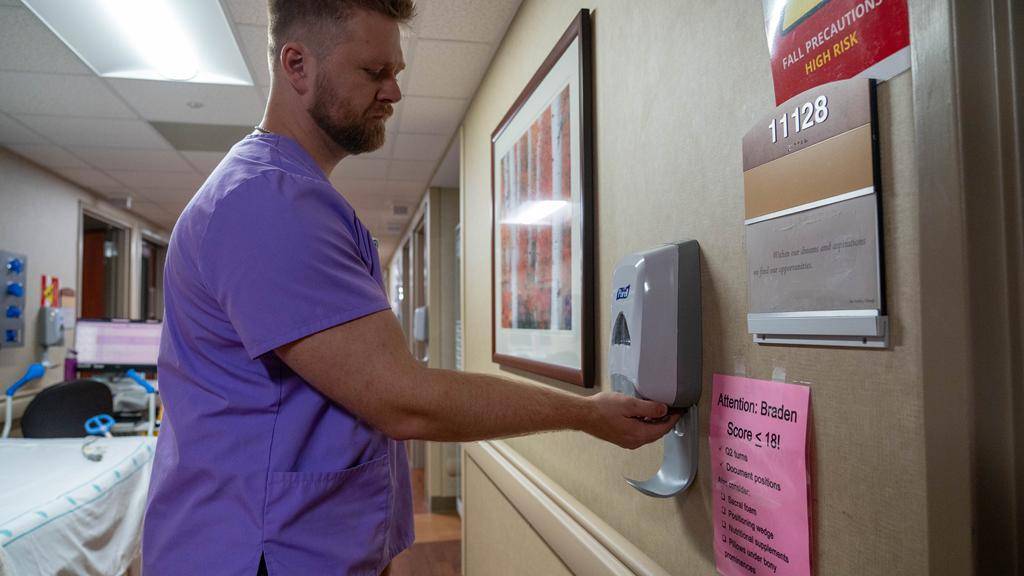
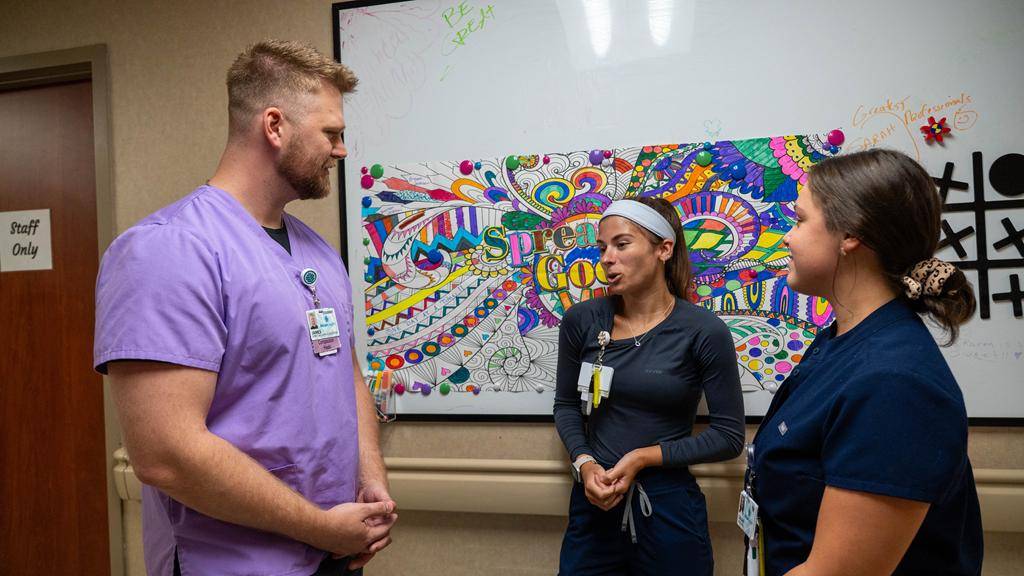
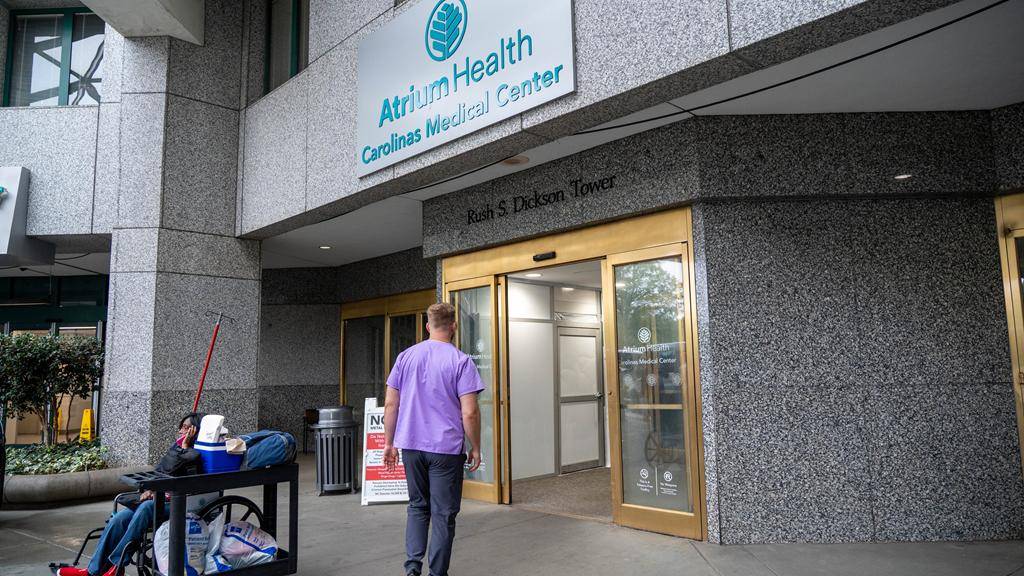
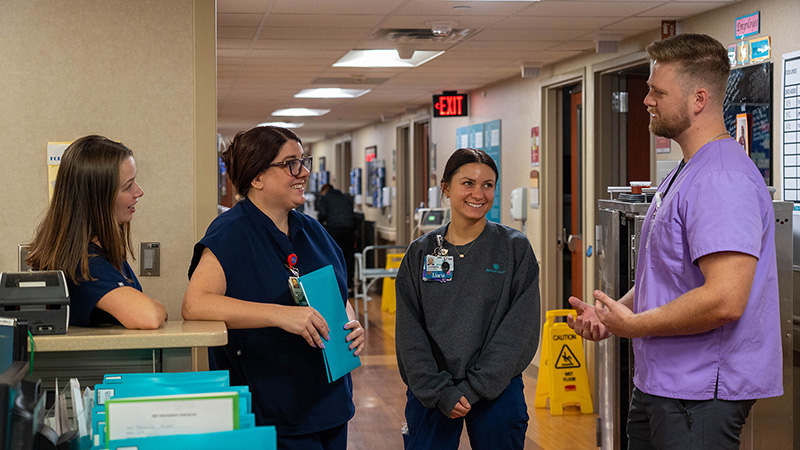
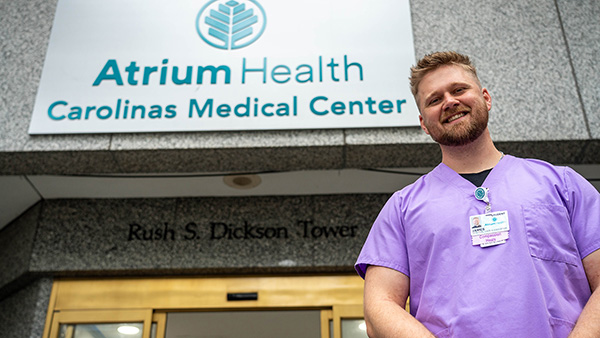
 Seminarian James Tweed spent the summer as an interfaith chaplain for Atrium Health in Charlotte, building friendships with staff and patients while spiritually leading people who are undergoing treatment in the trauma center. He also learned lessons that will serve him well in his future ministry as a priest. (Photos by Will Creter | Catholic News Herald)CHARLOTTE — Seminarian James Tweed’s summer assignment was serving as an interfaith chaplain at Atrium Health’s Trauma Center at Carolinas Medical Center. As the region’s only Level I trauma center, it is equipped to respond to the most severe cases of traumatic injuries 24 hours a day, seven days a week. He recently took the time to speak with the Catholic News Herald about his experience:
CNH: What did you think when you received your summer assignment?
Tweed: When I first learned I’d be spending the summer doing Clinical Pastoral Education, I was both intrigued and a bit skeptical… I studied science in undergrad, and it felt natural and rewarding to be among nurses, doctors and a multidisciplinary care team.
CNH: Do you have any prior experience in the medical field?
Tweed: I majored in molecular biology and biotechnology in college, worked in a microbiology lab for a semester, and then at the Max Planck Florida Institute for Neuroscience. Before seminary, I also served as a hospital chaplain for a year in Cincinnati.
CNH: Can you describe a day in detail at your assignment?
Tweed: After a two-week orientation and intensive education phase, my typical day was spent serving the 11th floor, Trauma, at the hospital.
Our team started with a morning huddle to coordinate care, and from there, I prioritized my day based on new consults, follow-ups and insights from nurses about who might benefit from spiritual or emotional support. Every visit was unique. I would introduce myself, ask how they were doing, and try to simply be present, offering space for the patient to open up if they felt ready. Some shared profound grief or fear, others longed for prayer or quiet companionship. I tried to walk into each room not with a plan, but with a heart open to them. Sometimes that meant five minutes of presence. Sometimes it meant an hour or more of sharing silence, tears, or prayer. After difficult visits, I often stepped away to walk and pray, just to breathe and let God recenter me.
 CNH: What did you learn?
Tweed: I learned to lead with my heart. I’ve spent much of my life forming my intellect through theology, philosophy and science, but this summer invited me to be more human. I realized that the most powerful form of care isn’t always in what we say or do, but in how we are with someone. To stand with a patient in their suffering required vulnerability. I had to let myself feel with them, deeply and honestly, without judgment or solutions. It is in that shared space, that mutual holding, where healing begins. I learned to listen without trying to fix, to follow instead of lead, to love without needing control. I also became more aware of my own inner landscape, my strengths, my blind spots, and my emotional triggers and how all of that impacts how I show up for others. I grew in emotional presence, cultural sensitivity and spiritual availability. Above all, I learned what it means to be a safe person for someone in crisis.
CNH: What did you like or not like about the assignment?
Tweed: I loved the learning environment. It felt like a safe and sacred space, fertile soil, where we were invited to grow through real experience, honest feedback and deep reflection. I was seen, heard, challenged and supported. I also loved being in the hospital, standing with people on some of their hardest days and offering a presence that was gentle, nonjudgmental and rooted in love.
CNH: How do you feel closer to God after serving at a hospital?
Tweed: While Christ is uniquely and substantially present in the Holy Eucharist, He is also truly present in the suffering, the tears and the silent prayers of those I encountered.
My time in the hospital as a multifaith chaplain helped to center me in a way that I could come into contact with the mystery personhood and God’s presence in that mystery.
Whether someone was baptized or not, I learned to listen with the kind of reverence I would have in a chapel, because I was often standing before a heart that was vulnerable, searching and open to grace. It was not the same presence as in the Eucharist, but it was still a place where God was moving, still a place where I could meet Him. That awareness deepened my love for the Eucharist, not lessened it, and helped me recognize how Christ reaches out to people in different ways. In a word, the hospital became a kind of sanctuary for me.
CNH: How did patients respond to your care?
Tweed: They received me with appreciation and trust, often opening up in ways that showed they felt safe, heard and supported. I think a big part of that was learning to bring my whole self to each visit – compassion, attentiveness, humility and strength. But I was also shaped by the tools and formation given to me by the education team: how to listen actively, how to be present without needing to control, how to honor each person’s story without inserting myself into it. That combination, natural empathy and trained awareness, allowed me to form genuine and meaningful connections.
CNH: Why is it important for seminarians and priests to serve in hospitals?
Tweed: Because human suffering is not abstract. It is real, gritty and sacred. Serving in a hospital teaches you how to be truly human with others, and if we believe Christ is fully human and fully divine, then that humanity matters in our priesthood. Ministry in hospitals helps us grow in emotional awareness, in sensitivity to cultural and spiritual complexity and in the ability to meet people where they are. It teaches us to find God in places beyond the sanctuary, without ever losing our love for the altar. It forms priests who are approachable, relatable and above all, present, like Christ.
CNH: Anything else you’d like to add?
Tweed: It takes courage to feel, to stay open, to not retreat into intellectual answers or safe routines. But if we want to serve like Christ, we have to learn to love like Him, and love always flows from the heart. That is what this summer taught me.
— Lisa M. Geraci