

The end of the world as we know it:
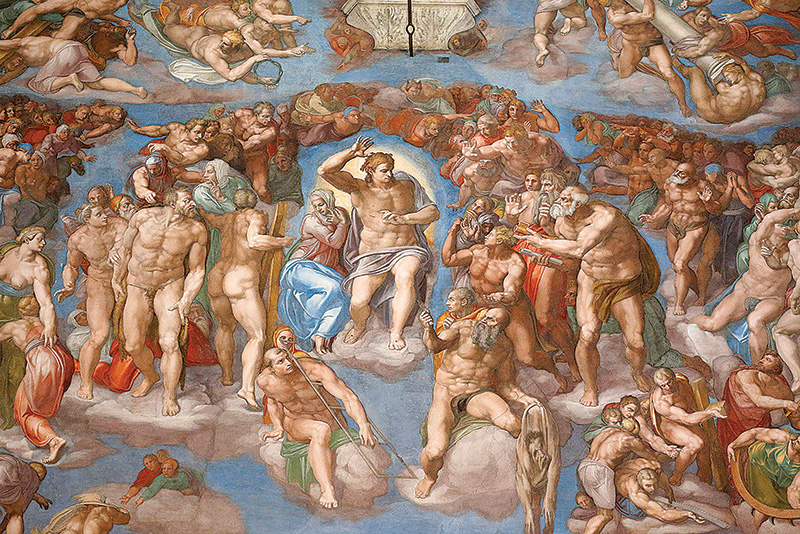 Curiosity about the end of the world abounds. For many, it is both frightening and exciting to think they will witness “The End.” Wars and natural disasters are commonly interpreted as signs of an approaching apocalypse; future famines and ecological crises are often promoted as hastening the same.
But are we really living in the end times? And what, exactly, does the Catholic Church teach about the end of the world?
For Catholics, the terms “end times” and “last days” refer both to the conclusion of history at some future point, and also – even primarily – to the last 2,000 years. “In times past, God spoke in partial and various ways to our ancestors through the prophets,” wrote the author of the Letter to the Hebrews, “in these last days, he spoke to us through a son, whom he made heir of all things and through whom he created the universe” (Heb 1:1-2).
It was the Incarnation, the entrance of God into time and space, that ushered in the end times and the last days. Yet God’s work of salvation and judgment still continues.
The message of the Gospel is that man can only be saved from the trials of history – especially sin and death – through God’s work within temporal history.
Thy kingdom come
Compared with the often fevered beliefs of certain fundamentalist and New Age groups, the church’s teaching might appear decidedly mundane. But false teachings and skewed sensationalism cannot compare with the authentically radical teachings of the church about history, salvation and the eschaton – the culmination of time and history. The heart of this teaching is Jesus’ proclamation that he was establishing the kingdom of God (see Mt 12:28; Mk 4:11; Lk 8:1-10). This everlasting kingdom was realized through his death, resurrection and ascension into heaven.
In fact, Christ himself is the kingdom. He calls for all men to enter into his divine life, which on earth is found in his Mystical Body. This is the work of divine restoration spoken of often by the prophets in the Old Testament.
Thus, the last days are all about a new creation and a new people, chosen by Jesus Christ and growing within history. This is the time of the New Covenant, the gathering together of God’s people in the church. Therefore, Christ’s first coming established the kingdom of God on earth and Christians are now living in that kingdom – the church – which is still growing, by the power of the Holy Spirit, throughout the world. At the end, the return of Christ in glory will fully reveal and manifest the kingdom.
That Catholics believe in the Second Coming surprises many non-Catholic Christians. But each week at Mass, we proclaim, in reciting the Creed, that Jesus Christ will “come again in glory to judge the living and the dead.” This is not symbolic language, but real belief in the bodily return of the risen Savior. This coming is the “parousia,” a Greek word meaning “presence” or “arrival.”
The Parousia began when the Son became a man and continues with the presence of the Holy Spirit.
We don’t know when
We’ve all wondered: When will Christ return? Some people are obsessed with figuring out the exact date. Groups have set dates for the end – and then re-set them.
Date-setting is not an option for followers of Christ. Jesus said, “But of that day or hour, no one knows, neither the angels in heaven, nor the Son, but only the Father” (Mk 13:32). But he also warned the disciples to be prepared for his return.
The delay emphasizes God’s merciful desire for all men to receive his freely offered salvation. It could be many more centuries or millennia before Christ comes again – or it could be very soon. The church teaches there are also at least three significant events that must take place before the Second Coming: an unparalleled period of tribulation and apostasy, the spread of the
Gospel to all the world, and the recognition of Jesus as the Christ by “all Israel” (see Catechism, Nos. 674-677).
Of the time of tribulation, the Catechism states, “Before Christ’s second coming, the Church must pass through a final trial that will shake the faith of many believers (see Lk 21:12; Jn 15:19-20)” (No. 675). This time of trial will be marked by religious deception, apostasy from the true faith and the rise of the Antichrist.
History has witnessed much speculation about the Antichrist. What is clearer is that when history draws to a close, Satan and his followers will seek to destroy as many souls as possible.
In the Olivet Discourse, Jesus told the disciples: “And this gospel of the kingdom shall be preached in the whole world as a witness to all nations, and then the end will come” (Mt 24:14). Has this occurred? Arguments can be made either way.
Of the third event, the church states Israel’s recognition of Jesus as the Messiah will take place prior to the Parousia. This is based on Romans 9-11 and St. Paul’s teaching that “hardening has come upon Israel in part, until the full number of Gentiles comes in” (Rom 11:25). It is far from evident how this “full inclusion” of ethnic Israel into the church will come about.
Rooted in hope
When will we be judged by God? The usual answer is, “After I die.” The Letter to the Hebrews states, “It is appointed that human beings die once, and after this comes judgment” (9:27). But judgment also takes place each time man commits sin and rejects God.
Judgment occurs every moment of every day. Our eternal destination originates from our response to God in this life.
Catholics, however, do not have a despairing view of the future, but one rooted in hope. Far from the action of an angry and vengeful God, judgment is an act of love, an act of transcendent justice spurring man to conversion and holiness. Judgment is an integral part of The End, for at the final judgment things will appear as they really are. When God fully reveals himself to man at the end of time, the heart of every man will be exposed.
The final judgment is not about vengeance, but holiness and truth, for they are at the heart of each man’s relationship with the Righteous One. It will bring to completion God’s redemptive, saving work. Catholic doctrine emphasizes individual eschatology – that is, hell, purgatory and heaven – because we possess free will and are accountable for our actions and choices.
Jesus didn’t want his disciples to cease anticipating his return. Anticipation and readiness need not turn into despair, fear or the error of date-setting. Yes, calculating the exact day of the end might seem far more emotionally stimulating than growing in grace and holiness. But it means nothing if we are not focused on being true children of God.
This life will end one way or another, to be followed by judgment and the revelation of who we have become and who we really are. The end of history might be centuries away, but the end of our lives is always near; each will be required to give an account to our Maker.
— Carl E. Olson, OSV News. Carl E. Olson is editor of Catholic World Report and Ignatius Insight.