


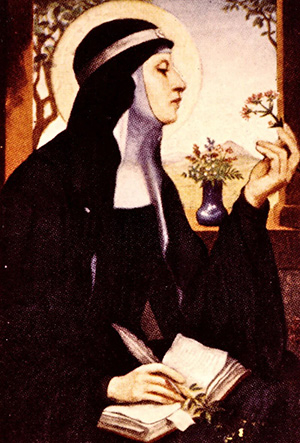
 There are only four female Doctors of the Church – and only one set her visions to music that lives on after nearly a millennium and has built her reputation as one of the pillars of Medieval sacred music.
When researching St. Hildegard von Bingen (1098-1179), one can quickly become overwhelmed since there is no scarcity of subjects in which this beloved saint excelled. Between medicine, theology and science, her influence has never been forgotten. However, it has only been in the past several decades that her contributions to music resurfaced. In less than a century, she has become one of the most famous composers of the Medieval era.
St. Hildegard’s visions began around the age of 5 and encompassed profound theological and cosmic truths. On All Saints Day 1112 she professed her vows along with Jutta of Sponheim (1092-1136), who was her primary religious instructor. Being a religious gave Hildegard opportunities that were not available to many Medieval women (or even men), such as being literate in both Latin and music and being the administrator of her own religious community. Throughout her life, St. Hildegard was consulted by popes and secular authorities.
Because St. Hildegard composed music primarily for the Divine Office, we can be certain of what she authored. In contrast, music composed for the Mass at that time was generally anonymous.
That makes it possible to associate unique stylistic traits with her works. Following the norms of her time, the words are in Latin and the melody is a sequence of notes without a designated rhythm. The uniquely Hildegard aspect is a beginning ascending leap of a perfect fifth – a jump up of five notes that produces a memorable introduction, like the unmistakable opening notes of the “Star Wars” theme or
“Twinkle, Twinkle, Little Star.” It is these large skips that make the chants immediately recognizable as Hildegard’s work.
One of St. Hildegard’s most noted works is the morality play “Ordo Virtutum” (ca. 1151) or “Play of the Virtues.” Its more than 80 chant melodies chronicle the fall and subsequent return to grace of a soul. More than a dozen virtues, such as humility and charity, are depicted as characters. The play originally was performed by an all-female cast with the exception of the devil. He was played by a priest who shouts his lines – his lack of music signified his separation from God.
As in modern performances, there is instrumental accompaniment, and because this work would not have been performed during Mass, there is no reason to believe that instruments were not improvised in St. Hildegard’s time.
It can be challenging for modern audiences and performers to connect to a composer whose music was written nearly a thousand years ago. Contemporary composer and tubist Dr. Joanna Ross Hersey (b. 1971) helps bridge the centuries through her compositions for low brass based on St. Hildegard. One such work is “ElevenTwelve” (2019), inspired by Hildegard’s life in the convent, and named for the year in which she professed her vows. This modern score presents melodies that reflect the saint’s busy life at Disibodenberg. Other compositions by Hersey based on Hildegard include “Convent Window,” “Mountain of the Cloistered Mind” and “O Greening Branch.”
St. Hildegard was not canonized until 2012. A few months later, in his apostolic letter proclaiming her a Doctor of the Church, her fellow German, Pope Benedict XVI, wrote, “In Hildegard are expressed the most noble values of womanhood: hence the presence of women in the Church and in society is also illumined by her presence, both from the perspective of scientific research and that of pastoral activity.”
St. Hildegard von Bingen’s feast day, Sept. 17, occurs exactly two weeks from that of St. Gregory the Great, another Doctor of the Church who made a significant contribution to music history. Both come at a time when music ministries are restarting, the perfect time to prayerfully consider joining your parish choir.
— Christina L. Reitz, Ph.D.
More online
Hear the final chorus of Ordo Virtutum