


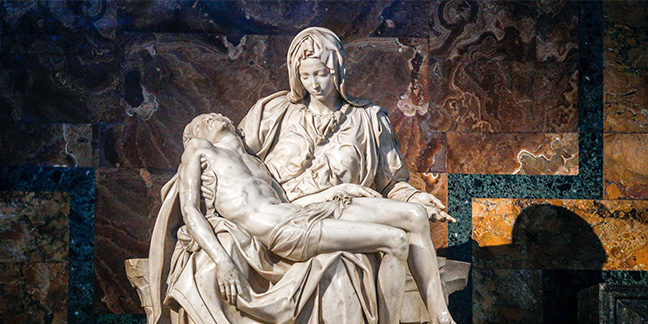
 Michelangelo’s Pietà is seen in St. Peter’s Basilica at the Vatican May 30, 2023. Seeing Lent through the eyes of Mary can help deepen the meaning of the season. (Lola Gomez | CNS photo)
CHARLOTTE — The season of Lent directs us to recall our own baptism and prepare for the celebration of the paschal mystery of the passion, death and resurrection of Christ. It is a time of prayer, fasting and almsgiving, and it helps us grow closer to Jesus.
In celebrating Lent, it is good to recall the teaching of the Second Vatican Council, that the “Church honors with special love the Blessed Mary, Mother of God, who is joined by an inseparable bond to the saving work of her Son.”
Mary is the perfect companion for Lent, and Lent is a perfect time to deepen our love, knowledge and veneration of the Mother of God. Lent is also a season of conversion, and here, too, we receive great help from Mary who, as the Mother of Mercy, points us to her divine Son, Jesus Christ, who came into the world to reconcile sinners to himself (Lk 5:31-32).
In his general audience on Ash Wednesday in 2014, Pope Francis highlighted the special protection and help of the Blessed Virgin for the journey of Lent: “On this journey, we want to invoke with special trust the protection and help of the Virgin Mary: May she, who was the first to believe in Christ, accompany us in our days of intense prayer and penance, so that we might come to celebrate, purified and renewed in spirit, the great paschal mystery of her Son.”
These words of Pope Francis help us to appreciate one reason why Mary is the perfect companion for Lent: She is the model of the perfect disciple because she entrusted herself completely to God.
Mary as protector
As our spiritual mother, Mary not only leads us to Christ, but she also protects and guides us from sin. Lent is a perfect time to renew our devotion to Mary as our spiritual mother who cares for us in the midst of challenges and difficulties.
One of the oldest known prayers to Mary is known as the “Sub Tuum Praesidium” (“Under Thy Protection”), which goes back to the third or fourth century. One translation of it reads: “We fly to
Thy protection, O Holy Mother of God; Do not despise our petitions in our necessities, but deliver us always from all dangers, O Glorious and Blessed Virgin. Amen.”
Because Lent is a time to turn away from sin, it is also an ideal time to recognize the gift that Our Lord himself gave us, giving us his own mother as our mother while he was dying on the cross (Jn 19:25-27). Pope St. John Paul II recognized that Jesus gave Mary as mother not only to the beloved disciple but to all of the faithful.
Mary’s spiritual motherhood is the basis for the “Marian dimension” of the life of each of the disciples of Christ. John Paul II wrote in 1987: “The Marian dimension of the life of a disciple of
Christ is expressed in a special way precisely through this filial entrusting to the Mother of Christ, which began with the testament of the Redeemer on Golgotha. Entrusting himself to Mary in a filial manner, the Christian, like the Apostle John, ‘welcomes’ the Mother of Christ ‘into his own home’ and brings her into everything that makes up his inner life” (“Redemptoris Mater,” No. 45).
Mary as sorrowful mother
Lent is a time to deepen our prayer life, and Mary provides the best example of prayer in her canticle, known as the Magnificat (Lk 1:46-55). This canticle expresses the attitudes of praise, gratitude and humility that are at the heart of all authentic prayer to God. St. Paul VI speaks of Mary as “the virgin in prayer” who “praises the Lord unceasingly and intercedes for the salvation of the world” (“Marialis Cultus,” No. 18). As our spiritual mother, Mary not only teaches us how to pray, but she prays for us “now and at the hour of our death.”
In the Gospel of Luke, Simeon told Mary that her heart would be pierced so that “the thoughts of many hearts will be revealed” (Lk 2:35). This prophecy was fulfilled during Christ’s passion when Mary stood beneath the cross witnessing her Son’s crucifixion (Jn 19:25-27). Vatican II tells us that Mary “faithfully persevered in her union with her Son unto the cross, where she stood, in keeping with the divine plan, grieving exceedingly with her only begotten Son, uniting herself with a maternal heart with His sacrifice, and lovingly consenting to the immolation of this Victim which she herself had brought forth” (“Lumen Gentium,” No. 58).
Lent, along with the feast of Our Lady of Sorrows, Sept. 15, is also a special time for venerating Mary as our sorrowful mother. This is done in the Stations of the Cross, which often includes the singing of parts of the medieval hymn the “Stabat Mater,” whose most memorable verses are: “At the cross her station keeping, Stood the mournful Mother weeping, Close to Jesus to the last. Through her heart, his sorrow sharing, All his bitter anguish bearing, Now at length the sword had pass’d. Oh, how sad and sore distress’d. Was that mother highly blest, Of the sole-begotten One!”
Because Lent points to Holy Thursday, Good Friday and the Easter Vigil, Mary as Our Lady of Sorrows assumes particular importance. But even under the cross, Mary remains a teacher and a model. She shows how all of the faithful, like her, can unite their sufferings to the passion of Christ for the redemption of the world.
Mary’s “unique contribution to the Gospel of suffering” (described by St. John Paul II in “Salvific Doloris”) shows us that suffering is not meaningless. Lent is a special time to remember the sorrows of Mary and to join ourselves to her in offering her divine Son “in atonement for our sins and those of the whole world” (Chaplet of Divine Mercy).
There is no better companion for the journey of Lent than Mary. As she leads us closer to Jesus, she will serve – as we pray in the “Salve Regina” – “our life, our sweetness, and our hope.”
— Robert Fastiggi, OSV News
Marian Stations of the Cross
While the Stations of the Cross are well known, there is the parallel pious exercise known as the “Via Matris” or “way of Mary.”
This devotion centers on the seven sorrows (or dolors) of Mary, which have a sure Scriptural foundation: 1. The prophecy of Simeon (Lk 2:34–35); 2. The flight into Egypt (Mt 2:13): 3. The loss of Jesus in the Temple (Lk 2:43–45); 4. The meeting of Jesus and Mary on the way to Calvary (Lk 23:27); 5. The crucifixion of Jesus (Jn 19:25); 6. The descent of Jesus from the cross (Mt 27: 57–59); and 7. The burial of Jesus (Jn 19: 40–42). There are many variations of Via Matirs, with different opening and closing prayers, but all include meditation on the seven sorrows.
The Directory on Popular Piety and the Liturgy, issued by the Congregation for Divine Worship and the Discipline of the Sacraments in 2002, says the “Via Matris” harmonizes well “with certain themes that are proper to the Lenten season.” It also notes that the Via Matris provides “stages on the journey of faith and sorrow on which the Virgin Mary has preceded the Church, and in which the Church journeys until the end of time.”