


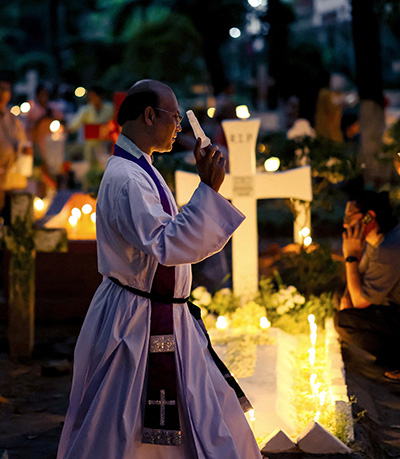
 November is a time when Catholics are especially encouraged to pray for the souls of those who have gone before us in faith. The Catechism attests that, “from the beginning the Church has honored the memory of the dead and offered prayers in suffrage for them, above all the Eucharistic sacrifice. … The Church also commends almsgiving, indulgences and works of penance undertaken on behalf of the dead” (CCC 1032). But why do we pray for the dead? When a loved one dies, it is common to say, “They are with God now,” or, “They are at peace.” What need, then, have they of our prayers?
The answer to this question is the Catholic doctrine of purgatory. This ancient teaching is the very reason why we have funerals, offer Masses for the dead and celebrate All Souls’ Day. But many Catholics struggle to explain this important doctrine, especially when asked by Protestant friends who want to know, “Where is purgatory in the Bible?”
It is true that you do not find the word “purgatory” in the Scriptures; neither do we find the words “Trinity” or “Bible.” Yet the concepts these words describe are nevertheless biblical. The passage most commonly cited in support of the doctrine of purgatory is 2 Maccabees 12:38-45, in which a collection is taken up to make a sin offering for fallen soldiers who had been discovered carrying idolatrous amulets. Affirming belief in the resurrection, the Scripture calls it “a holy and pious thought” to pray for the dead.
Support for Purgatory
Praying for the dead implies there is some state after death in which our prayers may do souls some good. This cannot be heaven, as the souls in heaven have no need of our prayers. Neither can it be hell, as prayer would be useless to the souls of the damned. That the Scriptures say it is “holy and pious” to pray for the dead supports the doctrine of purgatory.
The problem is that 2 Maccabees is not recognized as canonical by Protestants. There are other passages that support the doctrine of purgatory. In Matthew’s gospel, Jesus admonishes us to be reconciled on the way to court, “lest your accuser hand you over to the judge, and the judge to the guard, and you be put in prison; truly I say to you, you will never get out till you have paid the last penny” (Mt 5:25-26). Jesus is alluding to our final judgment. But He would not describe heaven as a prison. Neither could this be a reference to hell, from which the damned will never be released.
Another New Testament passage supporting purgatory comes in St. Paul’s first letter to the Corinthians. Speaking of the Day of Judgment when “each man’s work will become manifest,” St. Paul writes, “it will be revealed with fire, and the fire will test what sort of work each one has done … If any man’s work is burned up, he will suffer loss, though he himself will be saved, but only as through fire” (1 Cor 3:13, 15). Being saved through fire suggests a removal of impurities. This corresponds with purgatory.
“Purgatory” means “purification.” As the Catechism explains, “All who die in God’s grace and friendship, but still imperfectly purified, are indeed assured of their eternal salvation; but after death they undergo purification, so as to achieve the holiness necessary to enter the joy of heaven. The Church gives the name Purgatory to this final purification of the elect” (CCC 1030-31).
I find the most useful Scripture verse to help explain the doctrine of purgatory to Protestants to be Revelation 21:27, which states that “nothing unclean” will enter heaven. I ask if they believe they will go to heaven if they believe in Jesus and repent They say yes. Then I ask whether they think believing in Jesus makes them perfectly pure. If they have any self-awareness, they will say no. When I point to this verse, they conclude that God must do something to purify the souls of the elect after death. I say, “That final purification before heaven is what Catholics call purgatory.”
Purgatory transforms
Heaven is not the dwelling place of unrighteous souls let in because Jesus paid the price of their admission: it is the final abode of the saints who have been transformed by the love of Christ. Pope Benedict XVI, in his encyclical on hope, “Spe Salvi,” describes purgatory as an encounter with Jesus that “burns us, transforms and frees us, allowing us to become truly ourselves.” This encounter is “a blessed pain, in which the holy power of (Christ’s) love sears through us like a flame, enabling us to become totally ourselves and thus totally of God” (47). Understood this way, the doctrine is an extension of Church teachings on mercy.
If the final purgation of the dead is primarily the work of Christ, what difference is made by our prayers for them? We will let Pope Benedict have the final word: “No one lives alone. No one sins alone. No one is saved alone. The lives of others continually spill over into mine ...So my prayer for another is not something extraneous to that person, something external, not even after death. In the interconnectedness of Being, my gratitude to the other – my prayer for him – can play a small part in his purification. … It is never too late to touch the heart of another, nor is it ever in vain” (“Spe Salvi,” 48).
Deacon Matthew Newsome, Catholic campus minister at Western Carolina University and regional faith formation coordinator for the Smoky Mountain Vicariate, is the author of “The Devout Life: A Modern Guide to Practical Holiness with St. Francis de Sales,” available from Sophia Institute Press.