


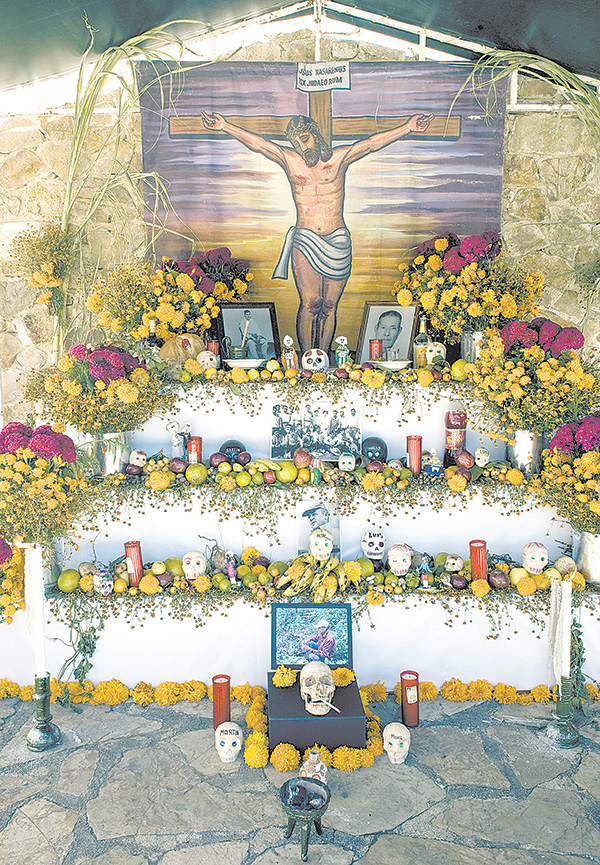
 The traditional Mexican holiday Dia de los Muertos – or Day of the Dead – has gone mainstream in American pop culture, with its colorfully decorated skulls and flowers adorning clothing, featured in advertising and embraced by organizations from Hollywood to major league sports. But beyond its commercial appeal, the Day of the Dead has deep roots in Hispanic culture and Catholicism.
The celebration coincides with the feasts of All Saints Day and All Souls’ Day, celebrated over two to three days, usually beginning Oct. 31 and ending Nov. 2. Despite its bleak name, the Day of the Dead is not a time for mourning or for scaring friends and neighbors. It is a celebration of life – a time to honor the memory of deceased loved ones, to pray for the souls in purgatory and to ask intercession from those in heaven.
“Death … is something that comes and is certain for everyone. Instead of being frightened by it, (Catholics) see it as something natural, as a step toward heaven,” Father Julio Dominguez, the diocese’s former vicar of Hispanic Ministry, told the Catholic News Herald in a 2022 interview.
WHAT IS THE DAY OF THE DEAD?
The Day of the Dead is a day when families gather to pray and remember their deceased loved ones. They may visit their family members’ gravesites, spending time in prayer and beautifying the resting places with candles, flowers and personal memorabilia. They also may bring a meal that includes the deceased’s favorite foods.
It is tradition to attend Mass, and families also create altars in their homes to remember and pray for the deceased. Adorned with candles, flowers, photos and mementos, the home altar becomes the centerpiece of the celebration.
“The feast and the altar of the deceased have nothing sacrilegious or satanic about them,” said Father Dominguez, adding that the skulls popularly depicted in Day of the Dead artwork are a way of acknowledging our mortality and reminding us to aspire for eternal life with God in heaven.
On Day of the Dead home altars, Father Dominguez said, “Christ is placed on high, remembering that He is our King, and we were redeemed by Him. It is followed by images of saints, and then come the photographs of our deceased relatives, for whom we pray that they will win heaven.”
Food placed on the home altar or offered in visits to cemeteries is a custom grounded in Mexican culture, as other cultures use flowers as a sign of honor and remembrance.
“It is a practice of communion with the saints. There is something precious embodied in the traditions of the Church,” Father Dominguez said.
IT IS NOT HALLOWEEN!
The Day of the Dead is often conflated with Halloween, but it is not connected.
Halloween is traditionally a solemn Christian feast day that dates as far back as the 8th century.
The feast day served as a vigil in which children went house to house asking for “soul cakes” to commemorate the faithful departed. The name comes from an old Scottish term meaning “All
Hallows’ Eve,” or “All Holy Night,” the vigil of the Solemnity of All Saints on Nov. 1.
In the 20th century, however, Halloween devolved into a secular holiday. In recent years, confusion about the feast days has led to popular culture incorporating Day of the Dead decorations and symbols during Halloween.
“Halloween is another old tradition, but the Day of the Dead is completely different and has no common elements,” Father Dominguez emphasized.
CELEBRATING THE DEARLY DEPARTED
While popular culture has distorted the feasts of All Saints Day and All Souls’ Day, the Day of the Dead is a Mexican Catholic celebration that honors one’s deceased family and friends and reminds us to pray for the dead – a spiritual work of mercy. So, whether building home altars, decorating memorials or gathering with family around the dinner table, this traditional feast is not a time of celebrating death, but a special, holy day in which we pray and remember all the deceased. Through prayer and familial communion, we look beyond death toward life’s true purpose: eternal life with God.
— Catholic News Herald