

St. Bruno is best known for founding the Carthusian Order, a contemplative order of hermits and nuns who maintain an extremely solitary, silent life of prayer and penitence.
The Carthusian Order, one of two orders of solitaries in the Occidental Church, has lasted more than 900 years. There are more than 300 Carthusians around the world today.
St. Bruno was not only renowned for his prodigious learning, but also for his great spirit of prayer, his severe mortification, and his devotion to the Blessed Virgin Mary.
He was born in Cologne, Germany, in about 1035, and died in Calabria, Italy, on Oct. 6, 1101.
Bruno went to a prestigious school in Rheims as a youth, known for its academic excellence. He excelled in his studies, consisting mainly of Sacred Scripture and the Church Fathers.
He returned to Cologne and was ordained a priest in 1055, but very soon after, in 1057, he was invited back to Rheims to teach.
On the retirement of the school's director, Heriman, to contemplative life, Bruno assumed the position and ran the school for 18 years, until 1075.
During that time many illustrious students emerged from under Bruno's careful intellectual formation, including Blessed Pope Urban II.
In 1075, Bruno was appointed chancellor of the Diocese of Rheims, which involved him in the daily administration of the diocese.
Bruno, however, had always been attracted to the contemplative and solitary life. In 1077, along with two companions, he made a vow to follow this lifestyle, but he was unable to fulfill his vow until 1080 due to his responsibilities as chancellor of the Rheims diocese.
After attempting different forms of solitary, or eremetical, life, Bruno founded the Carthusian order in 1084 at Chartreuse with six companions. The climate, desert, mountainous terrain and inaccessibility guaranteed strict silence, poverty and small numbers. They devoted their days to study, copying manuscripts, and prayer in their individual cells, and they would gather together only for certain prayers and celebration of the Eucharist.
However, in 1090 Pope Urban II, his friend and former student, called Bruno to the papal court in order to be his advisor, where he silently aided in all the councils of the time but remained uncomfortable away from the solitude he still desired.
On a trip to Calabria with the pope, Bruno was elected bishop of Reggio, a post he pleaded to be freed from so that he could return to monastic life. Urban II granted his wish but insisted that he remain in Italy so he could assist the pope when needed.
Bruno spent his last 10 years in the wilderness of Calabria, where he founded a hermitage with his companions and where he died in 1101. His holiness and wisdom became widely known, and his death was announced in parishes and monasteries all over Europe.
Bruno was buried in the little cemetery of the hermitage of Santa Maria, under the epitaph "Haec sunt ossa magistri Brunonis" ("These are the bones of the master Bruno"). Since the Carthusian Order maintains a strict observance of humility, St. Bruno was never formally canonized. He was not included in the Tridentine calendar, but in the year 1623 Pope Gregory XV included him in the Calendar of Saints for celebration on Oct. 6.
He is the patron saint of Calabria and of trade marks.
— Catholic News Agency
Learn more about the Carthusians
At www.diegrossestille.de/english: Watch the trailer for "Into Great Silence," the award-winning 2005 documentary about the life of Carthusian monks at the Grande Chartreuse, high in the French Alps (Chartreuse Mountains)
Our Lady of the Pillar is patroness of Spain and all Hispanics
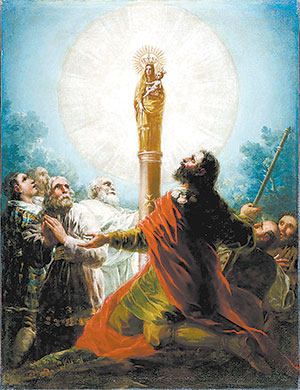 Our Lady of the Pillar (officially in Spanish, “Nuestra Señora del Pilar de Zaragoza”) is recognized as the first Marian apparition in the history of Christianity and is the only one that happened while the Virgin Mary was still alive. Although it was technically a bilocation of Our Lady, because she was living with John the Apostle in Jerusalem, it is still regarded as an apparition by the tradition of the Church.
According to tradition, James the Greater, brother of St. John the Evangelist, traveled with great effort to Roman Hispania (modern-day Spain) to evangelize the local tribes. He not only confronted great difficulties, but he also saw very little apostolic fruits of conversion. Tradition says that when he was at his lowest point of discouragement, in 40 A.D., while he was sitting by the banks of the Ebro River in Zaragoza (back then known as Caesaraugusta), Mary appeared to him accompanied by thousands of angels to console and encourage him.
The Virgin Mary, with the Child Jesus in her arms and standing on a pillar, asked St. James and his eight disciples to build a church on the site, promising that “it will stand from that moment until the end of time in order that God may work miracles and wonders through my intercession for all those who place themselves under my patronage.”
The church of Our Lady of the Pillar in Zaragoza is the first church dedicated to Mary in history, and it remains standing to this day, having survived invasions and wars.
During the Spanish Civil War (1936-1939), the Communists dropped three bombs on the church from an airplane. The bombs tore through the roof and hit the floor, but none of them exploded. The three now deactivated bombs are currently on display in one of the basilica’s walls.
Our Lady is also said to have given the small wooden statue of the apparition to St. James. It now stands on the pillar she arrived on. The wooden statue is a relatively simple image 15 inches high, standing on a jasper pillar 5.9 feet tall. But the crown adorning her head is a masterpiece. It was made in 44 days by 33 workmen. The sun-like crown is made of 2,836 diamonds cut triangularly, 2,725 roses, 145 pearls, 74 emeralds, 62 rubies and 46 sapphires. The crown of the baby Jesus is identical in shape, although not in size.
The basilica has been redesigned and expanded several times during its history. The current structure, completed in the 17th century, includes 11 brightly colored tiled domes and is the second biggest church in Spain.
Nuestra Señora del Pilar is not only the patroness of Spain but also of all Hispanic peoples, since it was on Oct. 12, 1492, the feast of Our Lady of the Pillar, that Christopher Columbus arrived on American land and the first Mass in the Americas was celebrated.
— Alejandro Bermudez, Catholic News Agency