

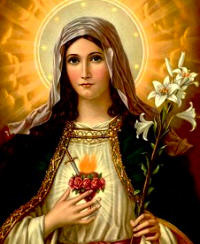
 Historically, devotion to the Heart of Mary grew up in parallel, but at a lesser intensity than that of devotion to the Heart of Jesus, only starting to become more prominent during the time of St. John Eudes. John Eudes was born in 1601 in Normandy, France. He entered the Congregation of the Oratory of France, founded in 1611 by Cardinal de Berulle and was ordained to the priesthood on Dec. 20, 1625.
St. John brought people to love Christ and the Virgin Mary by speaking tirelessly about their hearts, the sign of the love God shows for us and the communion to which we are called.
To offer them liturgical worship, he composed Masses and offices in their honor and had the first Feast of the Holy Heart of Mary celebrated on Feb. 8, 1648, at Autun, France, and the Feast of the Heart of Jesus celebrated on Oct. 20, 1672.
He died on Aug. 19, 1680, and was canonized by Pope Pius XI on May 31, 1925.
Nevertheless, it was not until after the Apparitions at Rue du Bac concerning the "Miraculous Medal" made to Catherine Labouré in 1830, and the establishment of a society dedicated to the Immaculate Heart of Mary at the Church of Our Lady of Victories in Paris in 1836, that this particular devotion became well known.
Since then devotion to the Immaculate Heart of Mary has gradually grown more widespread in the Church, particularly since the apparitions at Fatima.
The main difference between the devotions to the hearts of Jesus and Mary is that the one concerned with Jesus emphasizes His divine heart as being full of love for mankind, but with this love for the most part being ignored or rejected, while devotion to Mary's heart is essentially concerned with the love that her heart has for Jesus, for God.
Therefore, it is not an end in itself, so the love of her heart is meant to be a model for the way we should love God. The fact that her heart is immaculate, that is sinless, means that she is the only fully human person who is able to really love God in the way that He should be loved.
Honoring Mary's Immaculate Heart is really just another way of honoring Mary as the person chosen to be the Mother of God, recognizing her extraordinary holiness and the immense love she bestowed on Jesus as His mother, the person called to share in and cooperate in His redemptive sufferings.
— Catholic News Agency
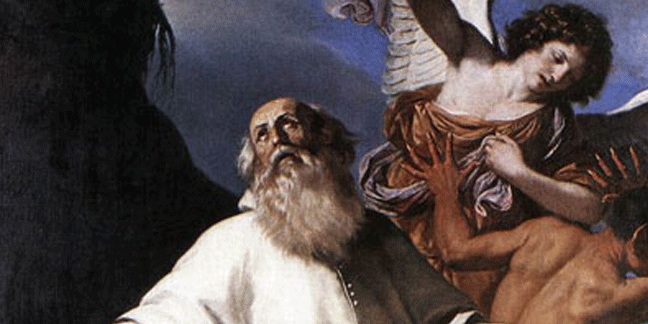 St. Romuald, who founded the Camaldolese monastic order during the early 11th century, has his liturgical memorial on June 19.
Working within the Western Church's Benedictine tradition, he revived the primitive monastic practice of hermit life, allowing for greater solitude in a communal setting.
Born into an aristocratic Italian family during the middle of the 10th century, Romuald grew up in a luxurious and worldly environment, where he learned little in the way of self-restraint or religious devotion. Yet he also felt an unusual attraction toward the simplicity of monastic life, prompted by the beauty of nature and the experience of solitude.
It was not beauty or tranquility, but a shocking tragedy that spurred him to act on this desire. When Romuald was 20 years old, he saw his father Sergius kill one of his relatives in a dispute over some property. Disgusted by the crime he had witnessed, the young man went to the Monastery of St. Apollinaris to do 40 days of penance for his father.
These 40 days confirmed Romuald's monastic calling, as they became the foundation for an entire life of penance. But this would not be lived out at St. Apollinaris, where Romuald's strict asceticism brought him into conflict with some of the other monks. He left the area near Ravenna and went to Venice, where he became the disciple of the hermit Marinus.
Both men went on to encourage the monastic vocation of Peter Urseolus, a Venetian political leader who would later be canonized as a saint. When Peter joined a French Benedictine monastery, Romuald followed him and lived for five years in a nearby hermitage.
In the meantime, Romuald's father Sergius had followed his son's course, repenting of his sins and becoming a monk himself. Romuald returned to Italy to help his father, after learning that Sergius was struggling in his vocation. Through his son's guidance, Sergius found the strength to persist in religious life.
After guiding his penitent father in the way of salvation, Romuald traveled throughout Italy serving the Church. By 1012 he had helped to establish or reform almost 100 hermitages and monasteries, though these were not connected to one another in the manner of a distinct religious order.
The foundations of the Camaldolese order were not laid until 1012 – when a piece of land called the "Camaldoli," located in the Diocese of Arezzo, was granted to Romuald. It became the site of five hermits' quarters, and a full monastery soon after. This combination of hermits' cells and community life, together with other distinctive features, gave this monastery and its later affiliates a distinct identity and charism.
Romuald's approach to the contemplative life, reminiscent of the early Desert Fathers, can be seen in the short piece of writing known as his "Brief Rule." It reads as follows:
"Sit in your cell as in paradise. Put the whole world behind you and forget it. Watch your thoughts like a good fisherman watching for fish. The path you must follow is in the Psalms – never leave it."
"If you have just come to the monastery, and in spite of your good will you cannot accomplish what you want, take every opportunity you can to sing the Psalms in your heart and to understand them with your mind. And if your mind wanders as you read, do not give up; hurry back and apply your mind to the words once more."
"Realize above all that you are in God's presence, and stand there with the attitude of one who stands before the emperor. Empty yourself completely and sit waiting, content with the grace of God, like the chick who tastes nothing and eats nothing but what his mother brings him."
St. Romuald of Ravenna died in his monastic cell on June 19, 1027. Pope Gregory XIII canonized him in 1582.
— Catholic News Agency