

diofav 23

Catholic News Herald

Serving Christ and Connecting Catholics in Western North Carolina
×

Warning

Failed deleting extensions.css

120420 Macero Deacon CarlCHARLOTTE — St. Thomas Aquinas Church is reviewing whether a former deacon may have used the incorrect formula for administering the sacrament of baptism at the parish more than 15 years ago – which would render those baptisms invalid and leave affected parishioners in need of a valid baptism.

St. Thomas Aquinas’ pastor Father Matthew Codd explained the unusual situation to parishioners at Masses Nov. 28-29 and in a Nov. 28 letter posted on the parish’s website, www.stacharlotte.com.

The Diocese of Dallas recently discovered that three of its deacons had used incorrect wording during some of the baptisms they attempted to confer in Dallas. Among them was Deacon Carl J. Macero, who is now deceased and who served at St. Thomas Aquinas Parish in Charlotte from 1996 to 2004.

Father Codd stressed in his letter that while the parish has received no reports that Deacon Macero incorrectly administered the sacrament during his ministry in Charlotte, “it must be presumed to be a possibility.” As a result, Father Codd said, parish leaders are attempting to contact parishioners who were baptized by Deacon Macero to review their specific circumstances and quickly rectify any issues.

“We are asking that anyone baptized by Deacon Macero review any video or audio recordings of their baptism or that of family members” and to contact the parish, Father Codd’s letter said.

The issue has emerged in recent months in various locations after, as the letter noted, “the Congregation for the Doctrine of the Faith issued an important clarification that the sacrament of baptism is not valid if the appropriate prayer for the rite is modified by the celebrant. Specifically, the doctrinal note explained that the modified words ‘We baptize you in the name of the Father, and of the Son, and of the Holy Spirit’ do not convey the sacrament of baptism. Rather, the proper prayer has always been ‘I baptize you…’ because it reflects the truth that the sacrament is administered by Our Lord acting through the minister, not through the assembly.”

In making this clarification, the Congregation cited the Second Vatican Council, which declared no one “may add, remove, or change anything in the liturgy on his own authority.”

Father Codd acknowledged the situation “may be unsettling or perceived as a burdensome technicality,” but explained that a valid baptism brings about adoption into the family of God and places sanctifying grace in the soul, which is necessary in order to spend eternity in heaven.

If a baptism is deemed invalid, the sacrament must be administered correctly. For parishioners who were baptized by Deacon Macero but have no recordings, it may be necessary to pursue a conditional baptism, which is administered when it is impossible to verify whether an individual has been validly baptized.

Father Codd’s letter also explained that an invalid baptism renders subsequent sacraments invalid as well, including confirmation and possibly matrimony – but that these issues can also be quickly rectified.

“Please be assured our parish and diocese are prepared to act swiftly to confer baptism and other sacraments to those affected,” Codd’s letter said, “and that issues related to marriage can be remedied quickly and without an additional ceremony.”

— Catholic News Herald

What should you do?

If you or a family member was baptized by Deacon Carl Macero, please review any video or audiorecordings of the ceremony.

If the incorrect wording was used, please contact the St. Thomas Aquinas Parish office at 704-549-1607.

If you don’t have recordings, also contact the parish in case a conditional baptism may need to be considered.

If you don’t know who administered the baptism, no action is necessary; the parish will contact you if records indicate Deacon Macero administered the sacrament.

This appears to be an isolated issue, and there is no reason for anyone else in the diocese not baptized by Deacon Macero to question the validity of their baptism.

More information is available on the parish’s website, www.stacharlotte.com.

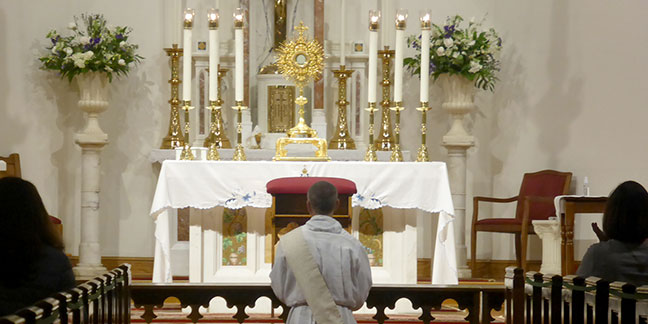
121820 Solari AbbotCHARLOTTE — The mystery of transubstantiation – the changing of bread and wine into the Body and Blood of Christ during the consecration at Mass – is a truth many Catholics find difficult to grasp.

In fact, a 2019 Pew Research Center poll found that less than one-third of self-described Catholics in the U.S. believe in or know about this core doctrine of our faith.
This was a wake-up call to members of the Charlotte region of the Order of Malta – part of a worldwide lay religious order whose charisms include defense of the Catholic faith as well as care for the sick and the poor.
“Obviously, we have a lot of defending to do,” said Knight of Malta Rick Menze.
The order is hosting periodic educational talks to deepen people’s understanding of the Catholic faith and the ability to explain it to others. First among their efforts has been two talks by Benedictine Abbot Placid Solari of Belmont Abbey, chaplain for the order’s Charlotte region.
Abbot Placid’s talks via video conference dove into this teaching, focusing on Church documents including St. Paul VI’s 1965 encyclical “Mysterium Fidei” (“The Mystery of Faith”), Pope Benedict XVI’s 2007 apostolic exhortation “Sacramentum Caritatis” (“The Sacrament of Charity”); and information from the pivotal Council of Trent in the 16th century.
The Eucharist is the real Presence of Christ, Abbot Placid explained, and that has consistently remained Church teaching since Jesus first spoke the words of consecration at the last Supper and directed the Apostles to “Do this in memory of Me.”
How the elements of bread and wine change into His Body and Blood is a mystery that the Church best describes as “transubstantiation”: we still see the physical appearance of bread and wine, but the underlying substance is transformed into a new reality seen only through the eyes of faith.
The bread and wine are not mere symbols, Abbot Placid noted. “The bread and wine cease to exist, and the Body and Blood become present.”
The word “transubstantiation” derives from ancient philosophy, and refers to the concept that something has a fundamental essence (“substance”) separate from its physical properties (called “accidents” or “species”). For example, a chair remains a chair (its substance) no matter whether it’s made of wood, metal or any other material (its accidents).

‘The Council of Trent summarizes the Catholic faith by declaring: ‘Because Christ our Redeemer said that it was truly His Body that he was offering under the species of bread, it has always been the conviction of the Church of God, and this holy Council now declares again, that by the consecration of the bread and wine there takes place a change of the whole substance of the bread into the substance of the Body of Christ our Lord and of the whole substance of the wine into the substance of His Blood. This change the holy Catholic Church has fittingly and properly called transubstantiation.’”
— Catechism of the Catholic Church 1376


Through the Eucharistic prayer spoken by the priest – acting in the person of Christ, the bread is changed by the efficacy of the word of Christ and by the action of the Holy Spirit.

The Apostles accepted this truth and the early Church Fathers reflected on its meaning, and through the centuries the Church has sought to understand it more deeply – yet ultimately the transformation of bread and wine into Christ’s Body and Blood “goes beyond the laws of nature,” Abbot Placid said.
Learning more about this central tenet of our faith is important for every Catholic, he urged. “We accept by faith, but we seek to understand.”

“I always accepted by faith that in the Eucharist, it was the changing of bread and wine into the Body and Blood of Christ. But the presentation by Abbot Placid using the term ‘transubstantiation’ helped explain the process and helped me focus on the importance of the sacredness of this moment during each Mass,” said Kaye McGarry, Dame of Malta. “It helped deepen my belief in the meaning of the Eucharist.”

— Patricia L. Guilfoyle, Editor


More online

Links to the Church documents referenced by Abbot Placid Solari, including St. Paul VI’s 1965 encyclical “Mysterium Fidei” (“The Mystery of Faith”), Pope Benedict XVI’s 2007 apostolic exhortation “Sacramentum caritatis” (“The Sacrament of Charity”).


Documents from the Council of Trent


At www.therealpresence.org: Read more about the Eucharist as “the source and summit of our faith,” stories of Eucharistic miracles, tips for participating in Eucharistic Adoration and much more