


Adequate care and pain relief give critical support
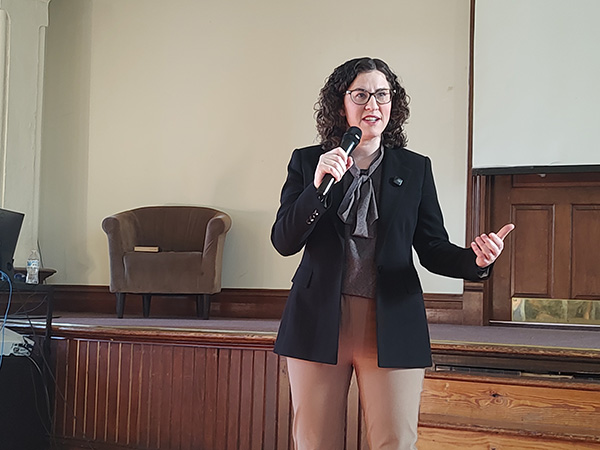 BELMONT — Amanda Achtman is a young adult from Canada who has dedicated her life to battling euthanasia and assisted suicide.
Her home country is one of several nations that have legalized dying by euthanasia, an issue that U.S. Catholics and people of faith should be concerned about as more states are legalizing assisted suicide, she recently told audiences in North Carolina.
The key difference between the countries is that the United States does not allow euthanasia, which is administration of life-ending medication by a doctor. Several states do allow assisted suicide, which occurs when a patient self-administers life-ending medication.
Achtman, the founder of the Dying to Meet You Project – a program that combats euthanasia and promotes hope, recently spoke at Belmont Abbey College and the Converging Roads Catholic medical conference in Charlotte. She is also the ethics director for Canadian Physicians for Life and an instructor of Catholic Bioethics for St. Bernard’s School of Theology and Ministry in Rochester, N.Y.
In Canada, she said, statistics show “one in 20 deaths is caused by a doctor or nurse…what started out as exceptional and the most extenuating of circumstances has become routine.”
Canada legalized assisted suicide and euthanasia in 2016. The procedure is most often known as MAID (Medical Assistance In Dying.) In the past decade, statistics show that more than 76,000 Canadians have chosen euthanasia. Once available only to the terminally ill, the nation has extended euthanasia to people with disabilities and is set to make it available to some people with mental illness in March 2027.
As the justifications have expanded, Achtman has heard from disabled and elderly people who have been offered euthanasia when they were simply seeking medical treatment.
“MAID is an attack on self-worth – it deflates and defeats a person’s self-worth and self-value just to have it offered,” she said. “I’ve had Canadians with disabilities say ‘MAID is the only thing the government tells me I qualify for right now.’ That’s very dehumanizing. That kind of language signals that there is a category of people who should just not be here. This is why euthanasia is a life issue that’s coherent with all other life issues – it’s a situation where life is discarded, dismissed and discounted.”
Euthanasia also brings up core issues of the patient’s relationship with their loved ones and their God-created self.
“We all know that other people can dehumanize us and mistreat us, but do we have the humility to recognize when we do it to ourselves?” she asked. “That is what is happening in Canada – people are discarding themselves subconsciously because of fears of being a burden, living too long and using up inheritance money, fears that if they are not independent then life is not worth living … our life is more than appearances and achievements.”
People wanting to end their lives because of suffering need two things – a health care system that offers them adequate care and relief, such as hospice and palliative care in terminal situations, she said. She also emphasized that people seeking an end to physical or mental suffering desperately want and need loved ones to advocate for them.
“We don’t always have the strength at any given moment to be strong and fight for our own value,” she said. “People throughout life experience depression and sometimes suicidal ideation, and what should not be accepted and what we shouldn’t abide is letting people concede and capitulate to that ideation. Resistance to suicidal ideation is always an act of love.”
She called euthanasia “quite literally the opposite of love,” a procedure that “goes to the heart of the issue of whether it is good to be a person in the world after all.”
“We who are full of hope and ideals and faith have to look out at the culture … and say we love you too much to see you go through with this,” Achtman said. “You are worth fighting for, and we’re going to create a culture where life is valued rather than death.”
— Christina Lee Knauss
What are euthanasia and assisted suicide? Where are they legal?
Assisted suicide occurs when a patient administers life-ending medication.
Euthanasia occurs when a doctor administers life-ending medication with patient permission.
- Assisted suicide is legal in 13 states as well as Washington, D.C.: California, Colorado, Delaware, Hawaii, Illinois, Maine, Montana, New Jersey, New Mexico, New York, Oregon, Vermont and Washington. Euthanasia is not legal anywhere in the United States.
- Euthanasia is legal in several countries, including Australia, Austria, Belgium, Canada, Colombia, Luxembourg, the Netherlands, New Zealand, Portugal and Spain.
— Source: Dignity in Dying