


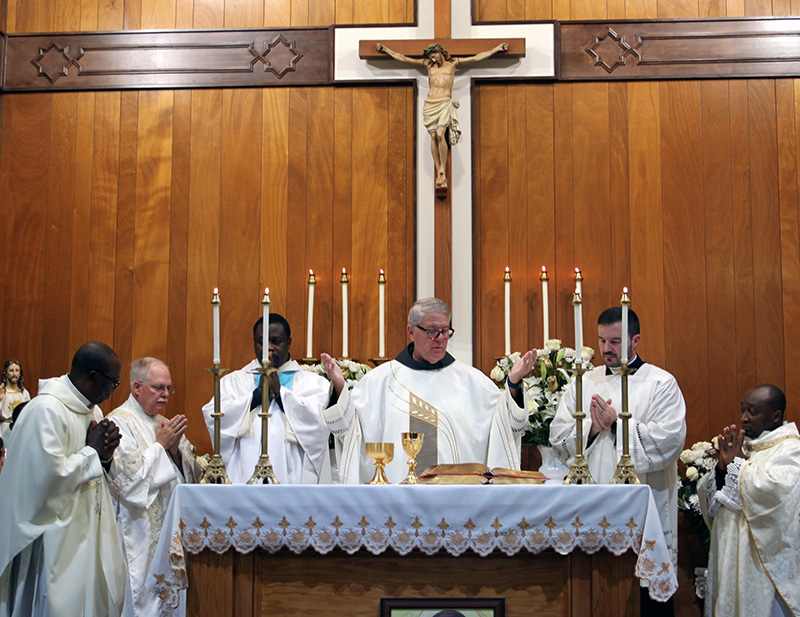
 WINSTON-SALEM — St. Benedict the Moor, one of four historically Black churches in the Diocese of Charlotte, marked its 85th Anniversary Oct. 25 with a Mass celebrated by Bishop Michael Martin.
Alongside the bishop, parochial administrator Father Melchesideck Yumo and the first Black priest to serve the parish, Father Basil Sede, shared in the joyous day.
The celebration recognized the parish's founding during the Jim Crow era in 1940 to serve persecuted Black Catholics, as well as its modern transition into a predominantly Hispanic parish.
“We come here today grateful, grateful to those who came before us, and as much as we look around and imagine what they must have thought, what will people 85 years from now say about all of us?” the bishop asked in his homily.
The once all-Black parish now consists of predominantly Hispanic members who work tirelessly to ensure the next generation remembers the church’s history.
The Hispanic population has exploded across the Diocese of Charlotte since the late 1990s, now comprising roughly 50% of the diocese’s more than 565,000 Catholics. St. Benedict the Moor celebrated its first Spanish Mass in 1999.
“We started coming here 15 years ago because I wanted to receive my Confirmation in Spanish, and we just fell in love with this small church and the big community,” parishioner Angelica Leonides said. “Father Yumo has definitely brought both communities together, and he’s made the church better. We love him.”
At the anniversary Mass, black parishioners sat among their Latin-American brothers and sisters in Christ, knowing they will inherit the small church they started, a common reality they have grown to love and accept.
“If these walls could talk, think about what they would say to us after these last 85 years. Think of what they heard, what they have seen,” Bishop Martin said.
Though the walls can’t literally speak, a living “piece of history,” Willie King, reverently nicknamed “King Willie,” can. He was the first baby baptized in the church in 1943 and has served as an altar server for the past 72 years.
King may be 86, but he remembers the roots of the Catholic faith which bear the names of his ancestors.
“I remember my grandfather had to sit in the back of St. Leo, but one day he said, ‘We aren't doing this anymore,’” King said. “A Franciscan priest overheard, and they commissioned a church to be constructed for $50,000. That church sits right here.”
The church from his youth may not be the same as it is today, but it is not dying anytime soon, and that reality comforts King.
King explains how many in the community converted to Catholicism while attending St. Benedict Grammar School or St. Ann Academy, both closed in the 70s.
“Now that the school closed, we don’t have the influx we used to have,” King said. At the same time, King said, the population is shifting and there are far fewer African American Catholic children in the area. “We have the Hispanics coming up now, and they are doing a super job filling in the gap,” King said. “But as far as Blacks, we’re getting old, and there are only a few of us left.”
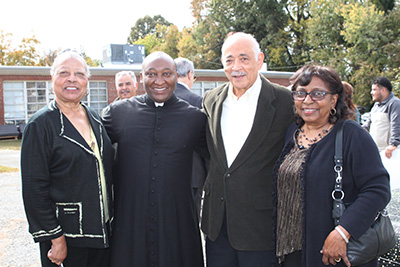
The Gospel reading from Matthew reminded the congregation of the instruction, “Come to me, all you who labor and are burdened, and I will give you rest.”
The bishop pondered how many people have found rest from their burdens over the years as they walked through St. Benedict the Moor’s double doors.
The walls are painted with layers of endurance, parishioner Harold Holmes said, and that endurance is the glue that bonds the communities together.
Holmes, leader of the parish council, has attended the church since the early 80s.
“This day is humbling because I have had both children and grandchildren cycle through here,” Holmes said. “But the Church endures through thick and thin… The goal is to see this church carrying out its original purpose – to endure.”
Holmes explained how a congregation with lots of differences but even more similarities came together.
“We learned that we accomplish more working together than separately,” he said.
During his homily, the bishop instructed the members to do something powerful with what they have been given.
“Is this the last chapter in the life of this parish?” the bishop asked.
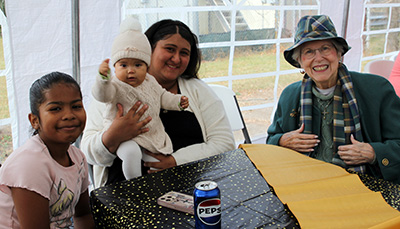 Dr. Betty Alexander, a Black parishioner since the 70s, is creating not just a new chapter but an entire book. For the past 10 years, her team, the St. Benedict the Moor History Committee, has gathered documents, pictures and testimonials, compiling everything into a manuscript.
“I heard what the bishop said about what would be our legacy. Hopefully this will be our legacy,” said fellow history committee member Lois Jones.
Bishop Martin, a Conventual Franciscan Friar, said it was his honor to preach in the same sanctuary his religious brothers before him helped construct.
After Mass, Father Yumo brought that honor and message full circle by surprising the bishop with a framed piece of the former altar carved with the universal symbol of the Franciscans.
The bishop ended his homily by asking parishioners not to limit the celebration to the 85-year-old structure but to bring the Good News out to their schools, soccer games and work.
“There are people out there dying of malnutrition in the Holy Spirit,” he warned. “We have to start sharing and inviting and bringing people along with us so that 85 years from now they will look back on us and say, ‘Praise God for what they did. Because of what they did, we are here today,’” Bishop Martin said.
— Lisa M. Geraci