


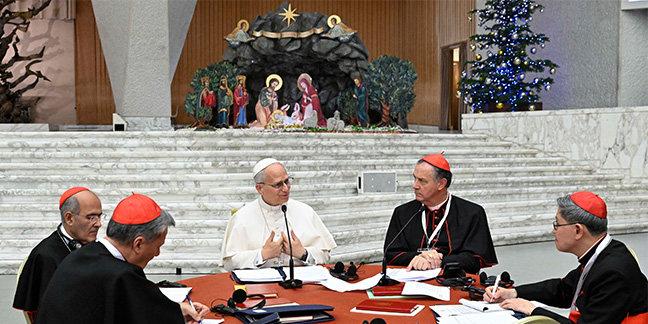
 Pope Leo XIV holds a consistory with cardinals from around the world at the Vatican Jan. 7, 2025. (OSV News photo/Simone Risoluti, Vatican Media)
VATICAN CITY — Pope Leo XIV and members of his College of Cardinals have begun what is a kind of synodal journey together to grow in communion and discern together "what the Lord is asking of us for the good of his people."
After convening the international group of cardinals in Rome for an extraordinary consistory Jan. 7-8, the pope decided to make the gathering an annual event, however with an additional meeting later this year.
It marked an approach that vastly expanded on what Pope Francis established after his election in 2013. Wishing for a more decentralized and listening Church, the late pope created a nine-member Council of Cardinals to help and advise him on several critical matters facing the Church, particularly the reform of the Roman Curia, by meeting at least quarterly in Rome.
Pope Leo decided he would be inviting all the world's cardinals to Rome every year for a few days, Matteo Bruni, director of the Vatican press office, told reporters at a news conference after the consistory ended Jan. 8.
College members will meet with the pope again for at least three days sometime in June, possibly around the feast of Sts. Peter and Paul, June 29, and then the gathering will be held over three to four days once a year in the following years.
The College of Cardinals is made up of 245 cardinals from all over the world. About 170 of them -- about 69% -- made it to Rome after the pope's invitation Dec. 12 that they come together again for the first time since the conclave that elected him May 8.
Cardinal Timothy Radcliffe, a Dominican theologian, offered a reflection Jan. 7 to help the cardinals understand their role not just as advisers to the pope, but as much-needed companions along life's way.
He recalled St. Mark's account of Jesus making his disciples go out ahead of him by boat, which encountered a "great storm."
Jesus does not want Peter or any of the disciples to go into the storm alone, he said. "This is our first obedience, to be in the barque of Peter, with his successor, as he faces the storms of our times."
Some of the storms shaking the Church, he said, include "sexual abuse and ideological division. The Lord commands us to sail out into these storms and face them truthfully, not timidly waiting on the beach. If we do so in this consistory, we shall see him coming to us. If we hide on the beach, we shall not encounter him."
However, Cardinal Radcliffe said, "If the boat of Peter is filled with disciples who quarrel, we shall be of no use to the Holy Father. If we are at peace with each other in love, even when we disagree, God will indeed be present even when he seems to be absent."
Pope Leo emphasized the essential element of love in his opening remarks to the cardinals in the Vatican's Synod Hall Jan. 7.
"To the extent that we love one another as Christ has loved us, we belong to him, we are his community, and he can continue to draw others to himself through us. In fact, only love is credible; only love is trustworthy," he said.
"Therefore, in order to be a truly missionary Church, one that is capable of witnessing to the attractive power of Christ's love, we must first of all put into practice his commandment … 'Just as I have loved you, you also should love one another,'" the pope said. Jesus underlined that it will be by a Christian's love that the world will know "that you are my disciples."
The "collegial journey" that they have begun with their first consistory, he said, would be an opportunity to reflect together on two themes of their choice out of the following four themes: the mission of the Church in today's world, especially as presented in Pope Francis' "Evangelii Gaudium"; the synod and synodality as an instrument and a style of cooperation; the service of the Holy See, especially to the local Churches; and the liturgy, the source and summit of the Christian life. The cardinals voted with "a large majority" to discuss the first two themes -- mission and synodality, Bruni told reporters.
Following a synodal structure, the cardinals were broken into 21 groups, but nine of those groups, made up of cardinals under 80 years old, who were not resident in Rome, were asked to submit reports based on their small group discussions, which followed the Synod on Synodality's "conversation in the Spirit" method.
"I am here to listen," Pope Leo told the cardinals before they began their two days of reflection and dialogue.
"We must not arrive at a text, but continue a conversation that will help me in serving the mission of the entire Church," he said. Specifically, he wanted the groups to look at the next one or two years and consider what "priorities could guide the action of the Holy Father and of the Curia regarding each theme?"
The pope further encouraged the cardinals the next day in his homily during an early morning Mass in St. Peter's Basilica.
Their task, he said, was to discern what "the Lord is asking of us for the good of his people," not "to promote personal or group 'agendas.'"
Through prayer, silence, listening and sharing, he said, "we become a voice for all those whom the Lord has entrusted to our pastoral care in many different parts of the world."
Speaking to reporters at a news conference after the consistory, Cardinal Luis José Rueda Aparicio, archbishop of Bogotá, Colombia, said the experience "strengthened us" individually and as a group as they got to know each other better.
The pope underlined how important hope was in the life and mission of the church, he said. When Christ is at the center of one's life, proclaiming his word "fills us and the world with hope."
Cardinal Stephen Brislin, archbishop of Johannesburg, South Africa, told reporters the vast differences between cardinals -- with their different perspectives and needs -- proved to be "very enriching" and interesting, and not a source of contention.
Cardinal Pablo Virgilio David, bishop of Kalookan, Philippines, told reporters the synodal format and style of the consistory "was familiar" to those who had taken part in the synodal assemblies in Rome in 2023 and 2024.
When asked if it seemed the pope was going to use their sessions to inform or contribute to any kind of papal document, Cardinal David said, "I don't know," but the pope was "taking notes very seriously so he must be up to something."
Cardinal Brislin said there is no indication that a document was the aim of the gathering, and it was more a concrete response to the cardinals' request that they meet.
Cardinal Aparicio said by listening to all the world's cardinals, the pope "listens to the different parts of the world."
— Carol Glatz, Catholic News Service
Cardinals leave consistory with a clear vision from pontiff: 'A Church that cares'
-
Cardinals leave consistory with a clear vision from pontiff: 'A Church that cares'
VATICAN CITY — After an intense day of roundtable discussions, the "low-batteried" but "very pleased" cardinals wrapped the first historic extraordinary consistory convened by Pope Leo XIV in a spirit of fraternity, with a sense of knowing each other better and saying they "discovered" the pope, while he did "more listening than talking." They left the consistory with a clear vision of the new pontiff for "a Church that cares."
Pope Leo intends to continue consistory discussions once a year, with the next consistory planned for the end of June and following ones scheduled once a year, lasting 3-4 days, Matteo Bruni, director of the Holy See Press Office, confirmed during the evening press conference.
The pope, according to Bruni, told cardinals Jan. 8 that the consistory is designed as a "continuity with what was requested during the cardinals' meetings before the conclave and also after the conclave," and that the synodal methodology used "was chosen to help them meet and get to know each other better."
Salesian Cardinal Cristóbal López Romero of Rabat, Morocco, told journalists waiting for the cardinals in front of the Paul VI Audience Hall that, with the level of fraternity reached during merely 15 hours of the consistory discussions, "the College of Cardinals has been strengthened."
He said he is "very pleased," as the meeting "has allowed us to get to know each other a little better, to share, and because it will also continue."
"I believe it has been a way of reaffirming that there is continuity -- not so much with Pope Francis, but with the Gospel, with the Second Vatican Council, and with all the magisterium that has emerged as a consequence of this Second Vatican Council. So in that sense, I am very pleased with the results," he said.
Cardinal Stephen Brislin of Johannesburg, present at the evening press conference in the Vatican Press Office, told journalists, "The importance of this consistory was not solely in the discussion that took place," but in the possibility "to listen to each other and to get to know each other" as the prelates "haven't known each other very well."
He stressed that the meeting "has been an assistance" to Pope Leo "as successor of St. Peter" and that it proved that synodality is "a way of being Church" -- and a "disposition" of the Church.
The second day of the consistory reminded the cardinals of the Synod on Synodality, with three-minute interventions from participants in group discussions, sharing meals and thoughts -- from "the treasure that the Gospel is for mission," through necessity to approach people's "broken lives with humility," and to synodality as "a tool for growing relationships," Bruni said.
Asked whether there were any tensions -- especially upon scrapping liturgy and Church governance from the list of issues to discuss, and leaving "Evangelii Gaudium" and synodality on the table -- the South African Cardinal Brislin said it was a "pleasant experience, friendly experience," and that "the pope wants to be collegial" and learn from "the richness that comes from the experiences of people" coming from different parts of the world.
Cardinal Luis José Rueda Aparicio of Bogotá, Colombia, also present during the press conference, added that "sometimes there is criticism or different positions -- but we try to reach harmony, which does not mean uniformity, but going back to the roots," which he referred to as the Second Vatican Council.
The themes of the June consistory are yet to be named, and were not specified when OSV News asked during the news conference whether liturgy or other pressing themes that have emerged would be addressed in the next consistory.
Cardinals walking out of the Paul VI Hall confirmed to OSV News, however, that during the Jan. 7-8 consistory there was no time to discuss liturgy.
The list of cardinals that participated in the extraordinary consistory has not been released, only the number -- 170. But the Vatican said the pope met 93-year-old Cardinal Joseph Zen on Jan. 7, and on Jan. 8 the pontiff specifically thanked the senior cardinals for making the effort to come.
Cardinal Zen, bishop emeritus of Hong Kong, had to get permission from the judicial authorities in Hong Kong to attend the consistory.
Passing the pope's words to journalists, Bruni said the pope emphasized: "'Your witness is truly precious,' reaffirming his closeness to the cardinals around the world who were unable to come."
"We are with you and we feel close to you," he said, repeating the pope's words, as some cardinals, like Cardinal Baltazar Porras of Venezuela, whose diplomatic passport was confiscated by the regime, were unable to come.
Cardinal Pablo David of Kalookan, Philippines, present at the press conference, said, "It was really refreshing to see the Holy Father was more listening than talking" during the consistory and added that while no concrete decisions have been made, "he was taking notes very, very seriously, so he must be up to something."
Dominican Cardinal Jean-Paul Vesco of Algiers, Algeria, speaking to journalists outside the Paul VI Hall, said that the consistory was "a wonderful time," emphasizing that it was not only a time for the cardinals to know each other, but for them to discover the personality of Pope Leo.
"This Pope is ... a pope you want to love. He's ... deeply kind. He loves. He was there, present, simply. It was beautiful," the cardinal, who may see the pope coming to his country in the footsteps of St. Augustine, told journalists.
He described the pontiff as "consistent" and "straightforward" in his "simplicity."
He said he leaves the consistory with a notion that the cardinals "feel loved" by their boss and "want to love him" with a certain level of fraternity being a clear fruit of the gathering.
"He completely succeeded in that from the very first time," Cardinal Vesco said, chatting the longest of all cardinals with journalists, including OSV News.
Emphasizing the need for teamwork in the Church, the pope told the cardinals in his off-the-cuff remarks on Jan. 7: "I experience the need to be able to count on you: you are the ones who called this servant to this mission!" adding in his introductory speech that the consistory will "point the way for our path ahead."
Cardinal Vesco said that even with such a short gathering, it is clear that Pope Leo “wants a Church ... that is both a missionary Church that proclaims the Gospel, but also a Church that cares," and "that is precisely in this form of communion and fraternity."
"Before anything else, rather than just talking about things, he does them. And to me, that seems very solid," Cardinal Vesco said, stressing "we can clearly feel that this reservoir of trust" the pope puts in the College of Cardinals "is a value, a value that will stand the test of time."
"The emphasis is more on the relationship part than content," Father Jordi Pujol, associate professor of the Pontifical University of the Holy Cross in Rome, told OSV News. While a day and a half is too short of a timeframe to deeply discuss any issue, let alone the four projected at the beginning of the meeting, Father Pujol stressed that the pope "wanted to show he is starting his pontificate as a good leader, and a good leader is making the cardinals know each other."
A good leader, Father Pujol added, is one that says "don't expect all coming from me -- it's the team that is going to move things forward. It shows that he is not personalistic, and it sets up his style" of listening first, the professor of media ethics and media law at the School of Church Communications said.
Cardinal Claudio Gugerotti, prefect of the Dicastery for the Eastern Churches, echoed this sentiment in his brief comments to journalists, including OSV News, saying the pope "was also very eager to exchange a few words, to connect with others in a very simple, informal way, and that was very pleasant."
Joking about the Italian nature of the Vatican consistory, he added, "The lunch was excellent. Unfortunately, we missed the nap."
— Paulina Guzik, OSV News
You are not experts promoting agendas, but a community of faith
-
Pope to cardinals: You are not experts promoting agendas, but a community of faith
VATICAN CITY — Pope Leo XIV gathered cardinals present for the extraordinary consistory this week for an early morning Mass Jan. 8 in St. Peter's Basilica, telling them they're together not to promote "agendas," but to take part in a "discernment" that "comes from the Lord."
In the afternoon of Jan. 7, as the consistory started, the cardinals chose two themes to discuss during the gathering -- the missionary nature of the church based on Pope Francis' "Evangelii Gaudium," and synodality as a means of effective collaboration with the pope. Because of time constraints, they were limited to two of the four initially proposed topics, which meant setting aside liturgy -- "the source and summit of the Christian life," in the pontiff's own words -- and governance of the Roman Curia for this meeting.
Pope Leo told the cardinals gathered in St. Peter's for 7:30 a.m. Mass that they are at the consistory "not to promote personal or group 'agendas,' but to entrust our plans and inspirations to a discernment that transcends us ... and which comes only from the Lord," encouraging 170 cardinals present to "place each of our hopes and ideas upon the altar."
"Our College, while rich in many skills and remarkable gifts, is not called primarily to be a mere group of experts, but a community of faith," the pope said. "Only when the gifts that each person brings are offered to the Lord and returned by him, will they bear the greatest fruit according to his providence."
Encouraging the cardinals in their service, the pope reminded them that what they offer to the Church, at every level, "is something profound and very personal, unique to each of you and precious to all. The responsibility you share with the Successor of Peter is indeed weighty and demanding."
After the Mass, the cardinals moved to the nearby Paul VI Audience Hall for a full day of discussions.
Reflecting on the meaning of the consistory, the pope said during the morning Mass that the world consistory -- "consistorium" in Latin, or assembly -- "can be understood through the root of the verb consistere, meaning "to stand still," highlighting how the cardinals paused their busy daily schedules "in order to be here."
"We have set aside our activities for a time, and even canceled important commitments, so as to discern together what the Lord is asking of us for the good of his people," Pope Leo said. "This itself is already a highly significant and prophetic gesture, particularly in the context of the frenetic society in which we live."
"It reminds us of the importance, in every aspect of life, of stopping to pray, listen and reflect. In doing so, we refocus our attention ever more clearly on our goal," the pope emphasized.
Through this pause, the pope said, the cardinals manifest "a profound act of love for God, for the Church and for the men and women of the whole world," allowing themselves "to be formed by the Spirit: primarily in prayer and silence, but also by facing one another and listening to one another."
Pope Leo stressed that the cardinals "may feel inadequate," faced with the pressing challenges of the contemporary world "where satisfaction and hunger, abundance and suffering, and the struggle for survival together with a desperate existential emptiness continue to divide and wound individuals, communities and nations."
But in this, Pope Leo said, the cardinals, along with the pope, "may not always find immediate solutions to the problems we face, yet in every place and circumstance, we will be able to help one another," and in particular, to help the pope, he said, "to find the 'five loaves and two fish' that providence never fails to provide wherever his children ask for help."
— Paulina Guzik, OSV News
'I am here to listen' Pope Leo tells cardinals at start of consistory
-
'I am here to listen' Pope Leo tells cardinals at start of consistory
VATICAN CITY — With 170 red hats present in Vatican City, the extraordinary consistory of cardinals started at 3:30 p.m. Rome time with Veni Creator Spiritus sounding in the Synod Hall inside the Vatican City walls. They later moved to round tables in the Paul VI Audience Hall, where the cardinals held group discussions.
In opening remarks, Pope Leo XIV met the cardinals with one crucial message: "I am here to listen."
"As we learned during the two Assemblies of the Synod of Bishops of 2023 and 2024, the synodal dynamic implies a listening par excellence," the pope told the cardinals. "Every moment of this kind is an opportunity to deepen our shared appreciation for synodality."
Calling the meeting "highly significant," and voicing expectations that the gathering will be one of the defining moments of his papacy, the pope said. "This day and a half together will point the way for our path ahead. We must not arrive at a text, but continue a conversation that will help me in serving the mission of the entire Church," he said.
Clearly answering a concern voiced during the general congregations before the May 2025 conclave that elected Pope Leo -- that the cardinals didn't know each other well -- the pope told the cardinals that while they "are a very diverse group, enriched by a wide range of backgrounds," they are still "called first to get to know one another and to dialogue, so that we may work together in serving the Church. I hope that we can grow in communion and thus offer a model of collegiality."
Urging unity, one of the main themes of his pontificate, Pope Leo told the gathering that "While unity attracts, division scatters," therefore "in order to be a truly missionary Church, one that is capable of witnessing to the attractive power of Christ’s love, we must first of all put into practice his commandment, the only one he gave us after washing his disciples' feet: 'Just as I have loved you, you also should love one another.'"
He said that due to time constraints, only two topics out of four proposed to cardinals prior to the gathering would be discussed during the meeting. The four options included "Evangelii Gaudium" and the mission of the church; "Praedicate Evangelium" and the service of the Holy See; synodality as an instrument of cooperation; and liturgy -- the source and summit of the Christian life. Through a vote, the cardinals decided to focus on the missionary nature of the church, based on Pope Francis's programmatic apostolic exhortation "Evangelii Gaudium," and synodality, Matteo Bruni, director of the Holy See Press Office, confirmed Wednesday evening.
At the opening of the meeting, a meditation from Cardinal Timothy Radcliffe reminded the cardinals "of not leaving the successor of Peter alone as he faces the storms of the world," Bruni said about the British Dominican cardinal's meditation.
"Jesus commanded the disciples to get into the boat and go before him. Peter must not go into the storm alone," Cardinal Radcliffe told the cardinals. "This is our first obedience, to be in the barque of Peter, with his successor, as he faces the storms of our times. We cannot remain on the beach saying, ‘Myself, I would not go sailing today.’ Or ‘I would choose a different boat.' Jesus is alone on the mountain, but Peter must not be unaccompanied.”
Images and video from the extraordinary consistory shared with journalists by the press office brought to mind the images of the Synod on Synodality as cardinals moved to the Paul VI Audience Hall after the initial remarks of the pope and Cardinal Radcliffe, where they were divided into 20 groups. Nine tables were occupied by ordinary bishops of dioceses across the world and nuncios, while 11 were taken by curial officials and non-electors -- specifically cardinals over 80. Each group had a president and secretary.
The pope was not present during the table discussions, Bruni said, except to offer brief closing comments.
To determine the topics to be discussed, "all groups gave their recommendations," Bruni said during the evening briefing. "However, due to time constraints, only the secretaries of the first nine (groups), which include the cardinals of the local churches, were given three minutes to explain the work done within the groups and the reasons behind (their) choice ... . The secretaries of the other 11 groups, however, only provided the titles of the chosen topics."
"Among these 20 groups, there was no group that voted for another topic; that is, they were chosen by majority vote," he confirmed.
Thanking the cardinals at the conclusion of the session on Jan. 7, Pope Leo "repeated the words of one of the secretaries, who mentioned how the path is as important as the conclusion," Bruni told journalists.
"He mentioned the importance of the participation of everyone in terms of an experience of collegiality in the Church, the will, the desire, the sacrifice of the journey," he said of the pope's final remarks.
The pope said "the time is short, but it is important," thanking some of the cardinals for traveling a long distance to reach Rome for the gathering," Bruni said.
"Also for me, I feel the need to come to you. You have called the servant to this mission, and it is important that we discern together," the pope told cardinals, according to Bruni, as they wrapped the first day of discussions.
Paraphrasing his own questions from his Epiphany's Mass homily Jan. 6, Bruni said the pope asked the cardinals: "Is there life in our Church? Is there room for what is born? Do we proclaim a God that puts people back on a path?"
Referring to the topic chosen by the cardinals -- the missionary zeal of "Evangeli Gaudium" -- Pope Leo said, according to Bruni, "The joy of the gospel liberates. It makes people more attentive, but also more audacious. It suggests paths which are different from the ones that have already been walked upon. This is the experience of the novelty of the Church."
"There may be doubt. There may be fear. Where shall we go?" Bruni the pope asked. "But if we put our trust in the Lord and in his presence, we can do great things. It is not possible to separate one theme from another. The missionary church which looks beyond itself, that is the reason to proclaim the Gospel. And that is our mission."
— Paulina Guzik, OSV News