


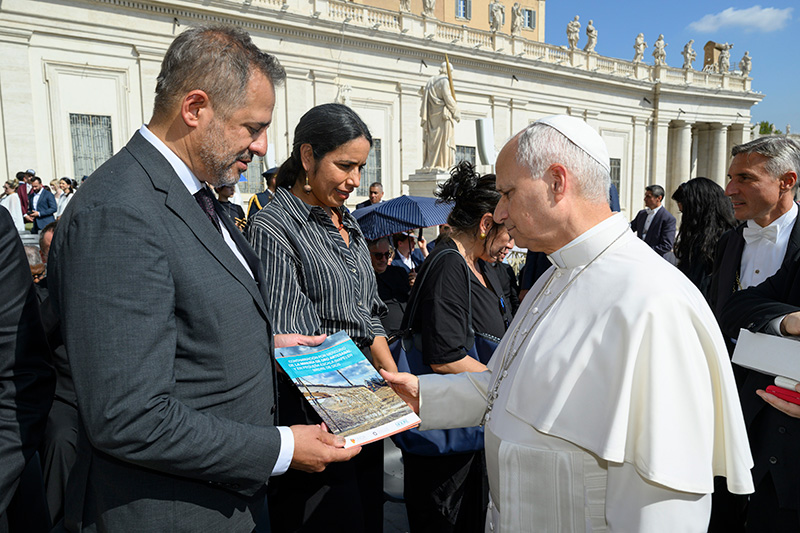
 Wake Forest University research professor Dr. Luis Fernandez and colleague Dr. Claudia Vega were part of a delegation invited to brief Pope Leo XIV on the environmental damage of gold mining in the Amazon. (Vatican Media)WINSTON-SALEM — If Pope Leo addresses environmental concerns as he is expected to during his Nov. 15 trip to Peru, decades of research by scientists from Wake Forest University will have informed his thinking.
Four scientists from the Center for Amazonian Scientific Innovation (CINCIA) had the opportunity to put their work in the pope’s hands Sept. 30 at the Vatican.
“It felt like Willy Wonka and Charlie and the Chocolate Factory where you get the golden ticket,” said lifelong Catholic Luis Fernandez of the experience. As the Wake Forest research professor of biology and CINCIA co-founder related, “There’s this gold-colored ticket with a little red corner that says your name and the party and the time.”
That ticket allowed him and three colleagues to hand the pope their brief that documented mercury contamination caused by gold mining across Peru, Bolivia, Brazil and Colombia.
“That evidence shows that mercury associated with gold mining does not stay at the mine – it moves through ecosystems and ultimately reaches people, including some of the Amazon’s most vulnerable Indigenous communities,” Fernandez said.
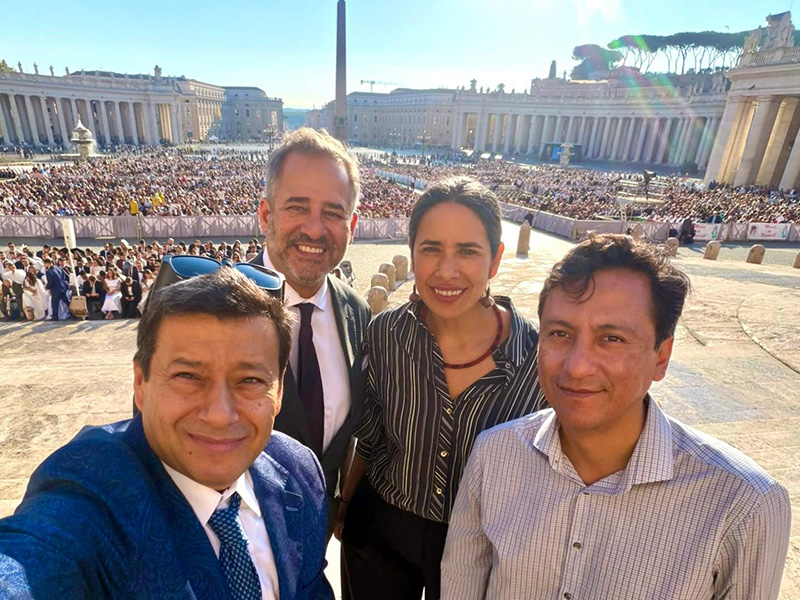
Protecting vulnerable people and the integrity of the Amazon is important to the pope, who is a citizen of Peru and served as Bishop of Chiclayo.
“We expect him to have a statement on the importance of preserving nature in protecting Indigenous peoples,” Fernandez said.
This isn’t the first pope to take an interest in CINCIA’s work. In 2018, Pope Francis visited Madre de Dios, Peru, to highlight the devastation of the rainforest and champion the rights of the people who have suffered from mercury pollution. The studies conducted by Wake Forest and CINCIA were included in a document the pope used to prepare for his trip.
When they handed their research to Pope Leo, “we had a very short discussion,” Fernandez said, “but he said that this was an important issue, and we hope that he’ll carry the message and amplify it and speak for the rights of those that can’t be heard.”
For Fernandez, who spent 12 years in Catholic school, the moment was beyond his imagination.
“When I started 25 years ago as a scientist working on something that seems as esoteric as gold mining in the Amazon, I never thought that I’d be talking to the pope about mercury pollution,”
Fernandez said. “I was thinking about me 10 years old with my little white shirt and my little clip-on tie walking with my sister in her plaid school outfit. You just never imagine yourself doing … or even fathoming that it would be possible, so it was a little surreal.”
— Trish Stukbauer