


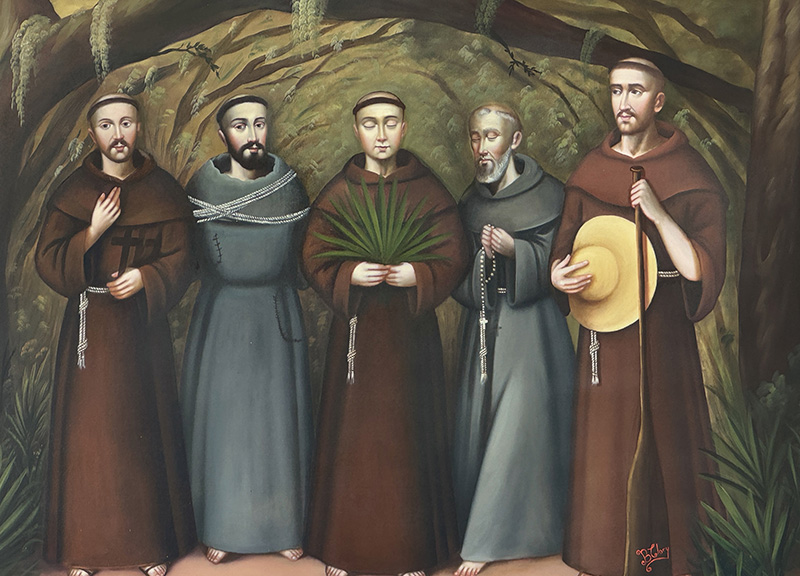
SAVANNAH — On Oct. 3, Catholics around the world marked the 800th anniversary of the death of St. Francis of Assisi. Not long after his death in 1226, his spiritual sons would carry the Gospel far beyond Italy to Africa, Asia and, eventually, to the Americas. And on Oct. 31, the Church will beatify five Franciscan missionaries from Spain who were martyred in 1597 in what is now the state of Georgia.
The beatification comes at fitting moment, just days after Catholics around the world mark World Mission Sunday on Oct. 18. This annual observance celebrates the Church’s enduring call to bring the Gospel to the ends of the earth and the role every Catholic plays in that mission through prayer, sacrifice and generous giving.
A powerful story
The story of the Georgia Martyrs offers a powerful early example of that missionary spirit on American soil. More than two decades before the pilgrims landed at Plymouth, Franciscan missionaries had already left Spain to evangelize the Indigenous peoples along what is now the Georgia coast. They established missions among the Guale people, learning their language and customs, preaching the Gospel and celebrating the sacraments.
Guale society was organized around a network of villages, with leadership mostly passing through matrilineal lines. Upon the death of the cacique (chief), the chiefdom transferred to the son or daughter of the cacique’s eldest sister. Because this structure was built upon a system of inheritance through the female, it was common for chiefs to take more than one wife.
The Franciscans, however, taught that those who had accepted baptism were also called to embrace the Christian understanding of marriage, which excludes any kind of plural marriage. That teaching brought one of these Franciscans, Father Pedro de Corpa, into conflict with Juanillo, a young man who was heir to an important chiefdom. When Juanillo sought to take a second wife, de Corpa reminded him that, as a Christian, he could not do this. In response, Juanillo and several followers killed de Corpa on Sept. 14, 1597.
The group then moved from mission to mission, killing the friars Blas Rodríguez, Miguel de Añon, Antonio de Badajóz and Francisco de Veráscola.
Complexity of cultures
There is a danger in telling their story simply as a clash between Christianity and Indigenous culture. The encounter between Europeans and the native peoples of the Americas was enormously complicated, and its history includes exploitation, violence and profound cultural loss. But acknowledging that larger history should not obscure the particular witness of these five men who lost their lives in service of Christ and his Gospel. They had left their homes and familiar surroundings to live among people whose language and way of life were vastly different from their own.
The Dicastery for the Causes of Saints has pointed to that initial decision as the first evidence of their willingness to give their lives for Christ. Their martyrdom did not begin on the days in September 1597 when they were killed. It began when they allowed themselves to be sent.
These five could not have imagined that the missions where they labored would one day become part of the United States, much less the vibrant Catholic Church that would take root here. But that is often the way the Gospel grows. The seed is planted by people who never live to see the harvest.
Nor were they the last missionaries to make the ultimate sacrifice on this continent. On Oct. 19, the Church celebrated the feast of the North American Martyrs (St. Isaac Jogues, St. Jean de Brébeuf and their companions). These French Jesuit missionaries crossed the Atlantic to bring the Gospel to the Indigenous peoples of New France, in what is now Canada and upstate New York.
Their stories bear striking similarities to those of the Spanish Franciscans. They too left behind the familiarity and security of Europe, and they, too, ultimately gave their lives for the mission they had embraced.
Centuries later, the direction of that missionary movement would change. The Church in the United States, once a mission territory, would send its priests, religious and lay people to bring the Gospel to other parts of the world. And some of them, too, would pay the ultimate price.
Among them were four American women who were murdered in El Salvador in December 1980.
Stanley Rother, a priest of the Archdiocese of Oklahoma City serving in Guatemala, remained with his people amid growing violence, insisting that “the shepherd cannot run,” and on July 28, 1981, he was murdered in his rectory. Beatified in 2017, he became the first U.S.-born martyr recognized by the Church.
When the five Georgia Martyrs are beatified on Oct. 31, we will remember not only the sacrifice of these brave Franciscans, but also the missionary story they represent. Their witness reminds us that the call to mission belongs to every Christian: To carry the Gospel beyond ourselves and trust that God will bring to harvest the seeds we may never see grow.
— Father Anthony D. Andreassi, OSV News Father Anthony D. Andreassi, is associate national director of The Pontifical Mission Societies USA.
More online
At www.diosav.org: Watch the beatification at 11 a.m. on Saturday, Oct. 31, and learn more
Savannah bishop shares timeless witness of Georgia Martyrs ahead of beatification
-
Savannah bishop shares timeless witness of Georgia Martyrs ahead of beatification
SAVANNAH — What would you give your life for? This is the question and challenge that Bishop Stephen D. Parkes of the Diocese of Savannah has been putting before young people receiving the sacrament of confirmation as his Georgia diocese prepares for the historic beatification of five Franciscan missionaries who laid down their lives for their Catholic faith on that same soil over 400 years ago.
"This has relevance for today," he told OSV News in a recent interview, "because in our world today, there's just so much happening and so much going on. And we hear all these divergent opinions and you think, 'Well, what do I believe? What do I feel so strongly about that I'm going to shed my blood for it?'"
"We know many are suffering; they're just struggling today and trying to find their place and wondering how their gifts and talents are going to serve the world," he said, "And when we embrace something and we feel strongly about it, well, we stand up for it."
The Georgia Martyrs, five Franciscans from Spain who were martyred in 1597 ministering to the Guale people, without any Spanish military presence, were Friars Pedro de Corpa, Blas Rodríguez, Miguel de Añon, Antonio de Badajóz and Francisco de Veráscola.
"The native peoples adopted them, welcomed them into their culture, and the Franciscans were good at evangelization. So, the five of them, they settled into various missions and they ended up becoming a part of the everyday life of the people," he noted. "That in and of itself was remarkable."
Their martyrdom came after Father Pedro de Corpa stood by the Church's teaching that marriage is between one man and one woman when the soon-to-be chief Juanillo wanted to take a second wife. Juanillo had Father Pedro killed and started an attack on the other Franciscans serving in different missions who were hunted down and killed.
Bishop Parkes observed the distinct personalities of each of the Georgia Martyrs.
"They came from different places in Spain and then they were known for certain things. Blas was a calm and devout pastor," he said, "Miguel was a gentle musician. Antonio was a gifted communicator and Francisco, he was called the Cantabrian Giant. He was an athlete. Apparently, he was well known to the young people ... around St. Simon's Island, where he ministered. He was a wrestler and he really worked with all the young people. He was very good at connecting with them."
"Each one would have suffered individually," he emphasized, "and they would have made that decision to say, 'I am going to give my life for this.' And that's a huge decision."
"This was almost 200 years before our country was even officially founded," he added, "it's very interesting to note that the faith was a part of life in such a way that it made its way to these shores."
Bishop Parkes first heard of the Georgia Martyrs when he became bishop of the Diocese of Savannah in 2020.
"Immediately upon my arrival," he said, "I noticed pictures of these five men around in almost every place that I went; but also, people were very excited to tell me (about them), which says something about the devotional life of the people in the local area. That's been an important part, I believe, of their cause."
"To get to know them, to spread the word, history is so important," he added, "especially in our faith, as we well know, we celebrate history. We learn from history. And I notice in Georgia, there's a great love for history."
The beatification is the first ever in the state of Georgia and the Southeast United States and the sixth beatification to take place on U.S. soil.
Bishop Parkes noted the Georgia Martyrs' cause was brought forward in the 1950s by the Order of Friars Minor, the Franciscans, and in 1984, the late Bishop Raymond W. Lessard officially opened it on behalf of the diocese.
Regarding why the beatification was moving forward now all these years later, he said such things take time: both as people become familiar with the story, but also as their story is appreciated more.
"We don't really know; there's mystery in it," he said. "I've asked that question, 'Why is it that it's happening during my time as bishop?' And there's mystery in that. And I say, 'Well, God has a plan somewhere along the line and I'm very grateful for that because it's a big opportunity for us to promote our Catholic faith.'"
Bishop Parkes said he hopes the beatification might result in a veneration of the Georgia martyrs by married and engaged couples within the diocese.
"Wouldn't it be beautiful if every household, every marriage that's being prepared, every couple preparing for marriage knows the story; that they look to the martyrs for their intercession, to these new blesseds -- as of Oct. 31 -- for their intercession for loyalty, faithfulness, fidelity in their marriage?"
"What a beautiful witness," he said. "Maybe they'll have pictures of them in their home, and that would be something that, again, would be part of our local Catholic culture."
Bishop Parkes said that he attended the beatification of Blessed Fulton J. Sheen in September, calling the experience "beautiful" to be able to "learn more about Fulton Sheen," who was a "great communicator and touched millions and millions of lives."
"The story of the martyrs is different," he said. "It's kind of delving into our history, our heart, realizing that from hundreds of years ago that holy people walked here in our soil and what they went through for our faith to be here today."
"We wonder, we struggle with things in our faith or promoting the faith," he said, "and resistance. What did they face back then? They lost their lives for it, because there was a lack of understanding or an openness about it."
Bishop Parkes was able to visit St. Catherines Island, the only site of martyrdom that has been identified with certainty where Father Miguel de Añon and Brother Antonio de Badajoz lost their lives. The mission on St. Catherines, rediscovered in the 1980s, is located on the privately owned island, and is closed to the general public.
"They were able to recreate what that Guale village looked like, even to the point where we actually have a place there through the generosity of the St. Catherines Island Foundation, we are able to have an outdoor chapel there," he said, adding that the diocese planted a group of palm trees on the outline of the chapel.
"I believe 430 of the natives are buried there," he said. "I went there on All Souls' Day, my very first visit, and it was just a beautiful experience, connecting with the history."
Bishop Parkes said the beatification taking place on Oct. 31, Halloween, was no coincidence.
"We had to submit a number of dates to the dicastery, and then it would be approved by the Holy Father," he explained. "This was our first choice."
"Halloween has taken a dark turn in these last decades," he said, "and there's a lot of nonsense that goes along with it. And I think this is a reminder of what it really is, and that is All Hallows' Eve and the next day is All Saints' Day. So we will be having a Mass of Thanksgiving at the Cathedral Basilica of St. John the Baptist on All Saints' Day, where we will recognize obviously all of the saints, but recognize these new blesseds."
He said, "It's a great connection, I think, to make, that we should live liturgically. And this is an opportunity for us to live the liturgical life of the Church within our secular calendar."
He said that having the beatification on a Saturday would also help those traveling from all over the state to attend as the diocese is over 37,000 square miles.
The diocese is expecting over 8,000 people to be in attendance for the beatification and have already had to expand the event to a larger venue.
"I feel as though we've put into place and planned all of the tools that are needed for a milestone, memorable, spiritually fulfilling celebration," Bishop Parkes said. "We'll let the Holy Spirit take it from there."
— Lauretta Brown, OSV News
Georgia Martyrs' beatification the next big event for US Church
-
Georgia Martyrs' beatification the next big event for US Church
ATLANTA — While six years separate the two most recent U.S. beatifications of Blessed Michael J. McGivney in 2020 and Blessed Fulton J. Sheen on Sept. 24, mere weeks pass before the next: five Franciscan friars known as the Georgia Martyrs on Oct. 31.
Cardinal Frank Leo of Toronto will celebrate the 11 a.m. beatification Mass, which will be livestreamed on social media channels and the diocesan website, diosav.org, as well as by EWTN.
Speaking about the Georgia Martyrs with OSV News, Cardinal Leo said, "We all have that same command from the Lord Jesus to go make disciples."
"The Georgia Martyrs offered more than self-sacrifice," he said. "They brought it to the next level in terms of self-gift. ... It was a choice and a decision to make a gift to the Lord by becoming a gift to his people, who needed to know him and to live for him."
In 1597, the Spanish Franciscans Pedro de Corpa, Blas Rodríguez de Cuacos, Miguel de Añón, Antonio de Badajoz and Francisco de Veráscola were ministering at five missions along the coast and barrier islands of present-day Georgia when they were killed out of hatred for the faith by a band of Indigenous men between Sept. 14-17.
The friars' murders were prompted by Father de Corpa angering the heir to a Guale chiefdom, Juanillo, by telling him that as a baptized Christian, he could not follow his culture's custom and take a second wife. Juanillo and his men killed the priest at a mission near the contemporary city of Eulonia, Georgia, before killing four of the other five Franciscan missionaries ministering in the area. The sixth friar, Francisco de Avila, was kidnapped and tortured for months before being set free. The incident is known as the 1597 Guale Uprising.
At the time, the Spaniards knew the wider coastal area as La Florida, home to the settlement of St. Augustine, established in 1565. By 1595, the friars had established five missions along the coast. Prior to their murders, the six Franciscans appear to have lived among the Guale and other indigenous peoples in peace, without a military presence, for two years.
About a month after the friars were killed, the governor of La Florida led an expedition to locate the martyred friars' bodies. According to the Diocese of Savannah's website on the martyrs, there is no record of Friar Francisco's remains being found. The bodies of Friars Blas, Miguel and Antonio were found buried in shallow graves on St. Catherines Island. The men in the October 1597 expedition reburied them, with the exception of the severed head of Friar Miguel, which they took with them.
Less than a decade later, when Franciscans had returned to the coastline to evangelize, the friars' bodies on St. Catherines Island were exhumed and brought to St. Augustine, but their whereabouts today are unknown. Some scholars speculate that Franciscans took the martyrs' remains with them to Cuba when St. Augustine transferred to British rule in 1763.
Friar Pedro de Corpa was decapitated and his body was not found; the location of his skull is uncertain. A skull recovered at the Fort King George State Historical Site in Darien may belong to Friar Pedro or Father Francisco, and testing is underway to learn more about its origins.
The National Eucharistic Pilgrimage drew attention to the martyrs in May, as the nine perpetual pilgrims spent the third day of their pilgrimage in southern Georgia, walking in a Eucharistic procession at Fort King George, where Friar Francisco is believed to have been killed.
The five Franciscans' martyrdom is "a reminder of how the Church has, over the centuries, continued to send out missionaries to all peoples, to all nations, to faraway places," Father Pablo Migone, vicar for mission advancement for the Diocese of Savannah, said during that visit. "That is something we have done from the very beginning from the words of Jesus to the apostles."
The Beatification Mass is not ticketed, and seats in the Savannah Convention Center are first come, first served. Doors for the liturgy open at 8 a.m. Oct. 31. The convention center will host the Georgia Martyr Museum between 8-10:30 a.m. and 1-2:30 p.m.
The Mass coincides with Halloween, the eve of All Saints' Day. It also coincides with the Jubilee Year of their order's founder, St. Francis of Assisi, which commemorates the 800th anniversary of his death.
On Nov. 1, Bishop Stephen D. Parkes of Savannah will celebrate a Mass of thanksgiving at 11:30 a.m. at the Cathedral Basilica of St. John the Baptist in Savannah, which will also be livestreamed at the cathedral's website, savannahcathedral.org.
Reports from civil and religious leaders in the months and years after the Franciscans' deaths reveal that the slain friars' contemporaries saw them as martyrs. New research in the 20th century about the history of La Florida and the Georgia Martyrs bolstered efforts to move forward with a cause for their beatification.
With the support of the Order of Franciscans Minor, the Diocese of Savannah opened the cause for the martyrs' canonization in February 1984 under Savannah's Bishop Raymond W. Lessard, who died in 2016. In January 2025, Pope Francis authorized the Dicastery for the Causes of Saints to formally recognize the five friars' martyrdom "in hatred of the faith."
Alongside the sainthood cause for the five Georgia martyrs is a separate cause for the Martyrs of La Florida Missions, which encompasses 58 people martyred in the region between 1549 and 1715. Known as Antonio Inija and Companions, Servants of God, their collective cause officially opened Oct. 12, 2015, and includes Dominican, Franciscan and Jesuit priests; lay men and women; and children, including an unborn child.
— Maria Wiering, OSV News