


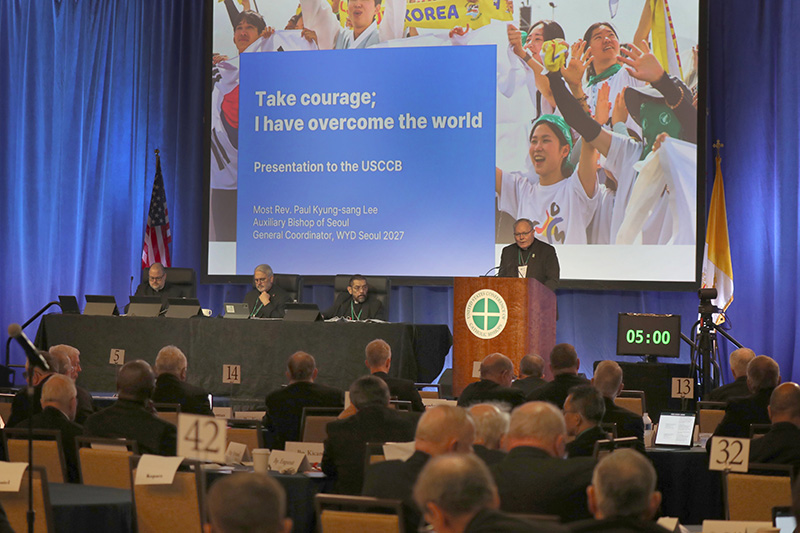
ORLANDO, Florida — Headlining the June 10 public session of the U.S. bishops' spring plenary in Orlando were addresses by the president of the U.S. Conference of Catholic Bishops and the new apostolic nuncio to the United States, along with a preliminary presentation on proposed updates to the bishops' landmark document on protection policies for children and minors.
A highlight in the afternoon was a report on World Youth Day 2027, accompanied by a gift of traditional Asian paper fans for each bishop from South Korea -- whose capital, Seoul, will host the international event.
In a morning presentation, Bishop Barry C. Knestout of Richmond, Virginia, chairman of the USCCB's Committee on the Protection of Children and Young People, said the bishops are reviewing proposed updates to the "Charter for the Protection of Children and Young People," seeking to define key terms while balancing care for victim-survivors with accused clergy's right to a presumption of innocence until proven otherwise.
The suggested changes would keep the charter focused "exclusively" on clergy abuse of minors, with a new document being developed to address abuse involving vulnerable adults, Bishop Knestout said. Voting on the agenda item was scheduled for June 11.
He said the revised text includes a glossary of terms in response to diocesan requests, and -- drawing on canon law -- the integration of"the right of an accused to the presumption of innocence."
Following the presentation, Archbishop Shawn McKnight of Kansas City, Kansas -- citing several factors, and calling for a "more synodal approach" -- asked if it would be possible to suspend the vote on the revisions pending further consultation among presbyteral councils and diocesan review boards.
At the start of the public session, Msgr. Michael J.K. Fuller, the USCCB's general secretary, read a message from the U.S. bishops to Pope Leo XIV thanking him for his new encyclical "Magnifica Humanitas" and for shining "the light of the Gospel and the tradition of the Church on the new opportunities and challenges posed by the rise" of artificial intelligence and "emerging technologies."
The bishop said the pope's teaching is a timely reminder that human life and dignity must remain at the center of technological development. Marking the first year of Pope Leo's pontificate, they prayed that he would continue to be a guiding light for both the Church and the wider world.
Archbishop Paul S. Coakley of Oklahoma City gave his first address to the body of bishops as USCCB president, having been elected during the conference's annual fall meeting in November 2025.
The Church must "put out into the deep" and "create hope in Christ," he said. He told the bishops he was "especially pleased to recognize the impact" of the USCCB's special message on migration, released during the conference's November 2025 plenary assembly amid the Trump administration's hardline crackdown on immigration, which has seen sweeping mass detentions and deportations.
The USCCB message "demonstrated our united concern as pastors for the dignity of every person, especially our migrant brothers and sisters," said Archbishop Coakley.
Archbishop Gabriele G. Caccia gave his inaugural address to the bishops as nuncio to the U.S.
He was named to his new post in March, after having previously served as the Holy See's permanent observer to the United Nations.
In his remarks, he highlighted the consecration of the U.S. Church to the Sacred Heart of Jesus, urged the bishops to fulfill their mission as missionary disciples by welcoming immigrants in their midst, and reminded his brother bishops he is there for them, especially in moments when their responsibilities as episcopal shepherds leads them to feel isolated.
"My service here is one of listening, trust, and shared discernment within the Church that we are all serving together," Archbishop Caccia said.
In the late afternoon, as chairman of the USCCB's Committee on Laity, Marriage, Family Life and Youth, Bishop Edward J. Burns of Dallas gave a report on World Youth Day 2027, which is to take place Aug. 3-8 in Seoul, and he introduced Auxiliary Bishop Paul Kyung Sang Lee of Seoul, general coordinator for WYD 2027, who brought traditional Asian folding fans as a gift to the bishops.
Bishop Burns said some 10,000 to 15,000 young pilgrims will travel to South Korea, a number he said would be comparable to the U.S. presence at WYD in Brazil (2013) and in Panama (2019).
Bishop Lee said he hopes all U.S. bishops will inspire young people of their dioceses to participate in the global event. The bishop detailed how the Catholic Church of Korea began in the hands of the laypeople, became strengthened by the blood of 10,000-plus martyrs, and served as a sanctuary for democracy and human rights.
"I have a simple hope that by the end of this presentation, Seoul will feel a little less far away," Bishop Lee said. After the Korean War (1950-1953), he said, "Korea was one of the poorest countries of the world. In 80 years, Korea moved from devastation to renewal. The hardships did not have the final world. Hope can renew and heal a nation."
Bishop Lee also spoke about three special WYD events that are to take place with Pope Leo XIV -- a meeting with people facing hardships, interreligious dialogue, and prayers for world peace.
World Youth Day promises to be a "powerful opportunity" for young people from across the globe to witness how "God's love never ceases, regardless of circumstances," the bishop said, adding that three special events with Pope Leo XIV are planned -- a meeting with people facing hardships, interreligious dialogue and prayers for world peace.
The bishops also heard from mathematical biologist Santiago Schnell, a Catholic scientist and provost of Dartmouth University. He was invited to speak June 10 by Bishop Kevin C. Rhoades of Fort Wayne-South Bend, Indiana, USCCB secretary and chair of its Committee on Priorities and Plans.
The talk anticipated the bishops' discussion of the 25th anniversary of the USCCB's implementation of "Ex Corde Ecclesia," St. John Paul II's apostolic constitution on Catholic universities.
The Catholic imagination needs to be reawakened in academic life to nurture leaders who can become "voices for the Catholic Church," Schnell advised the nation's bishops.
During his presentation, Schnell -- formerly dean of the University of Notre Dame's College of Science -- warned that Catholics were, as his presentation title asserted, "educated, yet absent" from American intellectual life.
"The Catholic paradox is that we have a massive infrastructure of higher education with average outcomes," said Schnell. "We are not educating sufficient Catholics in our Catholic higher educational system. And we're not educating them, actually, to become leaders."
The bishops also heard a preliminary presentation on portions of two texts for consideration: a new edition of the Lectionary for Mass, which provides the Scripture readings and psalm for each day's liturgy; and the 2025 Roman Missal-Liturgy of the Hours Supplement.
In a voice vote they showed support for the local advancement of two separate American canonization causes: Bishop Daniel J. Felton of Duluth, Minnesota, gave a presentation on the cause opened in his diocese for pioneer missionary priest Msgr. Joseph Buh and Archbishop Thomas G. Wenski of Miami presented the cause of entrepreneur-turned-evangelist John Rick Miller.
The consultation of a body of bishops -- at either the regional or national level -- is required by Church legislation governing the canonization process as a cause gets underway.
— Julie Asher, OSV News
Church must 'put out into the deep,' offer hope in Christ to all, says USCCB president
-
Church must 'put out into the deep,' offer hope in Christ to all, says USCCB president
ORLANDO, Florida — The Church must "put out into the deep" and "create hope in Christ," said Archbishop Paul S. Coakley of Oklahoma City, president of the U.S. Conference of Catholic Bishops.
The archbishop shared his thoughts in his opening address at the USCCB's annual spring plenary assembly, taking place June 10-12 in Orlando.
The public sessions of the meeting, June 10 and 11, were being livestreamed through the USCCB's website at usccb.org.
Archbishop Coakley opened the public sessions with his first address as USCCB president, having been elected during the conference's annual fall meeting in November 2025.
He began his remarks with a lighthearted quote of a comment Blessed John Paul I reportedly made to the cardinals upon his papal election: "May God forgive you for what you have done.”
Also speaking to the bishops was Archbishop Gabriele G. Caccia, who was appointed as papal nuncio to the U.S. in March, having previously served as the Holy See's permanent observer to the United Nations. Archbishop Caccia succeeded Cardinal Christophe Pierre, who turned 80 in January and had served in the post since 2016.
The meeting will see expected votes on several action items on the USCCB's agenda, which was publicly released June 8.
Among those items are revisions to the USCCB's "Charter for the Protection of Children and Young People," adopted in 2002 and updated at regular intervals over the ensuing years; episcopal consultations for the canonization causes of Slovenian missionary priest Msgr. Joseph Francis Buh and lay American John Rick Miller; and proposed adjustments to portions of several liturgical texts. Presentations on several initiatives, such as Catholic prison ministry and World Youth Day 2027, were also scheduled.
In his address, Archbishop Coakley said he was "especially pleased to recognize the impact" of the USCCB's special message on migration, which was released during the conference's November 2025 plenary assembly under Archbishop Coakley's predecessor as USCCB president, Archbishop Timothy P. Broglio of the U.S. Archdiocese of the Military Services.
The statement, overwhelmingly approved by the U.S. bishops, came amid the Trump administration's hardline crackdown on immigration, which has seen sweeping mass detentions and deportations.
The USCCB message "demonstrated our united concern as pastors for the dignity of every person, especially our migrant brothers and sisters," said Archbishop Coakley.
He noted that "the concern, the grief over how people are being treated, expressed in our message, remains as relevant now," adding, "We continue to advocate for “meaningful reform of our nation’s immigration laws and procedures.”
Archbishop Coakley said he was "grateful" for the unity of the U.S. bishops with each other and with Pope Leo XIV, whom he quoted frequently in his comments.
The archbishop said that during the past six months of his tenure as USCCB president, he had returned "many times" to Luke 5:4, the Scripture verse that he chose for his episcopal motto: "Duc in altum."
"It is the verse from the Gospel according to St. Luke where the Lord says to Peter, 'Put out into the deep and lower your nets for a catch,'" he explained.
The words are not only a source of comfort but "a command and a challenge," said Archbishop Coakley.
Both the Church and its bishops are "commanded to put out into the deep water, to move beyond our comfort zones and the safe places where we can maintain our illusions of safety and control."
He added, "Obeying this command is perhaps more necessary at this moment than ever."
Archbishop Coakley pointed to current challenges such as "constant flux … forced migration, polarization, disruptions, climatic, and economic upheavals, artificial intelligence, and wars," as well as the struggles of those who "are wondering what it even means to be a human person."
To restore hope, he said, "the truth of Christ must be proclaimed all the more confidently."
Peace, "which is the heart of the truth of Christ, always brings hope," said Archbishop Coakley.
Threats to that hope include attacks on human dignity, especially against "the unborn … the elderly … the sick and suffering," he said.
He also cited "the violence of war and injustice," as well as "the scourge of racism," "abuse, disdain and contempt -- especially towards the poor, the stranger, the condemned and the outcast."
Restoring hope "necessitates preaching" that "life is a gift from God," said Archbishop Coakley. "Every life has value and dignity, and we cannot forfeit that dignity, even when it is besmirched by sin and wickedness. It comes from God."
That truth "will renew hope in the hardest of hearts," he said.
Another threat is polarization "within our country, and even within our Church," said the archbishop, who described such division as "a scandal that can only be overcome through encounter, through the cultivation of interpersonal relationships and conversations between those who may disagree."
"We must never give up on those who are different or see things differently," he said.
Archbishop Coakley said that the "record numbers" entering the Church this year and prior were both "a great sign of the outpouring of the Holy Spirit" and "a further example of how we need to put out into the deep."
The bishops' current mission directive, "to reach out to the disaffiliated and the unaffiliated, remains a major task in helping to restore hope," he said.
Looking ahead to the U.S. bishops' June 11 consecration of the nation to the Sacred Heart of Jesus, Archbishop Coakley said he was "reminded how deep, unfathomable, and profound is the love that lives in that heart, and how it embraces the entire world."
"It excludes no one," he said. "Can there be a greater message of hope? Can a greater gift of hope be offered? It is the love flowing from the Sacred Heart of Jesus that feeds our hope."
— Gina Christian, OSV News
Nuncio to US bishops: Truth of human heart comes from the heart of Christ
-
Nuncio to U.S. bishops: Truth of human heart comes from the heart of Christ
ORLANDO, Florida — The new apostolic nuncio to the United States told the U.S. bishops June 10 their "generosity and collaboration" will assist him in carrying out his new mission "at the service of communion and peace."
Those words were offered by Archbishop Gabriele G. Caccia in his inaugural address to the bishops as nuncio to the U.S. during the first public session of their June 10-12 spring plenary at the Omni Resort at ChampionsGate near Orlando.
He gave thanks to his "brother bishops" for their fraternal welcome and turned to the new president of the U.S. Conference of Catholic Bishops -- Archbishop Paul S. Coakley of Oklahoma City -- and said "so we begin together."
The two prelates both addressed the assembly for the first time in their current positions; the nuncio was named in March, after having previously served as the Holy See's permanent observer to the United Nations, and the new USCCB president was elected last November.
In his address, Archbishop Caccia highlighted the consecration of the U.S. Church to the Sacred Heart of Jesus, urged the bishops to fulfill their mission as missionary disciples by welcoming immigrants in their midst, and reminded his brother bishops he is there for them, especially in moments when their responsibilities as episcopal shepherds leads them to feel isolated.
"My service here is one of listening, trust, and shared discernment within the Church that we are all serving together," Archbishop Caccia said.
Grateful for the U.S. bishop's fraternal welcome, the archbishop remarked how "beautiful is the image of unity of brother bishops gathered," sharing the same sprit and fulfilling the same mission. He added if he were to encapsulate his feelings in a few words, it would be "great esteem for the Church in America," which he said has "given so much to the universal church, even giving us our pope."
But he added that esteem does mean "wounds that remain in the life of the Church" should be ignored.
"I see the election of Pope Leo as a gift of the Holy Spirit, encouraging the Church in this country, on one hand to foster what is best in her tradition and on the other to continue facing with determination those wounds in her recent history that have caused much suffering especially through the cases of abuse," he told the U.S. bishops.
"As the (Second Vatican) Council reminds us, the Church is at once holy and always in need of being purified. Let us pray and work together for her renewal, so that her witness may be credible, her communities safe and her mission ever more faithful to the Gospel."
Leaders of the Church are called to witness to one another the "peace of the risen Christ," borrowing the words of Pope Leo XIV, as a peace that is "unarmed and disarming, humble and persevering," and a peace of God’s unconditional love.
As "builders of peace," Archbishop Caccia said the formal consecration of the U.S. Church to the Sacred Heart of Jesus, which will occur at the Basilica of the National Shrine of Mary, Queen of the Universe June 11, would serve as a "spiritual center" of the assembly.
"When the heart is lost, the person becomes fragmented. When the heart is healed, life can find unity again," the archbishop said. "From the heart of Christ, the Church learns the truth of the human heart: its dignity, its wounds, its desire for God, and its need for communion."
Archbishop Caccia said the U.S. Church certainly understands the missionary spirit, as its young history benefited from the missionaries who arrived on U.S. shores from other lands.
But he said the Church sends missionaries and awakens missionary disciples not just to go to foreign lands, but to welcome immigrants seeking hope in the United States. He said bishops should meet immigrants "with the charity of Christ, to recognize their dignity, and to help them find a place in the life of the community is also part of a missionary Church."
Before his closing remarks, the archbishop gifted each U.S. bishop a pocket-sized booklet containing the two dogmatic constitutions of the Second Vatican Council: "Lumen Gentium," on (on the Church) and "Dei Verbum" (on Divine Revelation). He said the constitutions "remind us who the Church is, and how the Church listens to the Word of God."
"They bring us back to the sources of our communion and mission," he told the bishops. "This continuity is important. We are not beginning again from zero. We receive a living tradition; and above all, we receive the love of Christ, poured out from his heart for the life of the world."
— Jean Gonzalez, OSV News
US bishops consider updates to landmark child protection policies
-
U.S. bishops consider updates to landmark child protection policies
ORLANDO, Florida — The U.S. Catholic bishops are reviewing proposed updates to their landmark document on protection policies for children and minors, seeking to define key terms while balancing care for victim-survivors with accused clergy's right to a presumption of innocence until proven otherwise.
The potential revisions were preliminarily introduced June 10 during the U.S. Conference of Catholic Bishops' spring plenary assembly in Orlando.
The suggested changes would keep the "Charter for the Protection of Children and Young People" focused "exclusively" on clergy abuse of minors, with a new document being developed to address abuse involving vulnerable adults, said Bishop Barry C. Knestout of Richmond, Virginia, chairman of the USCCB's Committee on the Protection of Children and Young People, in his introductory remarks.
Joining Bishop Knestout on the dais were Archbishop Ronald A. Hicks of New York, chair of the USCCB's Committee on Clergy, Consecrated Life and Vocations; and Bishop Thomas J. Paprocki of Springfield, Illinois, chair of the USCCB's Committee on Canonical Affairs and Church Governance. Both committees have also weighed in on charter updates, as have the USCCB's general counsel and its consultative National Review Board.
The charter -- instituted by the USCCB in 2002 as a number of clerical abuse scandals emerged -- lays out a comprehensive set of procedures for addressing allegations of sexual abuse of minors by Catholic clergy. Commonly called the Dallas Charter, the document also includes guidelines for reconciliation, healing, accountability and prevention of abuse.
A year after the charter's most recent revision in 2018, Pope Francis issued the motu proprio "Vos Estis Lux Mundi" ("You are the light of the world"), outlining global legal procedures for how the church should deal with clergy sexual abuse, including procedures for investigating bishops. The updated 2023 version included the specific term "vulnerable adults," and extended investigations to leaders of Vatican-recognized international Catholic lay associations and movements.
Bishop Knestout said that "forthcoming documents" are expected from the Vatican, "specifically the Universal Guidelines Framework being prepared by the Pontifical Commission for the Protection of Minors, and canonical legislation on spiritual abuse."
Both of those "may impact" the charter, he said.
Bishop Knestout noted that "none of the proposed modifications" to the charter would require changes to the U.S. bishops' 2005 essential norms, which are the particular application of the Church's canon law on the issue to the Church in the U.S.
He said the revised text includes a glossary of terms "in response to repeated requests from dioceses on having more consistent definitions."
In addition, said Bishop Knestout, proposed revisions -- drawing on canon law -- integrate "the right of an accused to the presumption of innocence."
Additional modifications include "the clear allowance for electronic letters of suitability," and "an added reference to the protection of information under the seal of the Sacrament of Penance," he said.
He also noted that among the general provisions under "Vos Estis" is "the identification of mandatory Church reporters to complement mandatory reporting to civil authorities.
Following the presentation, Archbishop Shawn McKnight of Kansas City, Kansas -- citing several factors -- asked if it would be possible to suspend the vote on the revisions pending further consultation among presbyteral councils and diocesan review boards. The latter are consultative bodies required under the charter, with members assisting bishops in their assessment of abuse allegations.
In particular, ArchbIshop McKnight pointed to concerns over the revisions "will impact known victims, as well as unknown" and priests.
In response, Bishop Knestout - acknowledging that the charter is "not a perfect document" -- noted that consultation on the revision has been "occuring for about five years," with "input received on multiple occasions from bishops."
Archbishop McKnight, while affirming "there has been extensive consultation over many years," said that "a lot has happened" since 2022, the last year that, as he was aware, consultations had taken place.
"There are a lot of new bishops that have been appointed since that time," he observed, while calling for a "more synodal" approach, with "better feedback and buy-in" regarding "how we're addressing these issues."
Archbishop McKnight underscored the need "make it very clear and not create more ambiguity" with respect to the charter.
The USCCB is expected to further debate and vote on the proposed charter revisions June 11.
— Gina Christian, OSV News