


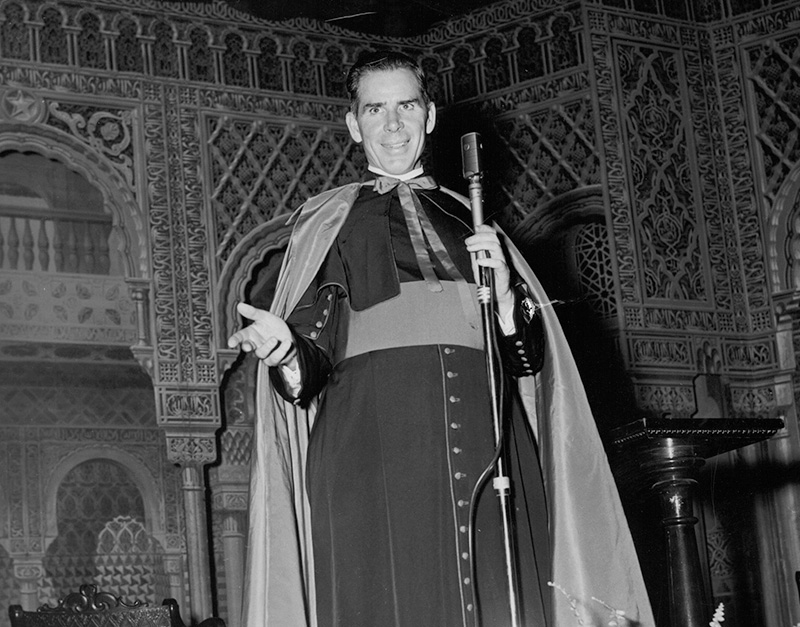
 Venerable Fulton J. Sheen, pictured in an undated photo, is remembered as one of the most influential and innovative evangelists in American history. Once dubbed "God's microphone," Archbishop Sheen announced God's truth in a nonconfrontational, yet no less life-giving, manner to untold millions through radio, print and television. (OSV News file photo)VATICAN — Venerable Fulton J. Sheen will soon be beatified, now that the Vatican has given the green light, the Diocese of Peoria, Illinois, announced Feb. 9. No date or location for the beatification was given.
The announcement comes six years after the Holy See had postponed the beatification, initially scheduled for December 2019, only weeks before the event was to take place.
"The Holy See has informed me that the Cause for the Venerable Servant of God Archbishop Fulton J. Sheen can proceed to Beatification," Bishop Louis Tylka of Peoria said in a Feb. 9 statement. "The next step in the process is the celebration of the Beatification, in which Fulton Sheen would be declared Blessed."
He added, "We are working with the Dicastery of the Causes of Saints at the Vatican to determine the details for the upcoming Beatification."
The bishop said the date and event details will be released soon through celebratesheen.com, the website for Archbishop Sheen's cause.
"Archbishop Fulton Sheen was one of the greatest voices of evangelization in the Church and the world in the 20th century," Bishop Tylka said. "I have long admired his lifelong commitment to serve the Church as a priest, rooted in his deep devotion to the Blessed Mother and the Eucharist. As he journeyed through the different stages of his life, his ability to share the Gospel and truly relate to people drew countless souls into an encounter with Jesus -- one that transformed not only his life, but more importantly, the lives of those he touched."
Archbishop Sheen's cause for canonization, opened in 2002, has been stalled by two controversies -- a public battle to relocate his remains from St. Patrick's Cathedral in New York to its current location, the side chapel of the Cathedral of St. Mary of the Immaculate Conception in Peoria; and, more significantly, concerns that as bishop of the Diocese of Rochester, New York, from 1966-1969, the prelate might have overlooked sexual abuse by at least one former diocesan priest there.
The latter concern was magnified after the state of New York adopted lookback laws that allowed hundreds of abuse claims to be considered, with the Diocese of Rochester ultimately filing for bankruptcy. The bankruptcy was finalized in September 2025, after the establishment of a $256.35 million settlement fund for abuse survivors.
In July 2019, then-Bishop Daniel R. Jenky of Peoria announced Pope Francis had approved a miracle attributed to the intercession of Archbishop Sheen, which led the way to the announcement he would be beatified. The announcement was made on Nov. 18, 2019, that Pope Francis had called for the beatification to be held Dec. 21, 2019, in Peoria.
A little more than two weeks later, a Dec. 3, 2019, news release from the Diocese of Peoria said it had been informed the previous day that the Holy See had decided to postpone the Dec. 21, 2019, ceremony "at the request of a few members" of the U.S. Conference of Catholic Bishops over the possibility that abuse-related concerns might surface.
The Dec. 3 statement from the Diocese of Peoria said, "In our current climate it is important for the faithful to know that there has never been, nor is there now, any allegation against (Archbishop) Sheen involving the abuse of a minor."
However, a Dec. 5 statement from the Diocese of Rochester, New York, said it had "expressed concern about advancing the cause for the beatification of Archbishop Sheen at this time without a further review of his role in priests' assignments." The statement said the Rochester Diocese, prior to the Vatican announcement Nov. 18 that Pope Francis approved the beatification, had provided documentation expressing its concern to the Diocese of Peoria and the Congregation for Saints' Causes via the apostolic nunciature in Washington.
The one-time New York lookback window, part of the state's Child Victims Act, was open from August 2019 until August 2021.
In December 2024, Msgr. Jason Gray, executive director of the Archbishop Fulton John Sheen Foundation, told OSV News that "Sheen is clean. ... Not one accusation has been raised that impugned Sheen."
Msgr. Gray said the foundation has examined "all of the pleadings" relevant to claims against the Rochester Diocese, and "there hasn't been anything that was brought up there" implicating Archbishop Sheen.
Msgr. Gray also told OSV News that "the desire to see Sheen beatified is increasing, and there is a growing devotion to him," as evidenced by a surge in visits to his tomb, requests for both relics and for his more than 50 books, and reports of favors and graces received through Archbishop Sheen's intercession.
Archbishop Sheen is remembered as one of the most influential and innovative evangelists in American history. Once dubbed "God's microphone," Archbishop Sheen announced God's truth in a non-confrontational, yet no less life-giving, manner to untold millions through radio, print and television.
Born in El Paso, Illinois, on May 8, 1895, Archbishop Sheen resolved to serve the Church as a priest from an early age. He was assigned to academic ministry following his ordination to the priesthood on Sept. 20, 1919, for the Diocese of Peoria.
After studies in Europe, a promising future as a professor awaited Archbishop Sheen. First, though, his bishop called him back to a parish in Peoria to test his obedience. And he zealously took on the task. In less than a year, though, Archbishop Sheen landed a professorship at The Catholic University of America in Washington. For a quarter century, he was known there for his engaging and stimulating lectures. During that time, he published more than half of his over 60 books, informed by a lively and heroic faith.
During the 1930s and 1940s, then-Msgr. Sheen became a household name as host of "The Catholic Hour," broadcast nationally from NBC radio in New York. The priest emerged as a national voice, a prophetic truth-teller who spoke out on a host of issues, particularly the threats of communism.
Having to give up his professorship after appointment as director of the Society for the Propagation of the Faith in 1950, Msgr. Sheen moved to New York City. The next year, he was appointed an auxiliary bishop of New York, ordained in Rome on June 11, 1951. Bishop Sheen began his work on behalf of the global missions with great energy, and his innovative efforts enabled him to evangelize at the same time. He donated all media earnings to the missions.
Beginning in 1952, Bishop Sheen proposed eternal truths each Tuesday evening to tens of millions via his "Life Is Worth Living" TV program, armed only with his charisma and intellect – and his famous cape and chalkboard. After his first year on the air, Bishop Sheen won an Emmy award for best television personality. Upon acceptance, he famously thanked his writers: Matthew, Mark, Luke and John.
Bishop Sheen was a charitable and attentive pastor who treated prince and leper alike. His intelligence, wit and sense of humor made him an effective evangelist. And with clear teaching and common sense, Bishop Sheen helped people make sense of life's problems. He was never afraid to proclaim Christ and brought many converts to Catholicism.
Throughout his 60-year priesthood, Bishop Sheen sought to conform himself more closely to Christ by observing a daily Eucharistic Holy Hour, what he called "the hour that makes my day." He also was intensely devoted to the Mother of God.
Bishop Sheen battled various temptations and difficulties throughout his life -- including a decade of behind-the-scenes hostility from Cardinal Francis Spellman of New York, which caused Bishop Sheen great pain. But in the face of his troubles, Bishop Sheen persevered in virtue. He understood his sufferings in light of God's providence: "Christianity begins not with sunshine, but with defeat. During those days when my life was backed up against the cross, I began to know and to love it more."
Despite his best efforts as bishop in Rochester, New York (1966-69) -- what many considered to be an exile -- Bishop Sheen's brief tenure was met with great resistance, resulting in a good deal of self-described failure. After retirement, Bishop Sheen was appointed titular archbishop of Newport, Wales, by Pope St. Paul VI. Archbishop Sheen delivered retreats aimed at renewal of the priesthood throughout the country and maintained a voice in the public square through regular media appearances.
The temptations and sufferings Archbishop Sheen faced purified him and intensified his union with Christ. He maintained "God has been easy with me." Toward the end of his life, writing in his autobiography, Archbishop Sheen apologized for his failures, wondering "Was I inspiring anyone to imitate Christ in the daily carrying of His Cross?"
After nearly two years in and out of the hospital following open-heart surgery, Archbishop Sheen died Dec. 9, 1979, in New York City, in the presence of the Blessed Sacrament. He was declared venerable in 2012.
Bishop Tylka said that Archbishop Sheen, particularly in his work for the missions, "helped us recognize that the Church is meant for all people" and that "as members of the Church, we are called to serve everyone, especially those most in need and those longing to hear and experience the Gospel, wherever they may be in the world."
"Archbishop Sheen will be a special blessing for the Church in the United States, where he was a powerful evangelist on radio, television, and in personal appearances," he said.
Bishop Tylka expressed thanks for "the collaboration, assistance, generosity, and prayers from the Holy See, my brother Bishops, clergy and lay people from around the world in moving this cause forward."
— OSV News
Biographer: Archbishop Sheen challenged US with love that he lived, fed by Eucharist
-
Biographer: Archbishop Sheen challenged US with love that he lived, fed by Eucharist
With the Feb. 9 announcement from the Diocese of Peoria, Illinois, that the Vatican has authorized the beatification of Venerable Fulton J. Sheen to move forward, OSV News sat down with Cheryl C.D. Hughes, author of "Archbishop Fulton J. Sheen, Convert Maker" (Ignatius Press, 2024), to reflect on the life and legacy of the late theologian and evangelizer.
This interview has been edited for length and clarity.
OSV News: How would you sum up the life and legacy of Venerable Fulton J. Sheen?
Hughes: His holiness and his enthusiasm for saving souls, for converting people and bringing them to Jesus.
They say he converted more than 42,000 people; that's something I came across in his positio (the dossier submitted to the Vatican laying out the case for an individual's proposed canonization). Actually, I think that number -- everyday people whose lives were impacted by listening to him, observing his holiness and his closeness to Jesus and to the Virgin Mary -- is way too low.
OSV News: How is Archbishop Sheen relevant to the current moment in the life of both the Church and the U.S.?
Hughes: I think he is very relevant to this moment, and I'll tell you why: Part of his main occupation was to critique the United States and its culture, really wanting to reform it. And for that, he kind of held up a mirror.
All the pathologies that he commented about in the 1950s are now here -- the dissolution of the family, the politicization of educational systems. So I think that what he saw of America in the 1950s and 60s and even 70s, he would see now in greater numbers, and in more dire circumstances, I believe.
OSV News: What do you think he would say at this moment? Would it be anything different than what he said in his own time?
Hughes: Well, he pointed to the Bible, stressing that God will prevail and that the Church will prevail. And I think he firmly believed that. ... I think if we keep on being faithful to our faith, we can have some impact. But maybe it's only just one person at a time.
I think he would say, "Get close to your rosary and get close to Jesus."
And love. He was a big advocate of love; love is just so important in the world. And we often don't move from a platform of love. I think our politicians go from platforms of power rather than love, our true concern.
So he (Archbishop Sheen) basically said, "I'm not a Democrat, I'm not a Republican, I'm a Catholic." ... I think he is as powerful today, if people would only read him and listen to him and heed his advice.
OSV News: Another interesting quality about Archbishop Sheen is that he was profoundly intellectual -- effortlessly moving between philosophy, theology, political and cultural commentary -- and yet he speaks very directly to the average person. Talk about how he was able to bridge all of those worlds.
Hughes: I think his high intellect really helped him to see more clearly what the issues were before him. He formed himself to know everything there was to know about communism, for instance. During the Cold War, he spoke out against communism. And yet when he reached out to communists, it was person to person. It was out of love that he approached them, really.
I think that's how he was so influential, because people thought he was talking just to them.
If you look back at those episodes of (Archbishop Sheen's 1952-1957 television show) "Life is Worth Living," he is looking right into the camera, which means he's looking right into the viewer's eyes, because the viewer is looking at the camera.
And I think somehow the warmth of his personality took away the camera, as if they (the viewers) were sitting in his study, or he was in their living room visiting with them and talking with them about things that really mattered to them.
It was that sense of personal concern that he had for everyone he met. He was just the kindest person you would ever meet.
OSV News: He was also known for his personal generosity, as well as his ability to rally support for those in need, especially during his 1950-1966 tenure as national director of The Pontifical Mission Societies in the U.S., for which he raised millions.
Hughes: He gave away his coat twice. On a cold New York day, he saw somebody shivering and said, "Here, take my coat."
He was being paid several thousands of dollars a night just to come and speak places. He could have luxuriated in all of his earnings. And what did he do with it? He gave it away. He gave away many of his royalties, mostly to the Catholic missions, because that was so near and dear to his heart.
He built a maternity hospital in Mobile, Alabama (the now-closed St. Martin de Porres Hospital) for Black women, because they weren't allowed to deliver their babies in the only (area) hospital, which was exclusively for whites.
He was a "person-to-person" person. He was very intuitive when it came to individuals, about what they needed, what would be the best thing for them, the best tactic for opening the door to them.
And even though we call him the "convert-maker" and the positio says he converted 42,000, he would always say, "I'm just the doorkeeper. The Holy Spirit does the work."
He really treated it that way, that the Holy Spirit did it, but he knew how to help that individual become susceptible to the moving of the Spirit. And I think that accounts for a lot of his success.
He had empathy for the human condition. Everyone to him was a child of God, and they were his brothers and his sisters.
OSV News: Archbishop Sheen had a profound love for the Eucharist, and he died while praying in his private chapel before the Blessed Sacrament. What do you think he would say about Eucharistic devotion in the U.S. at this moment, where we've just concluded the three-year National Eucharistic Revival amid a long decline in belief in the Real Presence?
Hughes: I think he would be preaching it up and down the streets. I think he would be scandalized by how many Catholics actually don't believe in the Real Presence. When he gave retreats, he insisted that the monstrance with the host was there before everyone -- because that was the locus of truth and beauty and goodness right there. So I think he would just encourage Eucharistic devotion more and more and more.
— Gina Christian, OSV News
Archbishop Sheen's cause for beatification has hit many speed bumps along the way
-
Archbishop Sheen's cause for beatification has hit many speed bumps along the way
After decades of anticipation and a cause marked by unexpected delays, the Diocese of Peoria has announced that Venerable Archbishop Fulton J. Sheen -- beloved evangelist, television pioneer and native son of Illinois -- will at last be beatified, a joy-filled announcement that comes only after years of legal disputes and renewed scrutiny briefly slowed his path to the altars.
Archbishop Sheen, a native of El Paso, Illinois, was ordained Sept. 20, 1919, at St. Mary's Cathedral in Peoria. He taught at The Catholic University of America in Washington and led the Society of the Propagation of the Faith. He is best remembered for his popular television show, "Life Is Worth Living."
He died in 1979 at age 84, and his cause for sainthood was officially opened in 2002. The Church declared his heroic virtues, and he was given the title "venerable" in 2012 by Pope Benedict XVI.
The path to sainthood for Archbishop Sheen was anything but smooth. In 2014, the Vatican suspended his cause due to a dispute between the Diocese of Peoria, which had opened the cause, and the Archdiocese of New York, where the late archbishop was buried.
At the center of the disagreement was the wish of Joan Sheen Cunningham, the archbishop's closest living relative, to have Archbishop Sheen's remains buried in Peoria and a statement in his will that he wished to be buried in New York.
A New York State Court of Appeals sided with Cunningham in 2016, and his remains were moved to St. Mary's Cathedral in Peoria on June 27, 2019.
In July 2019, Pope Francis recognized a miracle attributed to the former archbishop of New York, paving the way for his beatification in December that year.
The miracle concerned the healing of James Fulton Engstrom of Washington, Illinois, who was stillborn when delivered during a home birth in 2010. After doctors were ready to declare him dead after showing no signs of life for 61 minutes, his heart began to beat after his parents prayed for a miracle through Archbishop Sheen's intercession.
The beatification ceremony was to follow on Dec. 21 that same year.
However, Bishop Daniel R. Jenky of Peoria announced Dec. 3 that it was postponed "at the request of a few members" of the U.S. Conference of Catholic Bishops.
In a statement issued a few days after Bishop Jenky's announcement, the Diocese of Rochester said that prior to the beatification announcements, it had expressed concerns to the Diocese of Peoria and the then-Congregation for the Causes of Saints "about advancing the cause for the beatification of Archbishop Sheen at this time without a further review of his role in priests' assignments."
Archbishop Sheen served as bishop of Rochester from October 1966 until his retirement in October 1969. Upon his retirement, he was elevated to the rank of archbishop.
St. Paul VI named him archbishop of the titular see of Newport, Wales. Archbishop Sheen remained active, spending the last years of his life chiefly in writing and preaching.
The diocese said that although "other prelates" shared similar concerns, it had no complaints against Archbishop Sheen "engaging in any personal inappropriate conduct, nor were any insinuations made in this regard."
"The Diocese of Rochester did its due diligence in this matter and believed that, while not casting suspicion, it was prudent that Archbishop Sheen's cause receive further study and deliberation, while also acknowledging the competency of the Congregation for the Causes of Saints to render its decision. The Holy See ultimately decided to postpone the beatification," it said.
Nevertheless, no complaints have emerged, and no lawsuits or allegations were filed within the litigation window under New York's Child Victims Act.
— Junno Arocho Esteves, OSV News
10 books by Archbishop Fulton J. Sheen to add to your reading list
-
10 books by Archbishop Fulton J. Sheen to add to your reading list
Venerable Fulton J. Sheen remains one of the most compelling Catholic voices of the 20th century, and he left a sizeable body of written works in addition to his famous radio and television appearances.
His 66 books offer something for everyone: heady theological dissertation, accessible theology and philosophy, astute cultural reflections and profound meditations on the lives of Christ and Mary.
Here is a selection of 10 books by Archbishop Fulton J. Sheen to consider adding to your reading list.
-- "Life of Christ": A good read for any time of the liturgical year, this classic devotional reflects on the life and mission of Christ with a mix of scripture, history and philosophy in vivid detail.
-- "Three to Get Married": This book contains an approachable exploration of the philosophy and theology of Christian marriage to help one appreciate the sacrament's imitation of the divine love of the Trinity.
-- "A Declaration of Dependence": Written in the middle of World War II, this book by Archbishop Sheen explores the irrationality, violence, hatred and division of war and its cause in society, and uplifts the solution which only God gives.
-- "Treasure in Clay": Archbishop Sheen's autobiography was compiled shortly before his death, and in his own words gives an account of his childhood, priestly and academic formation, pastoral and media work, and extensive travel.
-- "The World's First Love": Archbishop Sheen dedicated most, if not all, of his writings to Mary, and his love for the Blessed Mother shines through in this account of Mary's life and role in the Church through the lens of history, philosophy and theology.
-- "The Way of the Cross": This short devotional booklet paints a vivid account of walking with Christ on his road to Calvary while reflecting on the gravity of sin. (Also, fun fact: OSV's founder Bishop John Francis Noll gave this booklet its imprimatur.)
-- "Life Is Worth Living": Trying to unplug from technology but want to learn from Archbishop Sheen's famous broadcasts? This compilation of his popular television addresses covering philosophy, politics and faith was originally published in five volumes, but more modern printings have 44 episodes in one book.
-- "The Rainbow of Sorrow": Pain, unjust suffering and feeling abandoned have long been a part of the human condition. Archbishop Sheen explores the meaning of pain and suffering in meditating on the seven last words of Christ from the cross.
-- "Moods and Truths": This book contrasts the modern perspective on the role of faith in society and the timeless good news of Jesus Christ, urging Christians to live their faith in the public sphere.
-- "The Priest Is Not His Own": Archbishop Sheen speaks to priests as a priest in this book which explores the meaning of the priesthood, sacrifice and their role as an "alter Christus."
— Megan Marley, OSV News