


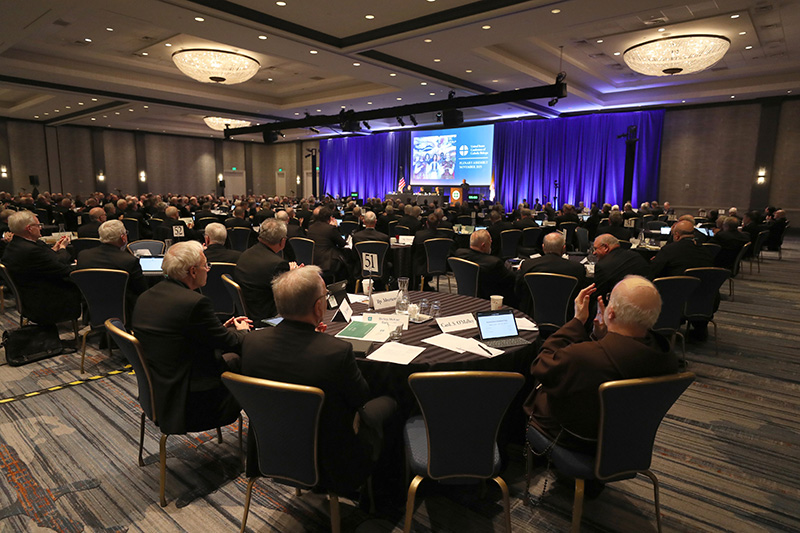
 Prelates attend a Nov. 11, 2025, session of the fall general assembly of the U.S. Conference of Catholic Bishops in Baltimore. (OSV News photo/Bob Roller)
BALTIMORE — From the start of the U.S. Catholic bishops' fall plenary assembly to its end, a resounding concern for the God-given dignity of immigrants, and for unity in teaching the faith clearly and renewing the country spiritually, dominated the days' proceedings.
The first order of business for the bishops, at the start of the Nov. 10-13 gathering was to invoke the intercession of the Holy Spirit. More than 320 active and retired bishops joined the opening Mass at the Basilica of the National Shrine of the Assumption of the Blessed Virgin Mary in Baltimore Nov. 10.
Archbishop Timothy P. Broglio, president of the USCCB and archbishop of the Archdiocese for the Military Services, reminded bishops in his opening homily of "their duty to be servants of truth," and shared the story of a young airman who asked him "how to be a saint."
The fall meeting was also Archbishop Broglio's farewell as USCCB president after leading the bishops for the past three years through a National Eucharistic Revival, its first National Eucharistic Congress in more than eight decades, the recently concluded Synod on Synodality, and the election of the first American pope.
In his final presidential address, he emphasized the need for the bishops to model unity and help "convince people to listen to each other" amid polarization.
"We have to draw on our unity to illustrate that civil discourse is not only possible, but the most authentically human way forward," he said.
For Cardinal Christophe Pierre, the papal ambassador, it was his first opportunity to address the bishops as Pope Leo XIV's representative to the U.S. since the pope's election in May. On the theme of unity, he emphasized continuity between the late Pope Francis and Pope Leo's pontificates, while encouraging them to look to the Second Vatican Council as their guide. As he has for the past several years, he encouraged them to develop a synodal culture that could help them unify the church at a time when many Catholics "identify more with tribes and ideologies than with the body of Christ."
He said, "The synodal path invites us to a different way: a style of being church that makes communion concrete, allows dialogue to become discernment, and catholicity to become shared mission."
The cardinal's remarks about synodality, as a means to help the bishops bring about unity, were underscored by a Leadership Roundtable survey from the prior week. It showed that Catholics tend to give their parish pastors and parish high marks, yet a consistent "trust deficit" pattern prevails at the diocesan and national level.
The bishops elected new leadership for the next three years on Nov. 11, the first day of public meetings, choosing the conference's secretary, Archbishop Paul S. Coakley of Oklahoma City, as their next president out of 10 possible candidates. Archbishop Coakley won on the third ballot in a close run-off with Bishop Daniel E. Flores of Brownsville, Texas. The bishops then decisively chose Bishop Flores, the conference's former doctrine committee chair and its point man on implementing synodality in the U.S., as vice president, succeeding Baltimore Archbishop William E. Lori.
The following day, the bishops elected Bishop Kevin C. Rhoades of Fort Wayne-South Bend, Indiana, as their next secretary. Archbishop Alexander K. Sample of Portland, Oregon, was selected to succeed Bishop Rhoades as chair of the Committee on Religious Liberty. The bishops then elected five other committee chairs: Archbishop Jeffrey S. Grob of Milwaukee, for Canonical Affairs and Church Governance; Auxiliary Bishop Peter L. Smith of Portland, Oregon, for Ecumenical and Interreligious Affairs; Bishop William A. Wack of Pensacola-Tallahassee, Florida, for Evangelization and Catechesis; Ukrainian Catholic Metropolitan Archbishop Borys A. Gudziak of Philadelphia, for International Justice and Peace; and Bishop Mark W. O'Connell, newly named bishop of Albany, New York, for Protection of Children and Young People.
While many of the elections were close contests, the bishops' voice on major issues -- from teaching on immigration and gender ideology to public manifestations of Catholic witness and devotion -- was overwhelmingly united in every vote.
On Nov. 12, the second public session of the gathering, the prelates approved a special pastoral message on immigration "to raise our voices in defense of God-given human dignity." They amended the message on the floor to clearly condemn "indiscriminate mass deportation" alongside their call to end "dehumanizing rhetoric and violence, whether directed at immigrants or at law enforcement."
The bishops applauded and many got to their feet after it passed with a resounding 216 votes in favor, five votes against, and three abstentions.
The bishops' plenary assembly heard a report on the immigration situation in the U.S. under the Trump administration, as well as a new initiative of solidarity with migrants called "You Are Not Alone." In a press conference, Bishop Rhoades also revealed that the issue of the ability of Catholic immigrants in ICE detention to receive sacraments "is now at the top of our concerns."
"Obviously, the beliefs of the church have political consequences, but they're not political in the usual sense of the word," Archbishop Richard G. Henning of Boston told OSV News, explaining the bishops' special message was "a pastoral address to our people rather than an attempt to lobby."
The bishops also heard about promising signs of progress in their ongoing efforts to resolve backlogs for religious worker visas with the Trump administration. Close to 90% of the nation's Catholic dioceses rely on foreign-born clergy and religious.
The bishops also heard a presentation on revisions to their "Ethical and Religious Directives for Catholic Health Care Services," which they approved the following day. They approved the new ERDs -- 206 bishops voted yes, with eight abstaining and seven opposing -- with substantial revisions from the previous version. They incorporate guidance issued in 2023 by the USCCB's Committee on Doctrine, which prohibited surgical or chemical interventions seeking to exchange or simulate the sex characteristics of a patient's body for those of the opposite sex.
The bishops also learned that a new English version of the Bible will be called TheCatholic American Bible, which aims to unify American Catholics' reading of Scripture from the Bible they use in the home to the readings they pray with in the liturgy. They also learned that the Vatican approved the new English edition of the Liturgy of the Hours -- concluding a 13-year process of revision -- and it would be available for everyone by Easter 2027.
As the U.S. marks its 250th anniversary next year, the bishops voted to consecrate the nation to the Sacred Heart of Jesus in 2026, during their spring assembly in June, which concludes on the solemnity of the Most Sacred Heart of Jesus.
Before the bishops concluded the second and final day of public proceedings -- the last day, Nov. 13, was spent in executive session -- they approved holding an 11th National Eucharistic Congress in the summer of 2029 following a presentation by Bishop Andrew H. Cozzens of Crookston, Minnesota. Bishop Cozzens, chairman of the National Eucharistic Congress Inc., which will organize the event, said Nov. 12 that a "Revival Impact Study," which will be made public in December, has shown that a great deal of fruit resulted from the National Eucharistic Revival effort, which included the 2024 National Eucharistic Congress in Indianapolis.
Bishop Cozzens said one of the gifts of the National Eucharistic Congress is the unity it brings to the whole church -- something he saw at the 2024 event.
"I think we'll experience that again in 2029," he told OSV News. He said a theme is in development and the 2029 National Eucharistic Congress itself will be "a beautiful experience of the power of the Holy Spirit."
— Peter Jesserer Smith, OSV News
Immigration concerns top of mind for US bishops at their annual fall assembly
-
Immigration concerns top of mind for US bishops at their annual fall assembly
BALTIMORE — From the opening gavel to adjournment Nov. 11, the immigration issue was at the forefront for much of the first day of public sessions of the U.S. bishops' fall plenary assembly in Baltimore.
The day's agenda included elections for new leadership of the U.S. Conference of Catholic Bishops; a report on the immigration situation in the U.S. under the Trump administration; preliminary presentations on possible revisions to the bishops' "Ethical and Religious Directives for Catholic Health Care Services"; and the unveiling of a new English version of the Bible for the United States that will be released in 2027.
They also approved a local diocesan effort to put forth a sainthood cause for Jesuit Father Richard Thomas (1928-2006), who for over 40 years led various ministries to the poor of El Paso, Texas, and Ciudad Juarez, Mexico.
The bishops elected Archbishop Paul S. Coakley of Oklahoma City as USCCB president and Bishop Daniel E. Flores of Brownsville, Texas, as the conference's vice president.
The 2025 elections were notable because they marked the first leadership change at the conference since Pope Leo XIV, the U.S.-born pontiff, began his pontificate in May.
The day began with the bishops' message to Pope Leo XIV at the start of their Nov. 10-13 gathering. The U.S. bishops told the pope Nov. 11 that they "will continue to stand with migrants and defend everyone's right to worship free from intimidation."
"As shepherds in the United States, we face a growing worldview that is so often at odds with the Gospel mandate to love thy neighbor," they wrote. "In cities across the United States, our migrant brothers and sisters, many of whom are fellow Catholics, face a culture of fear, hesitant to leave their homes and even to attend church for fear of being randomly harassed or detained. They told the pope that united in their concern, they "will continue to stand with migrants and defend everyone's right to worship free from intimidation."
"We support secure and orderly borders and law enforcement actions in response to dangerous criminal activity," they told the pope, "but we cannot remain silent in this challenging hour while the right to worship and the right to due process are undermined."
There are several flashpoints around the country for tensions over the Trump administration's hardline immigration policies, with regular protests taking place outside a number of Immigration and Customs Enforcement field offices.
Among Catholic concerns over how this policy is playing out in U.S. cities are detainees being denied the sacraments -- an issue highlighted most notably at an immigration processing center just west of Chicago. On the feast of All Saints Nov. 1, a delegation of clergy, religious sisters and laity, and a Chicago auxiliary bishop were barred for the second time in three weeks from bringing the Eucharist to those Catholics being detained there.
The issue of the ability of immigrants in ICE detention to receive sacraments "is now at the top of our concerns," Bishop Kevin C. Rhoades of Fort Wayne-South Bend, Indiana, said Nov. 11 during the midday press conference at the bishops' plenary. He is chair of the USCCB's Committee for Religious Liberty.
The bishops' focus, he said, has been "the church's right to provide charitable services for immigrants."
"We didn't really anticipate what we're facing now with the detention centers, but as soon as that became something that we became aware of, that's moved to the top of the list for us," he said.
"It's heartbreaking," Bishop Rhoades added, "when you think of the suffering and especially those who've been detained, separated from families ... they need spiritual support in this, and they need the sacraments."
In an afternoon presentation, Bishop Mark J. Seitz of El Paso, Texas, outgoing chair of the bishops' migration committee, said the Trump administration's "unyielding commitment to mass deportation," as well as "curtailing legal immigration," and deportations to "third countries completely unfamiliar to them," make clear "this is just the beginning."
Bishop Seitz said the migration committee, its staff and its partners are working on an initiative, titled "You Are Not Alone." It will focus "on four thematic areas of ministry, emergency and family support, accompaniment and pastoral care, communications and church teaching, and fourthly, solidarity through prayer and public witness."
But he did offer a glimmer of hope over religious workers visas, a process held up since the spring of 2023, saying he was "very optimistic" that efforts to resolve backlogs for religious worker visas were moving forward, thanks to potential new legislation and dialogue with the current presidential administration.
One major piece of business carried out before a midday lunch break was the election of the new USCCB president and vice president out of 10 potential candidates.
In a close contest, Archbishop Coakley was elected president on the third round of voting in a run-off with Bishop Flores. The U.S. bishops then selected Bishop Flores on the first round of the vice presidential election.Their three-year terms begin at the conclusion of the Nov. 10-13 fall plenary assembly in Baltimore. They succeed, respectively, Archbishop Timothy P. Broglio of the U.S. Archdiocese for the Military Services and Archbishop William E. Lori of Baltimore, who will complete their three-year terms in office at the assembly's conclusion.
Ahead of the elections, Archbishop Broglio, as outgoing president of the USCCB, delivered his final presidential address. He emphasized the need to "convince people to listen to each other" amid polarization.
"We have to draw on our unity to illustrate that civil discourse is not only possible, but the most authentically human way forward," he said.
"We must also convince people to listen to each other," he emphasized. "May the lessons learned through the synod spread throughout society so that we might take the time to listen to the other, and if we must disagree, we do so with courtesy, appropriate speech and even attentiveness to the personal situation of the other."
Cardinal Christophe Pierre, apostolic nuncio to the United States, then addressed the USCCB. His remarks at this year's plenary were his first as Pope Leo XIV's representative.
"Where have we been and where are we going?" he asked, pointing to "a guiding light: the teaching and vision of the Second Vatican Council." He emphasized that Vatican II "remains the key to understanding what kind of church we are called to be today, and the reference point for discerning where we are headed."
The bishops also heard a preliminary presentation on possible revisions to its "Ethical and Religious Directives for Catholic Health Care Services," before a planned Nov. 12 vote on the revised ERD document. The ERD articulates ethical standards for health care in light of Church teaching, and provides authoritative guidance on moral issues encountered by Catholic health care.
Also, Bishop Steven J. Lopes, head of the Ordinariate of the Chair of St. Peter and chair of the bishops' Committee on Divine Worship, announced that a new English version of the Bible will be released in 2027 with the name The Catholic American Bible.
The bishops adjourned that afternoon after hearing presentations on The Catholic University of America and the Pontifical Missions Societies. The public session of the bishops' plenary meeting was scheduled to resume Wednesday afternoon.
— Julie Asher, OSV News
Bishop Rhoades elected USCCB secretary; 6 bishops named to lead key posts
-
Bishop Rhoades elected USCCB secretary; 6 bishops named to lead key posts
BALTIMORE — The U.S. bishops Nov. 12 elected Bishop Kevin C. Rhoades of Fort Wayne-South Bend, Indiana, as the new secretary of the U.S. Conference of Catholic Bishops.
They also elected a successor for Bishop Rhoades as chair of the Committee for Religious Liberty, and selected chairmen-elect for five standing committees.
As secretary, Bishop Rhoades succeeds Archbishop Paul S. Coakley of Oklahoma City, who was elected president of the USCCB on Nov. 11. Bishop Daniel E. Flores of Brownsville, Texas, was elected vice president of the conference. Their three-year term in those roles begins at the end of the fall plenary.
Archbishop Coakley was at the end of his three-year term as secretary, having been elected to the post on Nov. 15, 2022.
The bishops then voted for a new chairman to succeed Bishop Rhoades as religious liberty chair. Two nominees stood for election for what was to have been chairman-elect of that committee, but because Bishop Rhoades was elected USCCB secretary, the spot was for chairman, who will finish Bishop Rhoades' term, which ends at the close of the bishops' fall 2027 plenary.
The nominees were Archbishop Alexander K. Sample of Portland, Oregon, and Bishop Michael J. Sis of San Angelo, Texas, and they each received 111 votes.
To break the tie, a standing USCCB rule was invoked that the prelate with the most seniority would win the election. That was interpreted -- after a check of the rules governing the bishops' plenary assembly -- as the prelate who was older by birth date.
Both Bishop Sis and Archbishop Sample are 65, but the Texas prelate is a few months older, so he got the nod. However, Bishop Sis then rose to withdraw his name, giving the win to Archbishop Sample.
Right before the conference met, the Portland archbishop issued a Nov. 8 statement regarding recent immigration enforcement activity in that state, declaring human dignity comes "not from government, but from our loving God."
"It does not matter whether some of our brothers and sisters have proper documentation or not," Archbishop Sample said in his message to encourage Hispanic Catholics. "They are our brothers and sisters in the body of Christ."
The bishops also chose chairmen-elect for five USCCB committees -- from two nominees for each committee.
For the Committee on Canonical Affairs and Church Governance, Archbishop Jeffrey S. Grob of Milwaukee won over Bishop Edward M. Lohse of Kalamazoo, Michigan, 113 to 108 votes.
For the Committee on Ecumenical and Interreligious Affairs, Auxiliary Bishop Peter L. Smith of Portland, Oregon, won over Bishop Daniel J. Felton of Duluth, Minnesota, 139 to 88.
For the Committee on Evangelization and Catechesis, Bishop William A. Wack of Pensacola-Tallahassee, Florida, won over Bishop Earl K. Fernandes of Columbus, Ohio, 116 to 106.
For the Committee on International Justice and Peace, Metropolitan Archbishop Borys A. Gudziak of the Ukrainian Catholic Archeparchy of Philadelphia won over Archbishop Edward J. Weisenburger of Detroit, 154 to 68.
For the Committee on Protection of Children and Young People, Bishop Mark W. O'Connell won over Bishop John P. Dolan of Phoenix, 116 to 106.
On Oct. 20, Bishop O'Connell was appointed by Pope Leo XIV to succeed retiring Bishop Edward B. Scharfenberger as head of the Diocese of Albany, New York. Bishop O'Connell had been an auxiliary bishop of Boston from 2016 until his new appointment.
Each bishop elected will serve for one year as the chairman-elect of his respective committee before starting a three-year term as chairman at the conclusion of the bishops' 2026 fall plenary assembly.
Archbishop Coakley as the new USCCB president and Bishop Flores as the new vice president succeed the outgoing president and vice president, Archbishop Timothy P. Broglio of the U.S. Archdiocese for the Military Services and Archbishop William E. Lori of Baltimore, who will complete their terms at the end of the plenary assembly. Archbishop Coakley and Bishop Flores will begin their three-year terms upon the conclusion of the bishops' Nov. 10-13 fall assembly.
Also beginning a three-year term is Archbishop Bernard A. Hebda of St. Paul and Minneapolis as the USCCB's new treasurer, succeeding Coadjutor Archbishop James F. Checchio of New Orleans. Archbishop Hebda was voted in as treasurer-elect at the bishops' 2024 fall plenary assembly and took over officially at the end of this year's plenary.
Prelates elected last November as chairmen-elect for a number of committees also start their three-year terms as chairmen of their respective committees: Auxiliary Bishop Michael G. Woost of Cleveland, for Divine Worship; Bishop Ronald A. Hicks of Joliet, Illinois, for Clergy, Consecrated Life and Vocations; Archbishop Shelton J. Fabre of Louisville, Kentucky, for Domestic Justice and Human Development; Bishop Edward J. Burns of Dallas, for Laity, Marriage, Family Life and Youth; and Bishop Brendan J. Cahill of Victoria, Texas, for Migration.
The 2025 elections were notable because they marked the first leadership change at the conference since Pope Leo XIV, the U.S.-born pontiff, began his pontificate in May.
Archbishop Coakley, 70, has led the Archdiocese of Oklahoma City since 2011. He was born to John and Mary Coakley in Norfolk, Virginia, in 1955, but the family moved to Kansas 10 years later. He began seminary studies for the Diocese of Wichita, Kansas, in 1978. He has been serving as the USCCB's secretary.
Bishop Flores, 64, was born to Fernando Javier Flores and Lydia Dilley Flores in 1961 in Palacios, Texas. He entered Holy Trinity Seminary, an institution associated with the University of Dallas, in 1981. He has led the Brownsville Diocese since 2010.
Archbishop Coakley was elected president on the third round of voting in a run-off with Bishop Flores in a race that had involved 10 candidates. Bishop Flores, who has led the USCCB’s involvement in the synod process, was then elected decisively on the first round for the vice presidential election.
— OSV News
US bishops approve 'special pastoral message' on immigration
-
US bishops approve 'special pastoral message' on immigration
BALTIMORE —The U.S. Conference of Catholic Bishops approved a "special pastoral message on immigration" Nov. 12, voicing "our concern here for immigrants" at their annual fall plenary assembly in Baltimore.
The statement came as a growing number of bishops have acknowledged that some of the Trump administration's immigration policies risk presenting the church with both practical challenges in administering pastoral support and charitable endeavors, as well as religious liberty challenges.
Archbishop Richard G. Henning of Boston told OSV News in an interview that the feeling "we have to say something" on the subject of showing solidarity with immigrants has been "kind of bubbling up from the bishops."
"Obviously, the beliefs of the church have political consequences, but they're not political in the usual sense of the word," he said. "And so there was a real effort to make sure that this would be a pastoral address to our people rather than an attempt to lobby."
Despite differences in age, geography or other viewpoints, Archbishop Henning said, the U.S. bishops have almost universally heard from parishioners or pastors about "suffering the effects of this."
"We're pastors," he said. "We care about the people we serve, and what we're hearing from them is fear and suffering. So it's hard not to want to respond to that."
The statement, released in the late afternoon, said, "As pastors, we the bishops of the United States are bound to our people by ties of communion and compassion in Our Lord Jesus Christ."
"We are disturbed when we see among our people a climate of fear and anxiety around questions of profiling and immigration enforcement," it said. "We are saddened by the state of contemporary debate and the vilification of immigrants. We are concerned about the conditions in detention centers and the lack of access to pastoral care. We lament that some immigrants in the United States have arbitrarily lost their legal status.
"We are troubled by threats against the sanctity of houses of worship and the special nature of hospitals and schools," it continued. "We are grieved when we meet parents who fear being detained when taking their children to school and when we try to console family members who have already been separated from their loved ones. Despite obstacles and prejudices, generations of immigrants have made enormous contributions to the well-being of our nation.
"We as Catholic bishops love our country and pray for its peace and prosperity. For this very reason, we feel compelled now in this environment to raise our voices in defense of human dignity."
The statement also refers to Catholic social teaching on immigration, which seeks to balance three interrelated principles: the right of persons to migrate in order to sustain themselves and their families; the right of a country to regulate its borders and immigration; and a nation's duty to conduct that regulation with justice and mercy.
For example, Archbishop Henning told OSV News that "Catholic teaching doesn't like chaos, because chaos often produces great injustice for the most vulnerable."
"But it's possible to go too far the other way too," he said.
Catholic teaching "exhorts nations to recognize the fundamental dignity of all persons, including immigrants," the statement said. "We bishops advocate for a meaningful reform of our nation's immigration laws and procedures. Human dignity and national security are not in conflict.
"Both are possible if people of good will work together. We recognize that nations have a responsibility to regulate their borders and establish a just and orderly immigration system for the sake of the common good. Without such processes, immigrants face the risk of trafficking and other forms of exploitation. Safe and legal pathways serve as an antidote to such risks."
The church's teaching, it noted, "rests on the foundational concern for the human person, as created in the image and likeness of God (Genesis 1:27)."
"As pastors, we look to Sacred Scripture and the example of the Lord Himself, where we find the wisdom of God's compassion," it continued. "The priority of the Lord, as the Prophets remind us, is for those who are most vulnerable: the widow, the orphan, the poor, and
the stranger (Zachariah 7:10). In the Lord Jesus, we see the One who became poor for our sake (2 Corinthians 8:9), we see the Good Samaritan who lifts us from the dust (Luke 10:30–37), and we see the One who is found in the least of these (Matthew 25)."The Church's concern for neighbor and our concern here for immigrants is a response to the Lord's command to love as he has loved us (John 13:34)," it said.
The message was approved by the vast majority of voting bishops and was met with a standing ovation. Archbishop Paul S. Coakley of Oklahoma City, newly elected president of the USCCB, spoke in favor of the statement from the floor, saying, "I'm strongly in support of it for the good of our immigrant brothers and sisters," adding that the statement sought "balance" in "protecting the rights of immigrants, but also securing and calling upon our lawmakers and our administration to offer us a meaningful path of reform for our immigration system."
According to a USCCB news release issued with the text of the statement, this "marked the first time" in 12 years the bishops' conference "invoked this particularly urgent way of speaking as a body of bishops. The last one issued in 2013 was in response to the federal government’s contraceptive mandate."
Details of the statement were a matter of some debate at the public session Nov. 12, with Cardinal Blase J. Cupich of Chicago suggesting the addition of language opposing "indiscriminate mass deportation." Others voiced concurrence but raised qualifications, like also adding "without due process," or questioned the conference's procedures for making an amendment at the assembly. The added phrase was ultimately approved, and is found in the final paragraph of the message: "We oppose the indiscriminate mass deportation of people. We pray for an end to dehumanizing rhetoric and violence, whether directed at immigrants or at law enforcement. We pray that the Lord may guide the leaders of our nation, and we are grateful for past and present opportunities to dialogue with public and elected officials. In this dialogue, we will continue to advocate for meaningful immigration reform."
The bishops' concern has a reference point in existing magisterial teaching. St. John Paul II's 1993 encyclical "Veritatis Splendor" ("Splendor of Truth") and 1995 encyclical "Evangelium Vitae" ("The Gospel of Life") both quote the Second Vatican Council's teaching in "Gaudium et Spes," that names "deportation" among various specific acts "offensive to human dignity" that "are a disgrace, and so long as they infect human civilization they contaminate those who inflict them more than those who suffer injustice, and they are a negation of the honor due to the Creator."
St. John Paul underscored that these acts were examples of "intrinsic evil" incapable of being ordered to God or the good of the human person.
When the U.S. bishops ultimately approved the language after some debate, Archbishop Henning quipped, "The amended amendment passes."
In his interview with OSV News after the vote, Archbishop Henning said, "It's not an easy thing to kind of get us all moving completely in the same direction." But he said the overwhelming support for the message showed "a fundamental unity among us."
"I think there was a pretty powerful sense among all the bishops that what we're experiencing on the ground in our dioceses is that there's a great deal of suffering and confusion, and I would say even chaos," he said. "There's kind of arbitrariness right now, in the experience of the people, that generates pretty significant fear."
— OSV News
New USCCB president Coakley talks immigration, Vigano criticism, and lifting up saints
-
New USCCB president Coakley talks immigration, Vigano criticism, and lifting up saints
BALTIMORE — Archbishop Paul S. Coakley of Oklahoma City was elected as the next president of the U.S. Conference of Catholic Bishops. He succeeds Archbishop Timothy P. Broglio of the U.S. Archdiocese for the Military Services, who has served in that office since 2022, at the end of the bishops' Nov. 10-13 fall plenary.
Archbishop Coakley sat down with OSV News to discuss his new leadership role in the conference. The interview has been edited for length and clarity.
OSV News: What do you hope to bring to your exercise of the office of president in the next three years?
Archbishop Coakley: I would like to demonstrate that we as bishops of the United States are far more unified pastorally, fraternally than is often portrayed in a lot of the media and a lot of people's imaginations. The narrative is out there that the American bishops are divided, we’re polarized, and that's not been my experience. I think there's a lot more mutual understanding and support for one another and genuine friendship among us. So I would like to be able to show that over the course of the presidency that I'm embarking upon -- that we are a wonderful fraternal body and united in this common mission as successors of the apostles in the United States.
OSV News: The issue of immigration is one of the political issues that most would agree is dividing Catholics at this moment. What do you think could be the most effective in helping the faithful build a truly Catholic perspective on this issue?
Archbishop Coakley: One thing that comes to mind is to help our people see this not as a political right or left, red or blue issue, (but as) a concern that we share as members of the Body of Christ, as Christians, as members of the baptized -- certainly, as bishops and priests. We have concern for our brothers and sisters, for their well-being, that their human dignity be respected and protected and promoted. But we also have a concern for our nation -- that everybody deserves to live in security and peace. And so we have a responsibility as a nation to protect our own borders and promote access to this nation in a legal fashion. Reform of our immigration policies would be so beneficial for everybody in this nation.
OSV News: Archbishop (James F.) Checchio said yesterday in his presentation to the bishops on the conference budget, "Times have changed, but our physical structure has not. And the way we do business largely remains the same." Drawing from your experience of leadership so far in this conference, what would you say might need to change about the way the conference does business?
Archbishop Coakley: Well, we certainly need to be good stewards of our assets and resources. I'm not sure if Archbishop Checchio was referring to the physical USCCB headquarters. If so, I would tend to agree. We have a beautiful facility, a beautiful building, but it's being underutilized right now. We'd like to find a good, practical and economically feasible way of being good stewards of that resource.
OSV News: No question, it’s an exciting time in the church right now in the United States, with the election of the first U.S.-born pope. How do you hope to best be of service to him as president of the U.S. bishops' conference?
Archbishop Coakley: I really look forward to meeting Pope Leo -- as a bishop, as a fellow American, as a Catholic. I would like to be able to have a line of communication with him -- an opportunity to help share our perspectives, that is on behalf of the bishops, on how things are here in the United States. I don't know where his information sources might be, I’m sure they're trustworthy and good, but I want him to understand our United States Catholic lived reality, and particularly our love and support for him and for his predecessors. I think that American Catholics have been historically very supportive of Rome and the papacy, not just financially but spiritually. There's a great love for the pope among our American Catholics, and I want him to experience that from us.
OSV News: The church in the U.S. is experiencing growth, in many areas including your own. But there is also what appears to be a general overarching decline of our institutional footprint across the country, with closures and mergers of parishes, schools and other facilities. How would you encourage Catholics observing this decline to keep the faith?
Archbishop Coakley: Our institutions obviously are very important, but the church is more than its institutions. So my encouragement for Catholics is to remain rooted in Jesus Christ -- to become disciples, to live that discipleship in terms of mission. And I think that's how the church will be revitalized, as we have a renewed encounter with the person of Jesus Christ and under the power of his Spirit, to serve him in our parishes, in our schools, communities, our homes and families, particularly among our lay Catholics -- to be the light, to be the leaven that we’re called to be. And to the extent that we do that, I think the institutional life will recover and will flourish.
We have many vibrant Catholic institutions still. The decline that you refer to is not universal. In many parts of the United States, it's still quite a vibrant institutional life in the United States. So I’d be careful about the narrative that we accept, that we need to be sure that it's an accurate and correct narrative. Many parts of the country, including in our own area in Oklahoma, we have vibrant strong parishes, vibrant Catholic schools, vibrant Catholic health care. So institutional life is not necessarily on the decline across the country. Populations, demographics have shifted, obviously, and we need to be prepared and able to follow that and build up the church where the Catholic population is currently, not where it was in the 19th or early 20th century because, obviously, there have been movements in that regard.
OSV News: Critics have tried to use against you a 2018 letter of support you sent the people of your archdiocese, in which you expressed support for fully investigating the scandal surrounding Theodore McCarrick and help bring "purification" to the church after revelations published by the former apostolic nuncio to the U.S., who then enjoyed a sterling reputation. How would you best characterize your motivations for that letter?
Archbishop Coakley: The harm that was done through that scandal has been deep and mistrust that followed is real. My comments at that time -- I don't remember, honestly, the contents of the statement -- I didn't know Archbishop (Carlo Maria) Viganò other than what I knew of him from walking these halls here at bishops’ meetings. He was always a gentleman, he was always supportive, he always showed an interest in how things are going in our dioceses. My comments when he was initially being criticized, and allegations being leveled against him, were meant to convey that that certainly has not been my experience of the man. And I just didn't want to jump to conclusions before all of the information was available. So I think, in retrospect, I think a lot more about his views became apparent in subsequent months and years, which I could certainly not support or countenance. But I didn't have that information. I didn't know him in that way, what his views were, when I made those comments, which have been thrown back in my face numerous times subsequently and used against me. I was simply trying to protect the reputation of a man who I knew to be a churchman who had served the conference of Catholic bishops here in the United States admirably and faithfully. I didn't know him in any other way.
OSV News: And had claims that were warranted?
Archbishop Coakley: Yeah.
OSV News: Finally, one of the most respected presidents of this conference, the late Cardinal Francis George, often remarked that one of the main tasks of a bishop is to look for the saints and to encourage them. So what are some of the ways you've found successful to identify them and encourage them?
Archbishop Coakley: Well, the first thing that comes to mind is our own work in the Archdiocese of Oklahoma City in promoting the cause of Blessed Stanley Rother, a diocesan priest of Oklahoma who volunteered to serve in our Oklahoma Catholic mission in Guatemala where he lived and worked from 1968 until his death in 1981. He was killed in his rectory after he had been urged to seek safety and security by returning to Oklahoma when his name appeared on a death list. He chose to remain, and he was murdered in his rectory. His death was subsequently declared martyrdom by Pope Francis, and he was beatified in Oklahoma City in 2017. He became the first martyr from the United States to be officially recognized as such by the church and the first diocesan priests from the United States to be beatified. So we have been promoting his cause and encouraging people to pray for his canonization by bringing to him their needs and asking his intercession seeking the miracle that will be necessary for him to be canonized one day, God-willing. So we're doing our part to promote the cause of Blessed Stanley and really lift him up as a model of holiness for seminarians because he struggled as a seminarian, as is widely known. But also for priests: parish priests, diocesan priests, missionary priests. He's a very approachable figure, and I think we need to make the saints approachable and lift up models of holiness that people can relate to. And I think Blessed Stanley Rother is that in spades.
It's been a great blessing for me. I saw it providentially in my appointment to the Archdiocese of Oklahoma City. I didn't know anything about the archdiocese except that, that's where Father Rother was from and so I figured this was God's marching orders for me to promote this cause, which I have done joyfully and eagerly. And after his beatification, to prepare a suitable place for pilgrims to come and to learn about his life, we developed a beautiful pilgrim center and shrine where we continue to welcome thousands of people year after year.
— Michael R. Heinlein, OSV News
Precedent, compromise mark Coakley-Flores leadership elections
-
Precedent, compromise mark Coakley-Flores leadership elections

BALTIMORE — The U.S. bishops' conference has elected its next president, Archbishop Paul S. Coakley of Oklahoma City.
Archbishop Coakley was elected by a narrow margin -- 54%, or 128 votes out of 237 -- in a third-ballot runoff against Bishop Daniel E. Flores of Brownsville, Texas, who subsequently was elected vice president of the conference on the first ballot, a fraction of a percent over the majority.
This was Archbishop Coakley’s fourth time on a ballot for the bishops’ top leadership, with an appearance on each triennial ballot since 2016. At 70, he would have been ineligible to stand for office in three years, as bishops must be able to complete a three-year term ahead of the mandatory retirement age of 75.
Since 2007, an archbishop or a cardinal has been elected conference president, and the same for those elected vice president. With the exception of 2010, the conference has elected the incumbent vice presidents to be president -- at least until 2022 when now-retired Archbishop Allen H. Vigneron of Detroit was unable to run for the presidency due to age. The same proved true this year when Archbishop William E. Lori of Baltimore, vice president since 2022, was ineligible for the presidency for the same reason.
In 2022, with Archbishop Vigneron unable to stand for office, the bishops turned to the next ranking office of conference secretary for the new president, Archbishop Timothy P. Broglio, who concludes his term at the conclusion of this week’s plenary. For this reason, it stood to reason for many observers that Archbishop Coakley, conference secretary since 2022, was the likely frontrunner and heir apparent in today’s election.
-- Respect for precedent and custom --
Archbishop Coakley’s election signals that an unspoken but regularly respected principle of seniority has yet again been a deciding factor of the bishops’ election. While some observers pondered what effect Pope Leo might have on the election, it would appear that the adherence to custom and respect for experience that Pope Leo has expressed to-date might stick out as more prevalent than anything else.
Archbishop Coakley, a bishop since 2004, possessed the combination of length of service as a bishop and higher rank as archbishop. He served as bishop of Salina for six years ahead of his appointment to the Oklahoma capital city in 2010.
Archbishop Coakley has long been a leader within the bishops' conference, and he has been a member of many committees. Then-bishops’ conference president Archbishop Joseph E. Kurtz appointed Archbishop Coakley to serve as chairman of the Catholic Relief Services board of directors in 2013, a position he held until 2016. In 2018, Archbishop Coakley was elected to a three-year term as chairman of the conference’s Committee on Domestic Justice and Human Development. He is currently a member of the Committee on Divine Worship.
After Archbishop Broglio was elected president in 2022, Archbishop Coakley twice has been elected to serve as secretary, first to fulfill Archbishop Broglio’s term, then to a term in his own right, which was to conclude 2027.
As conference secretary, Archbishop Coakley serves as chairman of the Committee on Priorities and Plans, which shapes and guides the conference’s strategic goals and is responsible for implementing its long-term vision. It was during the tenures of both Archbishop Broglio and Archbishop Coakley in this position that they became heirs apparent to conference presidency, since the tradition of elevating the outgoing vice president to the top position has been stalled by the election of two back-to-back vice presidents who were ineligible to stand for office due to age restrictions.
Other candidates on the presidential ballot proved unable to gain momentum for that office or the vice presidency. Notable for his media and evangelization fame, Bishop Robert Barron of Winona-Rochester, 65, has chaired two conference committees but did not have a significant showing during the elections. There are other candidates who did not advance on the ballot, but who almost surely will see their day in leadership, like Boston’s Archbishop Richard G. Henning, 61. Archbishop Henning is a rising star in the conference, who, although head of one of the largest American dioceses, also had the least amount of episcopal experience on the ballot, as he was only ordained in 2018.
-- A clear, orthodox leader --
Archbishop Coakley’s tenure as archbishop in the Oklahoma Bible Belt has seen a slight increase in Catholic population, despite a slight decrease in the overall population within his archdiocese. He also is regarded as a clear expositor of Catholic doctrine and morality.
In a state eager to employ use of the death penalty, Archbishop Coakley has been vocal in supporting alternatives and advocating against its use. In defense of life, he has been unafraid to speak out against abortion, particularly when it comes to political supporters within the church.
He is also on the record supporting the bishops’ longstanding view that opposition to abortion is a “preeminent” issue for Americans to consider when forming consciences to vote in elections. In 2024, Archbishop Coakley wrote: “Choosing a candidate who is most likely to promote a policy that respects innocent life is the primary consideration.”
In 2023, Archbishop Coakley released a pastoral letter articulating the church’s teaching on human anthropology, speaking to the threats posed by the transgender movement to individuals with gender dysphoria.
Archbishop Coakley sits on advisory bodies to many institutions and organizations, including the Institute on Religious Life. He also serves as ecclesiastical adviser of the influential and conservative Napa Institute's executive team.
After arriving in Oklahoma City, Archbishop Coakley took the reins of the cause of canonization of Stanley Rother, an Oklahoma priest martyred in Guatemala in 1981. Archbishop Coakley has dedicated himself to promoting and preserving Rother’s rich legacy of pastoral charity and missionary zeal. In the years after Rother’s 2017 beatification, which successfully drew an estimated 20,000 people to Oklahoma’s capital, Archbishop Coakley oversaw the construction of the impressive Blessed Stanley Rother shrine, dedicated in 2023, which houses the relics of the first U.S.-born martyr.
-- Vigano 'testimony' response --
In August 2018, after a “testimony” released by the now-excommunicated former apostolic nuncio to the U.S, Archbishop Carlo Vigano, Archbishop Coakley was among a number of bishops -- including then-U.S. bishops’ conference president Cardinal Daniel N. DiNardo -- to call for an investigation into the record and activities of the former cardinal Theodore E. McCarrick.
Archbishop Vigano, long since discredited due to his constant stream of divisive rhetoric and promotion of conspiracy theories, had an impeccable record at the time he released his initial manifesto. Archbishop Coakley’s response to Archbishop Vigano’s testimony -- along with that of many bishops -- called for a “purification” of the church from the sins and crimes of the clergy sexual abuse crisis.
The strong push from a wide array of U.S. bishops in the wake of the McCarrick scandal and the release of the Pennsylvania grand jury report on abuse in several of the state’s dioceses was widely anticipated to be the impetus to bringing into effect some necessary reforms. It was squelched, however, by a motion from Cardinal Blase J. Cupich of Chicago in November 2018, when he asked bishops from the floor of the plenary assembly to give Rome time to act. The resulting product was the Vatican-implemented “metropolitan model,” the procedure of which is outlined in Pope Francis' motu proprio "Vos estis lux mundi," which assigns bishops to opaquely investigate their own accused of any misconduct.
-- A successful compromise veep --
Looking ahead, custom now positions Bishop Flores of Brownsville, a close runner-up to Archbishop Coakley, to be frontrunner for the USCCB presidency in three years.
A bishop since 2006, Bishop Flores served previously as an auxiliary in Detroit from 2006 to 2009. He ranked third in seniority on the ballot for top conference officers. That Bishop Flores has not yet been elevated to a more prominent see has been a surprise to many, especially as he was widely speculated to be a possible successor to Cardinal Daniel N. DiNardo in Galveston-Houston before now-Archbishop Joe S. Vasquez was assigned there early this year. His election as vice president could signal to Rome his support among the body of bishops and position him better for an elevation in the years ahead.
Bishop Flores is widely viewed as a successful compromise candidate, a moderate backed by a consensus, with strong intellectual chops. A Thomist by training, Bishop Flores is a regular speaker at a variety of events and conferences -- including as a regular homilist at USCCB events -- invitations that speak to his broad appeal and wide-ranging talents.
Located on the U.S.-Mexico border, Bishop Flores is well-positioned to be able to offer a strong voice in support of the pastoral care of migrants now on the national level. Bishop Flores also has experience helping the church engage with and implement the synodal path, as he oversaw the synod process in recent years on behalf of the USCCB, as well as in the continental synodal process and in the two Synods on Synodality in Rome.
In the days ahead of this week's election, Bishop Flores’ candidacy garnered wide support, including from the conference's more progressive bishops, signaling that he doesn't fall into typical ideological camps..
While the election of Archbishop Coakley and Bishop Flores to the top spots of the U.S. bishops' conference draws attention to the needs of the church in the growing American south, it also signifies a growing inability for the bishops to select a leader by an overwhelming majority. Even though Bishop Flores was successfully elected vice president on the first ballot, it's noteworthy that he only earned 119 votes out of 234.
The days when USCCB leadership elections yielded victories by margins more than 70% on the first ballot -- such as with Cardinal Francis George, formerly of Chicago, in 2010 and Archbishop Jose Gomez of Los Angeles, in 2019 -- seem increasingly rare. It might also mean that Archbishop Coakley and Bishop Flores have their work cut out for them when it comes to helping Pope Leo advance the mission of unity he has been clearly articulating since the earliest days of his pontificate.
— Michael R. Heinlein, OSV News
US bishops celebrate Mass to 'beg the Holy Spirit to inspire' their fall assembly
-
US bishops celebrate Mass to 'beg the Holy Spirit to inspire' their fall assembly

BALTIMORE — Arriving by motor coaches, more than 320 bishops from across the United States streamed into the Basilica of the National Shrine of the Assumption of the Blessed Virgin Mary in Baltimore Nov. 10, where they donned matching vestments to celebrate Mass on the first day of their annual fall plenary assembly.
"A very, very warm welcome to everyone this morning," Baltimore Archbishop William E. Lori, vice president of the U.S. Conference of Catholic Bishops, said in his opening remarks. "This is a beautiful church, an ancient church. It is a historic church, but I think the most beautiful thing about this church is that it is a living, breathing community of mostly young adults who love the Lord."
In his homily, Archbishop Timothy P. Broglio, USCCB president and archbishop of the U.S. Archdiocese for the Military Services, noted that at the beginning of their sessions, the bishops "beg the Holy Spirit to inspire" their deliberations and "renew their duty to be servants of truth."
He spoke of the many distractions people face in the world today. He told of meeting a young airman at Fort Meade, the U.S. military base in Maryland, who asked him "how to be a saint" and where he could find the courage to live by his convictions of faith.
"I confess that I was moved by the sincerity of his question," Archbishop Broglio said. "For me, it was a moment of hope. A young man ... seeking ways to deepen his grasp on truth."
The way forward tends to be self indulgent, he said. The Gospel, he said, "does urge us to be demanding of ourselves" but asks us to "be eager to forgive the other when he or she asks for forgiveness. Help us listen."
The priority in the house of prayer is the worship of God, he said, and "not the motivation of other gods."
During the assembly, which runs through Nov. 13, the bishops are expected to talk about numerous issues, hold elections and discuss policies. Several bishops spoke with Catholic Review, the news outlet for the Baltimore Archdiocese, about the days ahead for the USCCB.
Auxiliary Bishop James Massa of the Diocese of Brooklyn, New York, noted that the first day of the conference was a time for reflection with Mass as well as confessions and adoration scheduled to allow the bishops to quiet their own struggles in order to be open and willing.
"Immigration is top on the agenda," Bishop Massa said. "It is a time of transition. We are electing a new president and vice president. We need the grace of the Holy Spirit."
"The meeting in Baltimore each year is a very important one," added Bishop Robert M. Pipta of the Byzantine Catholic Eparchy of Parma, Ohio. "The Eastern Catholic bishops are very much a part of this. We learn. We pray for one another. We really try to face some of the very real challenges in our country right now when it comes to not only our people, but all people of good will."
"When you see the church in diversity and unity, and Christ is proclaimed East and West, it's beautiful," Bishop Gregory J. Mansour of the Eparchy of St. Maron of Brooklyn, said.
For Bishop Bruce A. Lewandowski of the Diocese of Providence, Rhode Island, the conference was a homecoming as the Redemptorist was previously an auxiliary bishop of Baltimore until his appointment to Providence in May 2025.
"The thing I'm looking forward to most about the conference this time around is being in Baltimore and seeing the people I love," he said, between hugs and well wishes.
— Katie V. Jones / Catholic Review, OSV News
New English version of Bible to be called The Catholic American Bible
-
New English version of Bible to be called The Catholic American Bible
A new English version of the Bible will be released in 2027 with the name The Catholic American Bible, according to Bishop Steven J. Lopes, chairman of the U.S. Conference of Catholic Bishops' Committee on Divine Worship. The announcement was made Nov. 11 during the Fall Plenary of the USCCB.
The translation "is meant to be the common text between the lectionary at Mass, the Scripture that is used in the Liturgy of the Hours and a Bible text that you can have as a physical Bible for your own private prayer and devotion," Bishop Lopes said. The Latin Church bishops approved the revised New American Bible for liturgical use in 216-4 vote, with three abstentions, in November 2024.
The Catholic American Bible will replace the New American Bible -- Revised Edition (NABRE), which was released in March 2011, after 20 years of consultation and revision of the original New American Bible, published in 1970, according to the USCCB. The NABRE is the English translation of Scripture used in the readings at Masses, and the text from the Catholic American Bible will replace the current lectionary.
A Spanish New Testament, La Biblia de la Iglesia en América Nuevo Testamento, is also in the works, with availability for Ash Wednesday 2026.
The Catholic American Bible will be published through various approved publishers, including OSV, the parent company of OSV News.
Prior to the revision of the Code of Canon Law in 1983, translations of Sacred Scripture needed approval either from the Apostolic See or by a local diocesan ordinary. The 1983 revision to the code entrusted approval to both the Apostolic See and bishops' conferences, like the USCCB.
According to the National Catholic News Service, which went on to become the USCCB-operated Catholic News Service, Pope Paul VI praised the publication of the 1970 New American Bible as "a notable achievement." The then-pope also expressed his gratification" to find in this new translation of the Scriptures a new opportunity for men to give themselves to frequent reading of, and meditation on, the living Word of God."
Fifty-one biblical scholars worked on the New American Bible, from 1944 to 1970.
— OSV News
US bishops consider revisions to Catholic health care guidelines
-
US bishops consider revisions to Catholic health care guidelines on 'gender interventions'
BALTIMORE — As they gathered for their annual fall meeting in Baltimore, the nation's bishops considered possible revisions to their guiding document on Catholic health care -- with protocols on the issue of gender dysphoria being "especially relevant in our day," said the bishops' doctrinal committee chair.
Proposed updates to the "Ethical and Religious Directives for Catholic Health Care Services," or ERD, were presented during the Nov. 11 session of the U.S. Conference of Catholic Bishops' Fall 2025 Plenary Assembly.
Currently in its sixth edition, with a seventh edition up for a Nov. 12 vote at the USCCB meeting, the ERD -- developed in consultation with medical professionals and theologians, and regularly reviewed by the U.S. Conference of Catholic Bishops -- articulates ethical standards for health care in light of church teaching, and provides authoritative guidance on moral issues encountered by Catholic health care.
Auxiliary Bishop James Massa of Brooklyn, chair of the USCCB Committee on Doctrine, noted in his presentation that the bulk of the proposed revisions will examine how to incorporate into the document guidance issued in 2023 by the USCCB's Committee on Doctrine, which prohibited surgical or chemical interventions seeking to exchange or simulate the sex characteristics of a patient's body for those of the opposite sex.
"The current edition of the ERDs does not offer any explicit guidance regarding the morality of certain chemical and surgical interventions that are commonly offered for the treatment of gender dysphoria," explained Bishop Massa, adding that the doctrine committee sought to "address that lacuna" with the proposed revisions.
The 2023 guidance and the proposed ERD revisions were the fruit of extensive reflection and discernment, with feedback from Catholic physicians, bioethicists and health care organizations, said Bishop Massa.
"Every phrase, every word of the ERDs received scrutiny by multiple experts from different perspectives," he said. "We incorporated insights from all the consulting parties."
In addition, the proposed revisions of the ERD build on "Dignitas Infinita," the 2024 declaration on human dignity published by the Vatican's Dicastery for the Doctrine of the Faith.
That document recounts the biblical and magisterial basis for the Catholic Church's understanding of human dignity as inherent, since it ultimately flows from the human person's creation "in the image and likeness of God" and redemption in Christ.
The declaration addressed "some grave violations of human dignity that are particularly relevant," specifically poverty, war, threats to migrants, human trafficking, sexual abuse, violence against women, abortion, surrogacy, euthanasia and assisted suicide, the marginalization of people with disabilities, gender theory, sex change interventions and digital violence -- a list that was not "exhaustive," said the text.
While deploring violence and discrimination against those struggling with their gender and sexual identity, "Dignitas Infinita" reaffirmed church teaching on gender, describing sexual difference as "the greatest possible difference that exists between living beings," which in humans "becomes the source of that miracle that never ceases to surprise us: the arrival of new human beings in the world."
In his presentation, Bishop Massa said he also had "informal consultation" with the Vatican -- which had formally reviewed the 2023 doctrinal note -- on the ERD revisions.
"They did make a couple of recommendations that we include references to some of the more recent papal documents," he said. "We have a longer quote from 'Dignitas Infinita,' and also something on artificial intelligence."
Bishop Massa also said that upon USCCB approval of the ERD revisions, individual bishops would then decide to make the ERD document a particular law in their dioceses, or at least treat it as such without formally promulgating the text.
Speaking to OSV News ahead of the USCCB plenary, Bishop Massa observed that the directives are an "important resource" for developing pastoral letters and guidelines -- one that is "very helpful to those who continue the essential work of making our anthropology and our Catholic moral teaching accessible to our people, to the faithful."
— Gina Christian, OSV News
USCCB president warns against partisanship; nuncio urges bishops to follow pope's 'maps of hope'
-
USCCB president warns against partisanship; nuncio urges bishops to follow pope's 'maps of hope'
BALTIMORE — In his farewell address to his brother bishops, Archbishop Timothy P. Broglio of the U.S. Archdiocese for the Military Services, outgoing president of the U.S. Conference of Catholic Bishops, emphasized the need to "convince people to listen to each other" amid polarization.
"We have to draw on our unity to illustrate that civil discourse is not only possible, but the most authentically human way forward," he told the bishops gathered Nov. 11 for their annual fall plenary assembly in Baltimore.
Archbishop Broglio said he had mentioned to Pope Leo in October that "some of our faithful listen more readily to sound bytes, the sirens of political discourse, or whatever confirms their conclusions and partisan leanings" instead of "hearing their pastors and us."
"The ease of sending an e-mail has diminished common courtesy and, if I may be so bold, even common sense," he continued. "Our task, as unworthy successors of the apostles, is to proclaim the truth in and out of season, reaffirm the dignity of the human person and find ways to make the Gospel resound at the very least in the hearts of believers, if not from shore to shore."
During his time working in Rome at the Secretariat of State in the Apostolic Palace years ago, he said, he enjoyed visiting "an empty Sistine Chapel before the Vatican Museums were open," saying "the vivid images of Michelangelo's Last Judgment always captured my attention."
Those images have remained with him, he said, as he "issued a few reminders to interlocutors to remember that Jesus already told us the 'exam' questions for the final judgment. There is no room for doubt and the preparation is daily."
"Jesus identifies with the hungry, thirsty, helpless, unborn, stranger, naked, homeless and prisoner. He assures us that we meet Him in those others," he emphasized. "It should surprise no one when we defend the unborn, meet the basic needs of the immigrant, lobby for immigration reform, reach out to those in need outside our borders through CRS and call upon others to do the same."
Archbishop Broglio recalled "a weak, ill-advised moment" when he "responded to an irate email and suggested that my interlocutor read Matthew 25. The response came quickly: I should read the catechism."
"How can it be that someone would actually believe that the catechism and the Gospel do not agree and give the same message," he wondered. "Our work, brothers, is cut out for us and much remains to be done."
"We must also convince people to listen to each other," he emphasized. "May the lessons learned through the synod spread throughout society so that we might take the time to listen to the other, and if we must disagree, we do so with courtesy, appropriate speech and even attentiveness to the personal situation of the other."
Archbishop Broglio also emphasized the generous assistance provided by the faithful to those impacted by Hurricane Melissa's devastation in Jamaica, Haiti and Cuba.
He also noted that he "was shocked to learn that 42 million people are dependent on assistance from SNAP. In a country of such wealth and such possibilities, we should be able to do better so that all are able to share in the bounty of this land."
He shared an appeal from the Franciscans of the Holy Land who asked for aid "in fostering assiduous growth in the participation in the annual collection for the Holy Land" as "the need there is extreme and the war in Gaza has only exacerbated the suffering for the dwindling Christian population in the land where Jesus walked."
Archbishop Broglio concluded his address by thanking his brother bishops for their "unity, confidence and support, especially as I was stretched to speak for all of us in defense of the unborn, the stranger and the poor."
Following Archbishop Broglio's address, Cardinal Christophe Pierre, apostolic nuncio to the United States, gave his first address to the conference as Pope Leo XIV's representative. He opened with the two-fold question: "Where have we been and where are we going?"
He approached the question by "placing it under a guiding light: the teaching and vision of the Second Vatican Council." He emphasized that Vatican II "remains the key to understanding what kind of church we are called to be today, and the reference point for discerning where we are headed."
"Pope Leo also is convinced of this," he added. "Two days after his election, he told the cardinals: 'I would like us to renew together today our complete commitment to the path that the universal church has now followed for decades in the wake of the Second Vatican Council.'"
"The documents of the Second Vatican Council," he said, "gifted the church with a map for the journey ahead."
"The council's documents were not fully understood in their time," he said because "they were not a description of where the church stood, but a map drawn for the territory into which she was being sent. Today, that territory is our daily experience. We now inhabit the world that the council foresaw -- a world marked by profound cultural shifts, technological change and a secularized mindset that challenges faith at its roots."
The pontificate of Pope Francis, he said, "was marked, not by innovation for its own sake, but by a call to live more fully the vision of the council. 'Evangelii Gaudium' and 'Fratelli Tutti' both reflect that vision: a missionary church, joyful and outward-looking, a community that builds fraternity in a divided world."
Noting the "pivotal moment" of transition from Pope Francis to Leo XIV, Cardinal Pierre said, "even if some may be inclined to pursue paths that turn aside from the pastoral vision of Pope Francis, we know that the way forward is not to diverge, but to advance along the road he helped to illuminate -- a road on which Pope Leo continues to lead us."
Cardinal Pierre praised Pope Leo's vision for Catholic education in his recent apostolic letter "Drawing New Maps of Hope" which marked the 60th anniversary of the conciliar declaration
"Gravissimum Educationis.""This vision renews our dedication to formation in all its dimensions," the cardinal said, "to families as first educators; to schools that are both strong and accessible; to universities that serve culture through 'an inclusive outlook and attention to the heart'; and to policies that protect the poor -- since, as the Holy Father reminds us, 'losing the poor' is equivalent to losing the school itself."
Cardinal Pierre said that "the true vitality of Catholic education" depends "on how deeply it embodies the vision of Vatican II," and "Catholic education thus offers a window into the wider story of how the council's teaching has been received across the church in this country."
"The council's call to unity challenges us to resist the divisions that fracture our witness," he emphasized. "Polarization too often allows Catholics -- even within the same parish or family -- to identify more with tribes and ideologies than with the body of Christ. The synodal path invites us to a different way: a style of being church that makes communion concrete, allows dialogue to become discernment and catholicity to become shared mission."
Cardinal Pierre asked the bishops, having received so much from the council's vision, "the question now becomes: What does that ask of us as bishops? How are we to represent the church the council described?"
In part, he said, it means avoiding "both ideological narrowing and vague generality, proclaiming the whole Gospel with clarity and love" and in "engagement with public life, we are not chaplains to parties or distant commentators, but shepherds who bring the breadth of Catholic social teaching into the civic discourse in a way that transcends partisanships."
He also urged those assembled to "never forget the call Pope Leo XIV places at the heart of 'Dilexi Te': to renew our saving relationship with the poor, whose poverty takes many forms -- migrants seeking dignity, victims of human trafficking and abuse, families denied a fair chance to improve their lives."
"The council's documents continue to form us and guide our discernment of this moment," he concluded. "Pope Leo XIV now carries that same vision forward, interpreting it anew for the world of today. If we walk faithfully with him, we will be the church the council envisioned: A pilgrim people, a sacrament of communion, a beacon of hope, and a servant of the poor -- drawing, even now, new maps of hope for the generations to come."
— Lauretta Brown, OSV News
Bishops will consecrate US to Sacred Heart of Jesus for 250th anniversary of its founding
-
Bishops will consecrate US to Sacred Heart of Jesus for 250th anniversary of its founding
 BALTIMORE — As the U.S. marks its 250th anniversary next year, the U.S. bishops will consecrate the nation to the Sacred Heart of Jesus.
The decision was taken during a Nov. 11 session of the U.S. Conference of Catholic Bishops' fall plenary assembly in Baltimore.
Ahead of the vote, Bishop Kevin C. Rhoades of Fort Wayne-South Bend, Indiana, chair of the USCCB's Committee for Religious Liberty, said the consecration would take place at the USCCB's spring assembly in June 2026, which concludes on the solemnity of the Most Sacred Heart of Jesus.
"To help Catholics prepare for the consecration, we would develop prayer resources, including a novena that will lead up to the solemnity of the Sacred Heart," said Bishop Rhoades.
Devotion to the Sacred of Heart of Jesus, which traces its roots to at least the second century, grew during the Middle Ages and was later extended to the universal church following Christ's revelations of his Sacred Heart to St. Margaret Mary Alacoque, a 17th-century French woman religious.
Bishop Rhoades said USCCB staff are assembling resources for "dioceses, parishes and other groups to engage Catholics" during the 250th anniversary of the July 4, 1776, signing of the Declaration of Independence, through which the 13 American colonies formally separated themselves from Britain.
In preparation, a diocese might for example "invite the faithful to participate in 250 hours of adoration, or 250 works of mercy," said Bishop Rhoades.
He pointed to the tradition behind, and aim of, such a consecration.
"One hundred years ago, in 1925, in his encyclical instituting the feast of Christ the King, Pope Pius XI -- drawing on the teaching of Pope Leo XIII -- referred to the pious custom of consecrating oneself, families and even nations to the Sacred Heart of Jesus as a way to recognize the kingship of Christ," said Bishop Rhoades.
Through his final encyclical, "Dilexit Nos" ("He Loved Us"), Pope Francis "brought devotion to the Sacred Heart to the forefront of Catholic life as the ultimate symbol of both human and divine love, calling it a wellspring of peace and unity," said Bishop Rhoades.
Pope Francis "wrote of how the Sacred Heart teaches us to build up in this world God's kingdom of love and justice," Bishop Rhoades said.
Pope Leo XIV, writing in his first apostolic exhortation, "Dilexi Te" ("I Have Loved You"), carried forward his predecessor's teaching, inviting the faithful "to contemplate Christ's love, the love that moves us to mission in our suffering world today."
"To entrust our nation to the love and care of the Sacred Heart of Jesus as we celebrate its 250th anniversary is an opportunity to promote the beautiful devotion to the Sacred Heart among our people -- and also to remind everyone of our task to serve our nation by perfecting the temporal order with the spirit of the Gospel, as taught by the Second Vatican Council," said Bishop Rhoades.
— Gina Christian, OSV News
US bishops advance new sainthood cause for 'Good Samaritan' Jesuit priest
-
US bishops advance new sainthood cause for 'Good Samaritan' Jesuit priest
BALTIMORE — The U.S. bishops voted overwhelmingly Nov. 11 to support the advancement of a canonization cause for Jesuit Father Richard Thomas. The agenda item was presented by Bishop Thomas J. Paprocki of Springfield, Illinois, chairman of the U.S. Conference of Catholic Bishops' Committee on Canonical Affairs and Church Governance. He was joined in the presentation by Bishop Peter Baldacchino of Las Cruces, New Mexico, the diocese in which Father Thomas died on May 8, 2006.
The bishops' consultation is a necessary step ahead of formally opening a canonization cause.
This milestone in advancing Father Thomas' cause comes just a month after release of Pope Leo XIV's first apostolic letter, "Dilexi Te," which outlines the church's rationale for and record of service to the poor. Father Thomas' life reflects many of the stories of saints and holy figures to whom Pope Leo's letter draws attention. Father Thomas is being raised up as a model at the same time that U.S. bishops are drawing attention to the ongoing crisis involving immigrants in the United States.
While calls for Father Thomas' canonization have continued since his death, formal steps began in 2011, after the mandatory five-year waiting period following an individual's death. In 2012, formal permission was granted to publish devotional materials with a prayer seeking Father Thomas' intercession.
Bishop Baldacchino noted that "countless" individuals in Mexico and the U.S. have devotion to Father Thomas, and that miracles attributed to his intercession are being reported and documented.
Auxiliary Bishop Peter L. Smith of Portland, Oregon, spoke highly of Father Thomas and remarked about the miracles that were a regular occurrence in his ministry. In supporting the advancement of Father Thomas' causes, Bishop Smith noted, "He was always very joyful, and faith just radiated from him."
"Father Rick," as he was affectionately known, dedicated his life to service of the poor, and credited his vocation and work to a variety of spiritual experiences. He entered the Jesuit order in 1945 and was ordained a priest in San Francisco in 1958.
Father Thomas arrived in El Paso, Texas, in 1964, taking over Our Lady's Youth Center, which at the time included employment and credit resources, youth athletic teams, English classes, and meals for neighboring children. During his tenure, the center's work was expanded to include medical and dental clinics, schools, ministries to the sick and imprisoned, and food banks.
Early on in his tenure at the center, Father Thomas experienced discouragement from not seeing any real progress in alleviating poverty. But Father Thomas came to understand God's presence and action in the midst of the poverty and suffering around him. "When I began to hear that God was doing things, you know, I said, 'Well I want part of that,'" he said in an undated interview posted on YouTube. Father Thomas was known for his own simple living quarters, desiring to share in the conditions of those to whom he ministered.
Working as a horse trainer in high school, Father Thomas experienced a strong call from God to be a priest -- a surprise as he "never wanted to be one," he said. But about a decade into ordained ministry, Father Thomas viewed his own priesthood to be "rather stale," before he experienced his own personal Pentecost experience at a charismatic prayer service. After being prayed over at the gathering, he woke up in the middle of the night "in deep prayer" that he had not experienced "in a long time."
Father Thomas dedicated himself to social work after the model of the Good Samaritan, saying in the interview, "I think this is what will spread God's kingdom on earth, when we're all Good Samaritans." He believed strongly that people experience Jesus Christ in a special way when serving the poor.
One of the fruits of the charismatic renewal begun at Our Lady's Youth Center was a Christmas dinner in 1972 organized for hundreds of poor at a garbage dump across the U.S.-Mexico border in Juarez, Mexico. Father Thomas was dumbfounded at how much food was leftover given what little he had to begin with.
"Then we realized God worked sovereignly there ... in such a visible way," he said. From this experience, Father Thomas established, as an extension of his center, a "garbage dump ministry" that eventually bore fruit in a host of ways, from creative business endeavors to clinics and a daycare.
Father Thomas eventually expanded the work of his center to New Mexico, where, about 30 miles away from El Paso, he purchased a ranch in 1975. The ranch grew into an active farm and dairy. About a year later, he established a food bank for the underprivileged and elderly in Juarez.
Over the years, Father Thomas and his work were frequently featured in the media. French theologian Father René Laurentin, a notable advisor at the Second Vatican Council, visited Father Thomas, the fruit of which was two books about Father Thomas and his ministries. One was only published in French, and the other is now out of print. Canadian journalist Richard Dunstan also authored two books on Father Thomas, including a 2018 biography "A Poor Priest for the Poor: The Life of Father Rick Thomas S.J."
While Father Thomas, in addition to a few occasions for arrest on account of his advocacy, received many accolades and awards throughout his life, his cause's website states that "the only award he was interested in was to hear the Lord say, 'Well done, good and faithful servant ... come and share your Master's joy' (Mt 25:23)."
"We believe he heard those words," it says.
— Michael R. Heinlein, OSV News
Bishops tell pope they'll continue to stand with migrants, defend right to worship freely
-
Bishops tell pope they'll continue to stand with migrants, defend right to worship freely
BALTIMORE — In a message to Pope Leo XIV at the start of their fall plenary assembly in Baltimore, the U.S. bishops told the pope Nov. 11 that they "will continue to stand with migrants and defend everyone’s right to worship free from intimidation."
"As shepherds in the United States, we face a growing worldview that is so often at odds with the Gospel mandate to love thy neighbor," they wrote. "In cities across the United States, our migrant brothers and sisters, many of whom are fellow Catholics, face a culture of fear, hesitant to leave their homes and even to attend church for fear of being randomly harassed or detained.
"Holy Father, please know that the bishops of the United States, united in our concern, will continue to stand with migrants and defend everyone’s right to worship free from intimidation," the bishops wrote. "We support secure and orderly borders and law enforcement actions in response to dangerous criminal activity, but we cannot remain silent in this challenging hour while the right to worship and the right to due process are undermined."
The bishops continued: "In our nation, as well as in our world, we face so many challenges in witnessing to the Gospel: the growing narrowness and selfishness of individualism, economic and social impoverishment, growing polarization, animosity, and political violence, the inability to engage in civil discourse, the lack of generosity to work with each other, and constant threats to the life and dignity of every human person, especially the poor, the elderly, and the unborn.
"Despite these challenges, we are encouraged by the Christian virtues of hope and charity," the bishops wrote. "Where the world sees others as a problem or a burden, we must, and we will continue to show that each person is loved by God and therefore deserves to be respected, whether in the womb, a stranger, or homeless, hungry, in prison, or dying."
The bishops continued: "As you know well, the United States is richly blessed with vibrant parishes, dedicated clergy and religious, and many faithful lay women and men who live in hope and charity. With them, on a person-to-person level, our dioceses and our parishes continue to help those in great need. Your Holiness, we humbly ask you to bless them and the whole Church in our Country that we may be ever more faithful disciples of the Lord Jesus and credible witnesses to His kingdom."
They concluded, "May the Holy Spirit inspire our assembly and the work that lies before it."
The message was met with applause by the body of bishops.
— OSV News
USCCB has 'balanced budget' for now, but priorities, resources under review
-
USCCB has 'balanced budget' for now, but priorities, resources under review
BALTIMORE — The U.S. Conference of Catholic Bishops is on solid financial footing, having restructured some operations while weathering the end of key federal refugee resettlement contracts -- but changes in resource allocations may be on the horizon, said the conference's budget chair.
Archbishop James F. Checchio, outgoing chairman of the USCCB's Committee on Budget and Finance, delivered a Nov. 11 update to the bishops during their annual fall plenary meeting, which took place Nov. 10-13 in Baltimore.
While "the budget for 2026 restricted funds looks very different than in the past" due to the loss of millions in federal funds for refugee resettlement, "the budget is balanced with a surplus of $3.2 million," largely due to reorganization and cutbacks in the USCCB's Catholic Campaign for Human Development, said Archbishop Checchio, who was named coadjutor archbishop of New Orleans Sept. 24. Until the appointment, he had headed the Diocese of Metuchen, New Jersey.
In his presentation -- which preceded a vote approving the conference’s upcoming budget -- Archbishop Checchio said the conference’s third-quarter year-to-date rate of return on long-term investments was 13.6%.
He noted that earlier in 2025, the USCCB “had to withdraw $15 million” from those long-term investments -- specifically, to cover the loss of revenue from longstanding cooperative agreements with the federal government for the resettlement of vetted refugees and unaccompanied minors.
The Trump administration's termination of the contracts -- part of hardline shifts on immigration policies -- ended the USCCB's four-decade partnership with the congressionally established U.S. Refugee Assistance Program. The domestic initiative, created in 1980, enabled refugees vetted and approved by the federal government to be legally resettled in the U.S. The USCCB’s Migration and Refugee Services was one of 10 national resettlement agencies working with USRAP.
The USCCB filed suit in response and in February laid off approximately one third of its MRS staff.
The conference said it would not renew its cooperative agreements with the federal government regarding children's services and refugee support, as such arrangements had become "untenable."
However, Archbishop Checchio said in his presentation, the USCCB has since been able to return the $15 million withdrawn from its long-term investments, "once we received that money."
Archbishop Checchio highlighted the financial results for the year ending Dec. 31, 2024, saying that "there was a $35.5 million positive change in our net assets."
The archbishop added he was "particularly pleased to report" -- as Bishop Timothy C. Senior of Harrisburg, Pennsylvania, chairman of the USCCB's Subcommittee on the Catholic Campaign for Human Development, had said Nov. 10 -- that "CCHD's net asset balance at the end of 2024 was a positive $1.4 million," compared to the negative $2.8 million it saw at the conclusion of 2023.
"We certainly want to commend him and the committee for their difficult work of making changes and producing those good results throughout this year," said Archbishop Checchio.
Among those changes were 2024 restructuring and layoffs of an unspecified number of employees in the USCCB's Department of Justice, Peace, and Human Development, of which the CCHD is a part.
But "the good news notwithstanding, said Archbishop Checchio, "my annual report spoke to a challenge."
"Succinctly, times have changed, but our physical structure has not," said Archbishop Checchio. "And the way we do business largely remains the same."
He pointed out that since the restructuring of the USCCB's communications, justice and peace, and more recently its migrant and refugee services divisions, the cost to maintain the USCCB's "underutilized headquarter building" in Washington "was roughly $4.4 million, which includes insurance but not capital projects."
Archbishop Checchio noted that the USCCB is now evaluating its "priorities and plans" to calibrate resources accordingly.
"What do we want the conference to do? That will determine what we need space-wise -- to know what we're trying to have, what we need to supply for our mission," he said.
"Even if we do nothing and continue to just use half or less than half of the USCCB headquarters for our operations, we can fund our operations and balance our budget by taking a 4% annual draw from our unrestricted long-term investments," said the archbishop.
However, he added, "the question obviously arises, is that a wise use of our revenues, to fund the building?"
The archbishop explained that "historically, the long-term investments have only been used when necessary and to the extent that they are needed."
The 2026 budget relies on a $1.3 million draw from the long-term investments, as well as monies set aside "for the closing out of our terminated pension plan," he said.
But "this is just a one-year solution and not long-term," the archbishop added.
As a result, the conference "has much to do" over the next year "to figure it out."
In the meantime, he said, the 2026 budget is balanced, and represents "neither a surplus nor a deficit."
— Gina Christian, OSV News
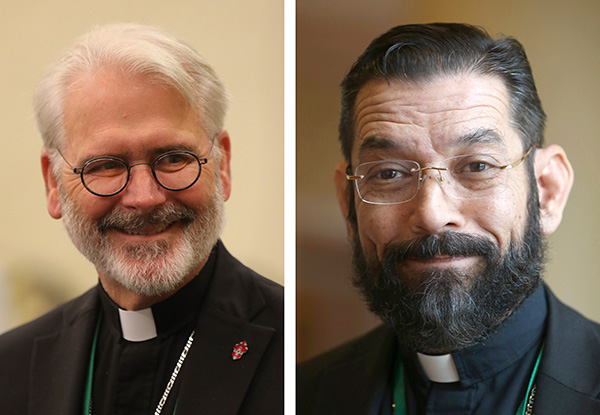
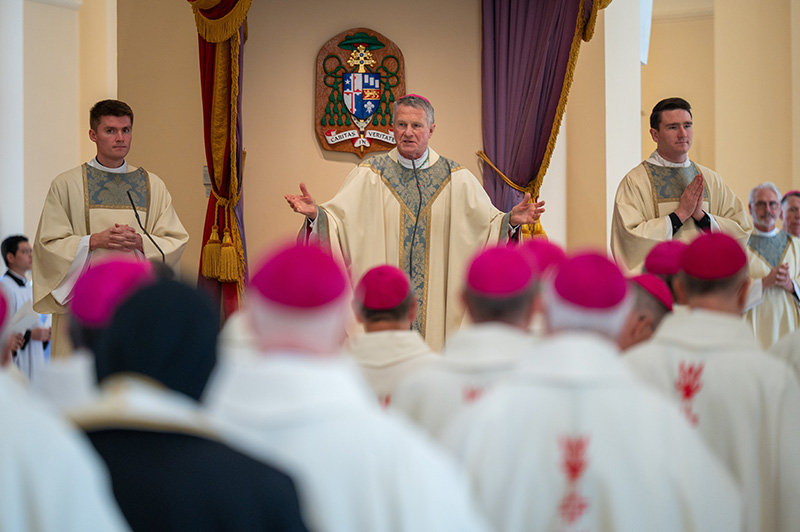
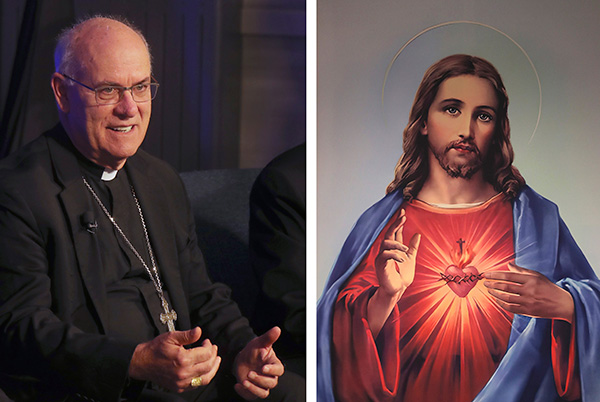 BALTIMORE — As the U.S. marks its 250th anniversary next year, the U.S. bishops will consecrate the nation to the Sacred Heart of Jesus.