


 Writing to the Church at the ancient city of Galatia (now in modern-day Turkey), St. Paul the Apostle declared, “For freedom Christ has set us free; stand fast therefore, and do not submit again to a yoke of slavery” (Galatians 5:1).
St. Paul was addressing the specific issue of whether, and to what extent, aspects of ceremonial Mosaic law were still binding on Christians. It was not political commentary or a statement about the relationship of Christians to the government.
Nonetheless, St. Paul’s admonition can, at least by analogy, teach us something about how Christians should think about political freedom, including the freedom purportedly secured by the Declaration of Independence, the 250th anniversary of which we are commemorating this summer.
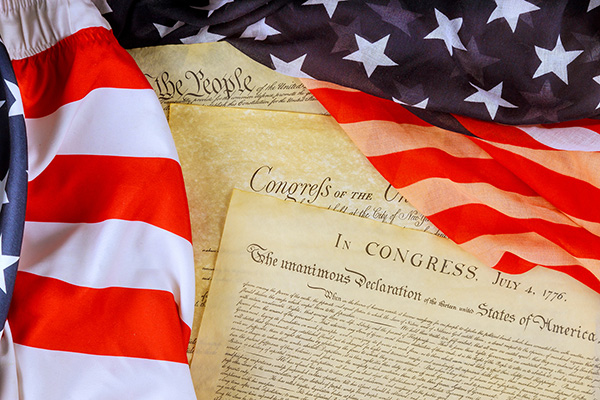
“We hold these truths to be self-evident,” the Declaration asserted in 1776, “that all men are created equal” and “endowed … with certain unalienable Rights, (including) Life, Liberty and the pursuit of Happiness.”
Echoing this passage in 1787, the Preamble to the U.S. Constitution declares that its purpose is, among other things, to “secure the Blessings of Liberty to ourselves and our Posterity.”
While these are assertions of moral and political principles that most Catholics embrace, the anniversary of the Declaration of Independence is an opportunity to examine how we understand human liberty and how that is compatible with the American idea of freedom. If, as St. Paul declares, “for freedom Christ has set us free,” how does this resonate in American political life?
Not just a lack of constraint
 St. Paul’s equivocal use of the word “freedom” teaches us that liberty is not simply the absence of constraint on our choices or actions. Rather, that notion of freedom – the ability to choose among contrary options – is for the greater purpose of achieving full human freedom. We are set free from unreasonable constraints to our liberty, but that is not the complete definition of Christian freedom. Indeed, if we stop at freedom as lack of constraint, we are ultimately endorsing a false notion of freedom as understood in Catholic theology.
On Oct. 8, 1995, then-Pope John Paul II delivered a homily at Baltimore’s Camden Yards baseball stadium during his pilgrimage to the United States. “Today, the challenge facing America is to find freedom’s fulfillment in the truth,” the pope explained, the truth “that is intrinsic to human life created in God’s image and likeness.”
Complete freedom is achieved in using our political freedom to embrace the truth about God and man. “The truth shall make you free,” declares Jesus. If we stop at defining freedom merely as the ability to make contrary choices, we have failed in St. John Paul II’s – and Jesus’ – admonition. The absence of constraint is the means to freedom, not the end itself.
The true purpose of freedom
The central political question, St. John Paul II explained, is not how we can maximize personal choices, but rather “how ought we to live together?” – and we cannot find an answer to that question outside a proper understanding of the nature and purpose of freedom. What is that purpose?
“Every generation of Americans needs to know that freedom consists not in doing what we like,” St. John Paul II explained, “but in having the right to do what we ought.”
This is a salutary lesson for us American Catholics as we celebrate the 250th anniversary of our assertion of political independence. The freedom secured by the Declaration, the Revolutionary War and the Constitution is merely the possibility of authentic freedom. As Catholics, we are challenged to witness to the relative goodness of that political freedom for the purpose of embracing the fullness of freedom found in the truth of the Gospel.
Can we celebrate freedom as an absence of constraint? Yes, certainly. But is that the highest form of freedom? Our faith tells us it is not.
If we do not use our political freedom to embrace the fullness of truth, we have nothing to celebrate.
Kenneth Craycraft is a professor of moral theology at Mount St. Mary’s Seminary and School of Theology in Cincinnati and author of “Citizens Yet Strangers: Living Authentically Catholic in a Divided America” (OSV Books).