


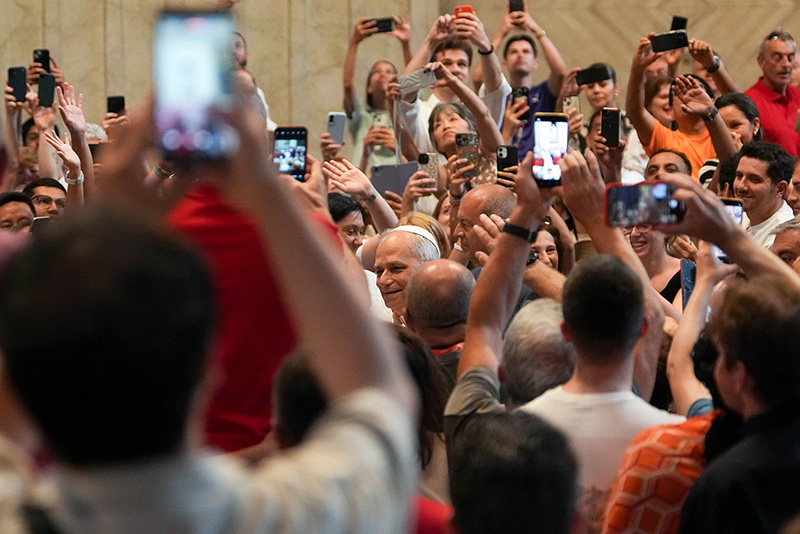
 Pope Leo XIV greets people who record his every move on their phones as he marks the International Day Against Drug Abuse and Illicit Trafficking with a meeting in the San Damaso Courtyard at the Vatican June 26. (CNS | Lola Gomez)
One of the most historic shifts I continue to witness in my lifetime is that of the papacy and modern media.
 On occasion I have found myself searching YouTube for video of popes from the past. If the internet can be trusted in this regard, a quick search suggests Pope Leo XIII (1878-1903) was the first to be captured on film. He was the first to experience his living visage shared around the world to be seen by those with the equipment to view it. I doubt that crossed the mind of our current Holy Father when he selected the name of Pope Leo XIV.
Nonetheless, unlike the predecessor his name invokes, the current Leo will have to navigate a world that communicates almost instantaneously, nearly at the speed of light.
Managing social media
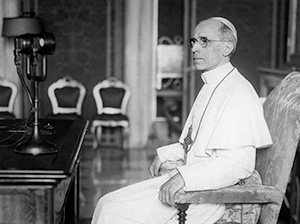 Pope Pius XII sits in front of a microphone, prepared to give a radio address in 1943. During World War II, the pontiff made many pleas for peace through Vatican Radio. (OSV News file) Prior to Pope Leo XIV’s election, I was asked in several interviews about what challenges the new pope will face. In my humble opinion, I shared that I believe Pope Leo’s biggest challenge will be that of managing the threats and opportunities of an evolving social media climate in which any utterance, any glance, any side comment can go global in an instant for interpretation by the masses – with or without context.
The 20th-century popes at first found their papacies contextualized by the printed word, then radio, television and now the internet. Popes previously could speak more freely and even make mistakes without a global audience watching every move and listening to every word – and offering their opinions in response. While Popes John XXIII and
Paul VI increased their visibility through television, it was Pope John Paul II who seemed to first embrace the opportunity, one that would allow him to speak to the whole world. With the modern advantages of air travel, he not only circled the globe but spoke through cameras and microphones that amplified his message to all who cared to listen.
Perhaps in the thread of Divine Providence, a man who contemplated theater before discerning his call to the priesthood was the perfect pope to take up this emerging opportunity. In the context of carefully orchestrated liturgical events and addresses, his words were thoughtfully considered and delivered. Of course, there were also impromptu moments that offered rare, unscripted glimpses into the man who then occupied the Chair of Peter.
When something seemed impossible, it used to be said “it’s like trying to get an interview with the pope.” So, it was rather extraordinary in the 1990s when Pope John Paul II accepted an invitation to a television interview on the occasion of his 15th papal anniversary. Having done what was proverbially impossible, Italian journalist and writer Vittorio
Messori was no doubt surprised – and delighted – to learn of his once-in-a-lifetime score. In the end, the interview was cancelled due to what was described as a “scheduling conflict,” although some may wonder if cautions of those surrounding the pope came into play.
Nonetheless, the Holy Father answered every question Messori had provided in preparation for the interview, and he was entrusted to assemble and publish the pope’s replies, which were published in the 1994 book “Crossing the Threshold of Hope,” a title Pope John Paul II proposed to Messori. Through it, all were privy to the pope’s personal reflections in the style of an interview, with questions coming not from within the Church but from a journalist on the outside. A seeming novelty, one could hardly realize at the time that this was a mere prelude to far more public papal engagement in the years to follow.
Pope Benedict XVI went a step further in the early 2000s. An academic, he intended to spend his retirement publishing his theological and ecclesial reflections. But the Church had other designs for him. Drawing upon his own inspiration, he set aside his papal authority to publish a trilogy entitled “Jesus of Nazareth,” stating in the preface that the books are his thoughts as a Catholic theologian and should not be seen as an exercise of magisterial authority. Catholic academics were free to offer contrary views. In this way, something new seemed to emerge: the pope engaging in public theological discourse, not from the Chair of Peter but standing next to it. And while this wasn’t exactly posting on Facebook, Pope Benedict was inviting conversation.
Innovation and conversation
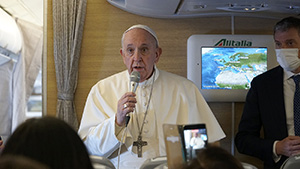 Pope Francis talks to the press on board his plane as he leaves from Fiumicino’s Leonardo da Vinci International Airport near Rome, headed to Baghdad, Iraq, March 5, 2021. (Catholic News Agency)His successor Pope Francis presented himself even more freely, providing impromptu interviews before press gaggles while flying around the world. This too was an innovation, a response to the shifting reality of global communications. On more than one occasion, it seemed the man who occupied the Chair of Peter, like Benedict before him, felt free to speak publicly not from the chair but alongside it, often speaking in impromptu ways.
This was refreshing for many. Pope Francis had a certain charm and was able to speak through social media to engage people who might otherwise tune out the Church. Yet this style was also confusing for some. Pope Benedict’s thoughts and reflections came with a disclaimer clearly separating magisterial authority from his words. It was not so clear with Pope Francis. One might wonder how the average listener was to know when he was speaking with papal authority and when he was simply reflecting.
The canonist and theologian understand there are specific and defined ways in which the pope teaches with magisterial authority. The sharing of personal thoughts and academic inquiry are not among them. The practical reality, however, is that the average listener might easily conflate that which is a personal thought with magisterial teaching. It’s not surprising that Vatican officials had to adjust to this new approach of conversing with the world – and occasionally issue formal distinctions and clarifications.
Looking ahead, it will be up to Pope Leo XIV to decide best practices. In his first few months, he appears to be more measured than Pope Francis, yet still strategic in sharing his message. He emphasizes the need for journalists to “disarm” communication, avoid divisive language and use their platforms to foster peace and understanding. He also stresses the importance of listening to the voices of the weak and marginalized and of using communication to build bridges rather than walls. It will be interesting to see how he models that message while the whole world watches.
Monsignor Patrick J. Winslow is vicar general and chancellor of the Diocese of Charlotte.
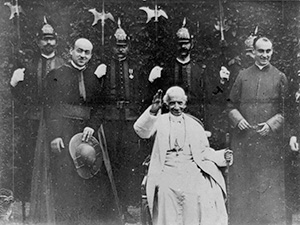 Pope Leo XIII was the first pope to have his image captured on film in 1896. (Library of Congress)