


 There have always been charlatans and pirates, but today’s swindlers are breathtakingly bold. Their “tech-spertise” has reached a level of sophistication that is matched only by their audacity.
Just a few years ago, no one would have guessed that fraudsters would be impersonating the pope’s family members. Yet, that is precisely what has occurred.
Using several fake social media accounts, con artists claiming to be Louis or John Prevost – the pope’s brothers – have been contacting people with requests for donations to a PayPal account. Other people were approached with offers to arrange private papal audiences.
Most of us know and live by the ancient proverb “caveat emptor” – let the buyer beware. But the AI revolution currently underway means that the internet isn’t just a figurative
Wild West anymore; it’s downright dangerous.
The digital landscape is always evolving. But those who innovate aren’t always pursuing legitimate activities or virtuous purposes. And when things like credit card skimming and identity theft become easy, new and more complex scams have also become possible. The founder of one targeted nonprofit even received a fraudulent call featuring a deep fake, AI-generated voice that sounded genuine.
The election of an American-born pontiff has engendered a great deal of excitement in the United States. People love Pope Leo XIV, and millions of people – even those who aren’t particularly close to the Church – want to be close to him. That desire has made good and otherwise cautious people vulnerable to scammers looking for an in. Clearly, the development of technology has once again outpaced the development of the security we need to protect us from those who would abuse it.
Reporting scammers can help, but the process of shutting them down is slow. It took a number of days for Facebook to eliminate the fake accounts, and not all of them have been. In the meantime, Vatican News has issued an alert about spurious Facebook profiles claiming to belong to the Holy Father, noting that Pope Leo has no official page on
Facebook and that the only way to donate to Peter’s Pence online is through the charity’s official website, www.obolodisanpietro.va/en/dona.html.
But warnings like these are often a two-edged sword. Swindlers who are impersonating the pope’s brothers have actually shared the Vatican News post to gain the credibility they need to continue exploiting people.
Although reticent to do so at first, John Prevost has made an effort to speak out publicly online, according to Betty-Ann Medeiros Hickey, an employee of the Archdiocese of New Orleans who talked with him about the matter.
Jaymie Stuart Wolfe is a Catholic convert, freelance writer and editor in New Orleans.
Is the pope online?
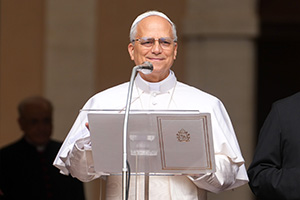 The Vatican News site issued a warning in several languages May 21 after a 36-minute, AI-generated fake video of Pope Leo was posted on YouTube.
In addition, there are many fake social media accounts that have cropped up claiming to be that of the pope.
So how do you know what’s real? There are two official papal social media accounts:
- On X and Instagram, you can follow Pope Leo: @Pontifex
- The pope has just one official charity, Peter’s Pence, that can be accessed through its website: www.obolodisanpietro.va/en.html