


Editor’s note: This is part of a series profiling great American Catholics ahead of the July 4, 2026, celebration of the 250th anniversary of the signing of the Declaration of Independence.
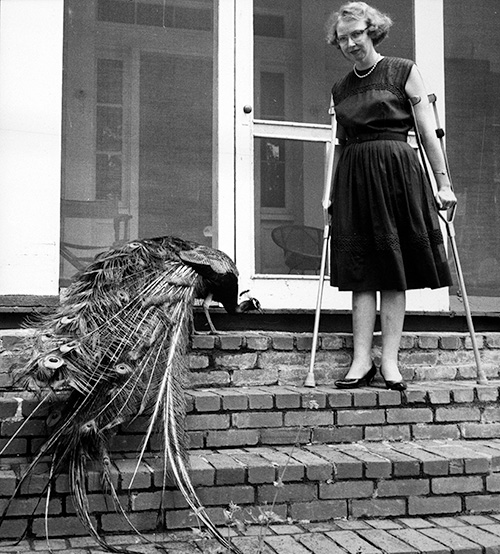 Catholic writer Flannery O’Connor shares the steps with one of her pet peacocks in an undated photo. This Southern writer’s Catholic faith shaped her vision of a world that often ignores goodness. (Floyd Jillson/Atlanta Journal-Constition | OSV News)Flannery O’Connor was not an evangelist. She was an artist, one of the most gifted American fiction writers of the 20th century. But a profoundly Catholic theological vision informs her art, giving her stories resonance and depth that sound deep – and sometimes deeply disturbing – spiritual chords.
Explaining why she often wrote about grotesque characters in bizarre situations, O’Connor remarked that in an age of disbelief like this one, “You have to make your vision apparent by shock – to the hard of hearing you shout, and for the almost blind you draw large and startling figures.”
She said, “All my stories are about the action of grace on a character who is not very willing to support it.” Then, with her characteristic mixture of ruefulness and realism, she added, “But most people think of these stories as hard, hopeless, brutal, etc.”
Today, more than six decades after her death, that sort of reaction to O’Connor’s fiction is more and more giving way to the realization that these are richly imagined analogies of faith flung in the face of skeptical secularism by a master storyteller.
A foundation of faith
Writing in the New York Review of Books, author Joyce Carol Oates cited O’Connor’s “unshakable absolutist faith” as the foundation of her creative work. Faith, said Oates, provided O’Connor with “a rationale with which to mock both her secular and bigoted Christian contemporaries in a succession of brilliantly orchestrated short stories that read like parables of human folly confronted by mortality.”
The only child of a real estate agent named Edward F. O’Connor and Regina Cline O’Connor, Mary Flannery O’Connor was born March 25, 1925, in Savannah, Georgia. Her great-grandparents were Irish immigrants, and the family had remained staunchly Catholic, members of a religious minority in the Protestant Bible Belt. As a child, Mary Flannery attended parochial schools until her father’s failing health forced a move to the Cline family home in Milledgeville, Georgia. There she attended Peabody High School, drawing cartoons and writing for the school paper.
In 1942, she entered Georgia State College for Women,near her home. It was then she began to use the name Flannery O’Connor on school assignments. She graduated with a degree in social science.
In 1946, she was accepted by the prestigious Writers’ Workshop at the University of Iowa and went there to study journalism. In 1950 she was diagnosed with lupus, an inflammatory connective tissue disease that had killed her father.
A Christian view of the world
Her first novel, “Wise Blood,” appeared in 1952 and received respectful but sometimes puzzled reviews. The story, she later said is about a “Protestant saint, written from the point of view of a Catholic.”
Her short fiction was collected in two volumes, “A Good Man Is Hard To Find” (1952) and the posthumously published “Everything That Rises Must Converge” (1965).
The unraveling of hypocrisy is a favorite theme and a story called “Revelation” is a striking example of that. Beyond mere hypocrisy, O’Connor sometimes confronted monstrous evil.
“The novelist with Christian concerns will find in modern life distortions which are repugnant to him, and his problem will be to make these appear as distortions to an audience which is used to seeing them as natural.”
In 1960, the Dominican Servants of Relief for Incurable Cancer approached O’Connor to write a book about a girl with a facial tumor whom the sisters had sheltered until her death at the age of 12. O’Connor wrote the introduction, which is an extraordinary testimony of faith.
“One of the tendencies of our age is to use the suffering of children to discredit the goodness of God,” she wrote, “and once you have discredited His goodness, you are done with Him.” In earlier times, people viewed unmerited suffering with “the blind, prophetical, unsentimental eye of acceptance, which is to say, of faith.” But now “we govern by tenderness” – tenderness divorced from its source in Christ – which “ends in forced labor camps and in the fumes of the gas chamber.”
O’Connor died of kidney failure on Aug. 3, 1964. “The Complete Stories of Flannery O’Connor” received the National Book Award for Fiction in 1972.
— Russell Shaw, OSV News
Learn more
St. Matthew Church invites book lovers to attend a six-week series, “Peculiar Crossroads: An Introduction to Flannery O’Connor’s Life and Her Works.” The series is open to anyone interested in gleaning timeless and timely spiritual insights from one of America’s most celebrated fiction writers, who was also fiercely Catholic.
Explore O’Connor’s short stories, essays and letters with expert guest speakers and discussion. Sessions will be held from 7 to 8:30 p.m. on Tuesdays, April 28 to June 9 in the New Life Center Banquet Room.
Visit www.stmatthewcatholic.org/adultfaithformation to register. Organizers recommend buying “O’Connor Collected Works,” the textbook for the series.