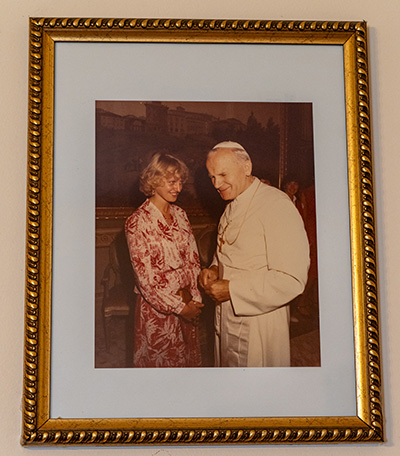
BOONE — Aleksandra Banasik was rebellious from an early age. Although she lived in Poland under communism, an ideology which from the 1940s to 1980s strongly limited religious freedom, her mother imposed strict rules: she had to attend Mass every Sunday and report what the priest said in his homily to ensure she really had gone.
But Banasik had her own plan.
“I would stay just to hear the first words of the homily, to get an idea of what it was about, and then my friends and I would go to the cinema,” she remembered with laughter. “My mother never found out.”
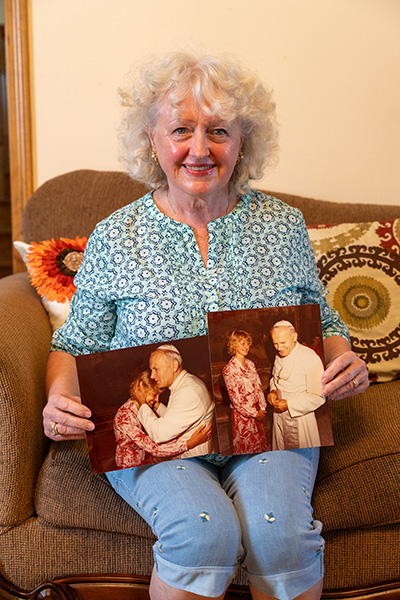
Today, Banasik works as Hispanic Vicariate coordinator, or region of the diocese, in Boone. She recognizes that it was the Holy Spirit who guided her life from rebellion toward an extraordinary friendship with a saint: Pope St. John Paul II.
Beginnings of Divine Providence
At 18, Banasik was a curious young woman who wanted to discover the world. Through her relationship with some nuns, she got the opportunity to study at a Catholic school for girls in England. It was her first exposure to an environment in which she lived with young women from different countries and cultures.
There, however, she felt lonely. “I was far from my family, and I couldn’t even call my mom,” she recalled. “But it was in the midst of that loneliness that I discovered God.”
She came from a working class family, and many of the girls were from wealthy families. What struck her most, however, weren’t the material differences, but the spiritual ones. Banasik maintained her daily prayers before meals and at bedtime, and that awakened curiosity.
“I didn’t know much about the Church, but I knew I had to pray,” she said. “The girls asked me: ‘Why do you pray?’ And that was difficult… because I didn’t have an answer.”
It was at that moment that something in her sparked. She realized she couldn’t justify what she believed, and that shook her deeply.
“I had to know how to defend my practices,” she says. “So I decided I was going to go to university to study theology.”
Back in Poland, she enrolled in the Pontifical University of Kraków. There she began a new stage, full of study, formation and providential encounters.
Encountering the future Holy Father
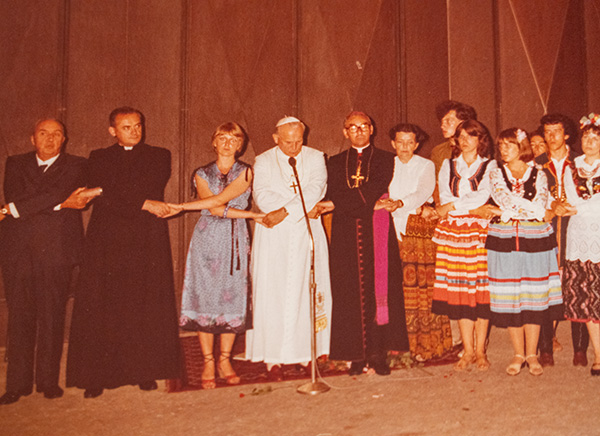
During her university years in Kraków, Aleksandra met then Cardinal Karol Wojtyła, the future Pope St. John Paul II. He was close to the students, with whom he often shared meals and conversations.
“I had the opportunity to share many dinners with him at the university,” Banasik said.
They had much in common. “One of the things I remember most about him was his love of singing,” Banasik said, recalling how she sang with a student group.
Despite the difficult situation that Poland was in under communism, Wojtyła encouraged young people to live the faith courageously. He promoted organizing Masses and pilgrimages despite the regime’s restrictions.
“He was an excellent leader of the diocese at that time,” Banasik reflected. “He would tell us: ‘Do not be afraid, open the doors.’”
She also remembers his deep Marian devotion: “He offered his life to the Blessed Mother.”
A providential surprise
A year later, Banasik received news that left her speechless: her beloved cardinal had been elected pope. On October 16, 1978, Karol Wojtyła became John Paul II, the first non Italian pope in more than 400 years.
“When I saw that it was him, I couldn’t believe it,” Banasik says.
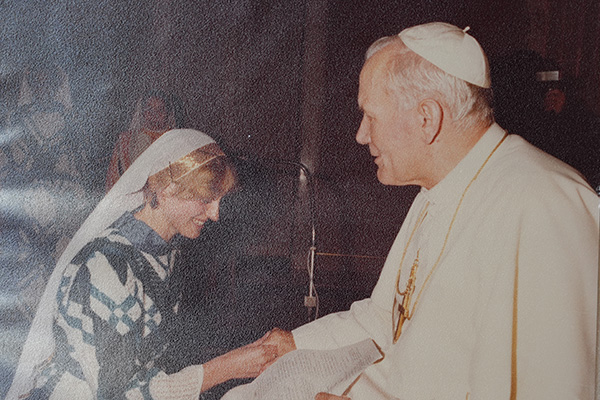
In July 1979, John Paul II visited Kraków. Amid the crowd that came to see him was Banasik, who saw him pass in his popemobile, dressed in white.
“It was a historic event for Poland,” she recalled. It would not be the last time she saw him up close.
A leap of faith: Heading to Rome
After studying for a year and a half in Kraków, Banasik felt the call to continue her formation in Rome at the Pontificia Università Urbaniana. She was accepted but she did not have a student visa.
“I had travelled with a tourist visa, and I didn’t know how the formalities worked,” she recounts. “Everyone told me I wouldn’t be able to get the visa, but I had faith that God would help me.”
She presented herself at the immigration office with that conviction. “With God’s help, I will get the student visa,” she said. The official, surprised, responded with a laugh: “Really?” Banasik answered, “Yes.”
The incredible happened: the official stepped away and returned with her passport stamped with the student visa. “It was a moment of grace. God is great,” she said.
A paternal relationship
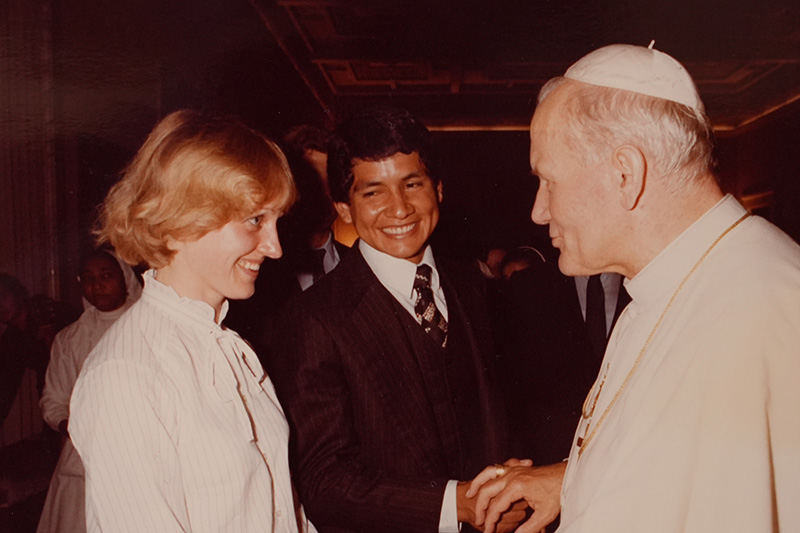
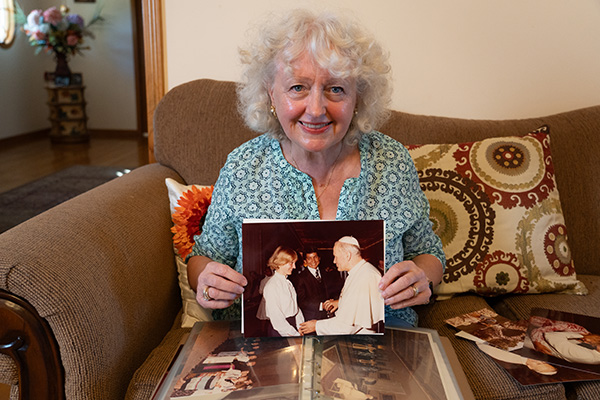
In Rome, Banasik and other students lived at Castel Gandolfo in a school apartment, next to the gardens of the pope’s summer residence. As Banasik became more involved with the university, she met a Polish bishop who invited her and another student to attend a private audience with the Pope for the first time, held in the garden of his summer residence.
She clearly recalls the moment when the pope first saw her in Rome. “His expression changed. Then he approached me and greeted me in Polish, something he did not usually do. He spoke to me as though I were his daughter,” Banasik recalled.
From that moment, their relationship deepened. The pope became interested in her studies and her life in Rome.
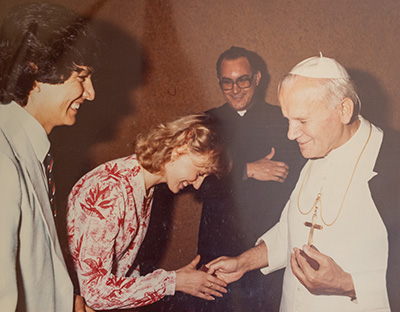
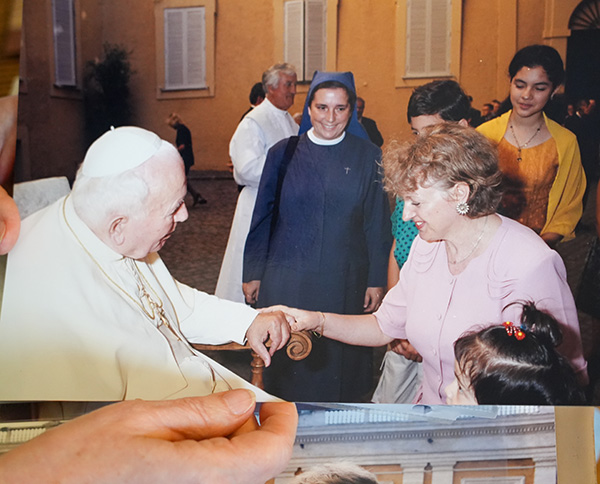
“He would tell me: ‘Keep studying. After each exam, you have to come and tell me how it went,’” Banasik said. Later, thanks to her friendship with photographer Arturo Mari, she was able to attend many more papal audiences and share numerous moments with the Pope.
That closeness was vital for Banasik, who was far from home. “From that moment, the pope took the place of my father. He knew I was alone and showed a very real paternal concern.”
On one occasion, during an audience, the pope pointed her out among the crowd and said: “She is my little girl.”
“Every time we talked, he listened attentively. He always was like a father to me,” she remembered.
A Life Grounded in Faith
Banasik continued her studies, finished her master’s degree in theology and eventually married a fellow student from Mexico in Rome. The day following her marriage Pope John Paul II personally went to bless their marriage. Her children also had the opportunity to grow up near the pope, seeing his constant example of humility and service.
They lived in Rome for 12 years, until God called them to serve in Mexico. However, until the Pope’s death in 2005, the family remained close to him.
“We had many blessings for being so close to the pope,” Banasik said. “And now he still lives in my heart as a saint. I always ask for his intercession.”
— Brian Segovia